
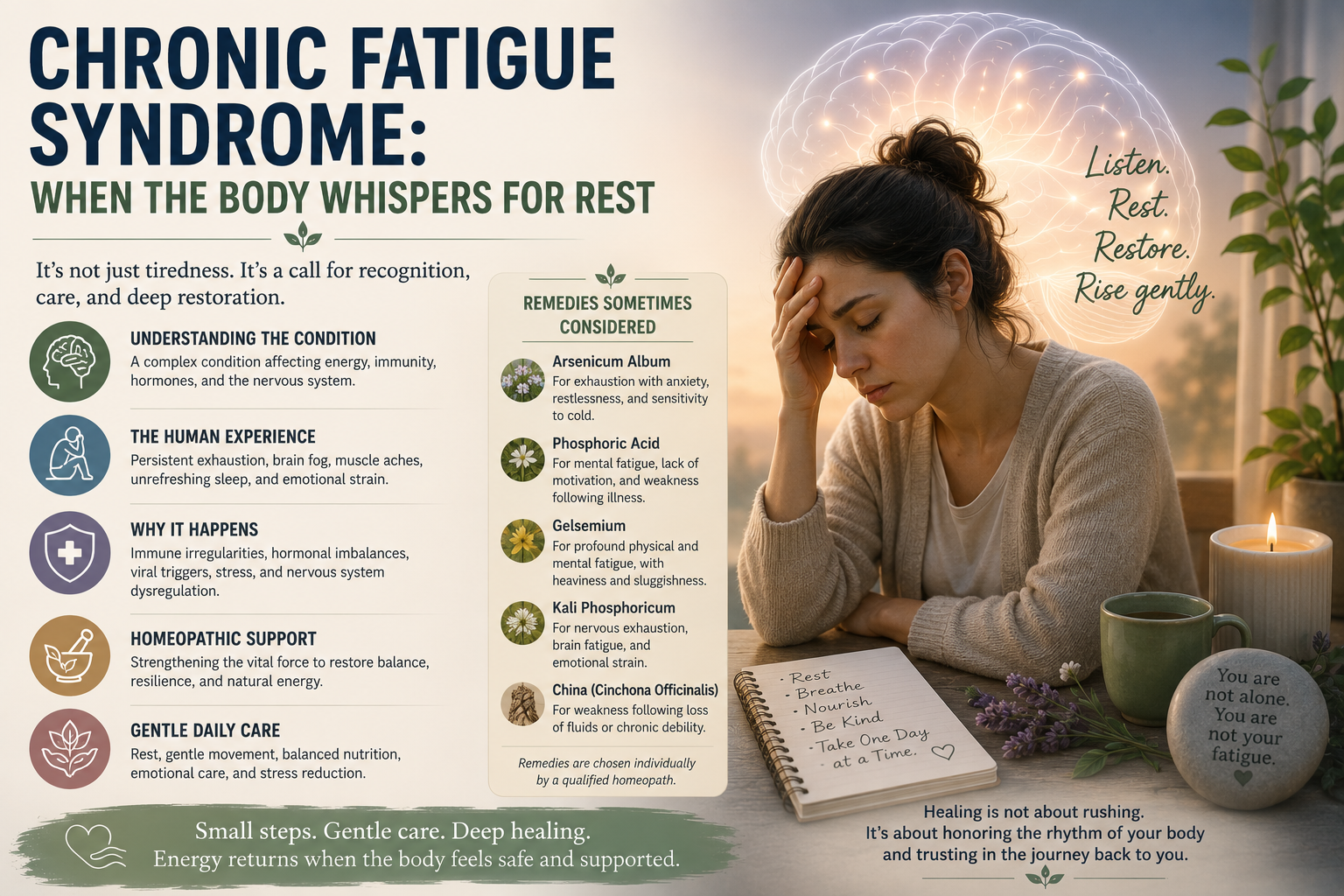
WHEN THE BODY WHISPERS FOR REST
There are times when the body feels heavier than usual, even after a full night’s sleep.
When every task — getting out of bed, walking to the kitchen, focusing on work — feels like moving through thick water.
This is the quiet reality of Chronic Fatigue Syndrome (CFS).
It often arrives gradually.
At first, it may feel like lingering tiredness.
Then it deepens, becoming persistent, resistant to rest, and sometimes accompanied by other symptoms:
Brain fog that clouds thought, muscles that ache, or sleep that never feels restorative.
For the person experiencing it, life can feel slowed, disconnected, and uncertain.
For families, friends, and colleagues, it can be difficult to understand — because fatigue is invisible, yet all-consuming.
CFS is not a weakness.
It is the body asking for deep recognition, care, and gentle listening.
Understanding the Condition
Chronic Fatigue Syndrome is a condition where the body’s energy systems struggle to maintain balance.
It is not simply “being tired.”
Even rest and sleep often fail to restore vitality fully.
The condition may be influenced by:
- Immune system irregularities
- Hormonal imbalances
- Nervous system dysregulation
- Viral triggers or infections
Each person experiences it differently.
Some find that activity worsens symptoms, while others notice subtle shifts with changes in routine or environment.
Homeopathy sees CFS as a disturbance in the vital force, the inner intelligence that governs energy, immunity, and resilience.
It is a call to honor the body’s limits, rather than push against them.
How It Feels — The Human Experience
Living with CFS is a deeply personal journey.
It affects both body and mind.
People may notice:
- Persistent exhaustion that does not improve with rest
- Muscle or joint aches
- Brain fog, difficulty concentrating, memory lapses
- Sensitivity to light, noise, or temperature
- Sleep that is unrefreshing or interrupted
- Emotional strain, including frustration, sadness, or anxiety
Even small daily tasks can feel monumental.
Social engagements, work responsibilities, or hobbies may need to be scaled back.
Yet within these challenges, many discover resilience, patience, and self-compassion — qualities that grow quietly, like roots strengthening beneath the soil.
Why It Happens
Chronic Fatigue Syndrome arises from complex interactions within the body:
- The immune system may be overstimulated or underperforming
- The nervous system may struggle to regulate energy effectively
- Hormonal and metabolic processes may be imbalanced
- Past infections or stressors may leave lingering effects
It is important to understand: CFS is not the person’s fault.
The body is responding to its internal environment, asking for care, rest, and restoration.
The Homeopathic Understanding — Supporting Vital Energy
Homeopathy approaches CFS by observing the whole person.
A homeopath listens carefully to:
- Patterns of fatigue: when it worsens, what alleviates it
- Emotional and mental states, including stress and anxiety
- Sleep patterns and digestion
- Sensitivities and constitutional traits
The goal is to strengthen the vital force, helping the body regulate energy, immunity, and resilience naturally.
Remedies are tailored individually, respecting the unique presentation of symptoms and temperament.
Remedies Sometimes Considered
A qualified homeopath may explore remedies such as:
Arsenicum Album
For exhaustion with anxiety, restlessness, and sensitivity to cold.
Phosphoric Acid
For mental fatigue, lack of motivation, and weakness following illness.
Gelsemium
For profound physical and mental fatigue, with heaviness and sluggishness.
Kali Phosphoricum
For nervous exhaustion, brain fatigue, and emotional strain.
China (Cinchona Officinalis)
For weakness following loss of fluids or chronic debility.
Each remedy is selected carefully according to the person’s overall constitution and current state.
Gentle Daily Care
Managing CFS requires patience, self-compassion, and supportive routines:
- Prioritize rest and gentle pacing of activities
- Engage in light, restorative movement such as walking or stretching
- Maintain balanced nutrition to support energy
- Create quiet spaces to reduce sensory overload
- Encourage emotional processing through journaling, meditation, or counseling
Small, consistent adjustments often help the body preserve energy and foster gradual improvement.
A Closing Reflection
Chronic Fatigue Syndrome is not a flaw or a failure.
It is a whisper from the body, a request to slow down, listen, and honor its limits.
Healing is rarely sudden.
It grows quietly, with gentle care, balanced living, and support for the body’s vital force.
Within the fatigue lies an opportunity — to learn patience, to cultivate self-compassion, and to discover strength that moves more quietly than the world expects, yet is deeply enduring.
Every moment of recognition, rest, and gentle attention becomes a step toward reclaiming energy, resilience, and harmony.





Leave a Reply