
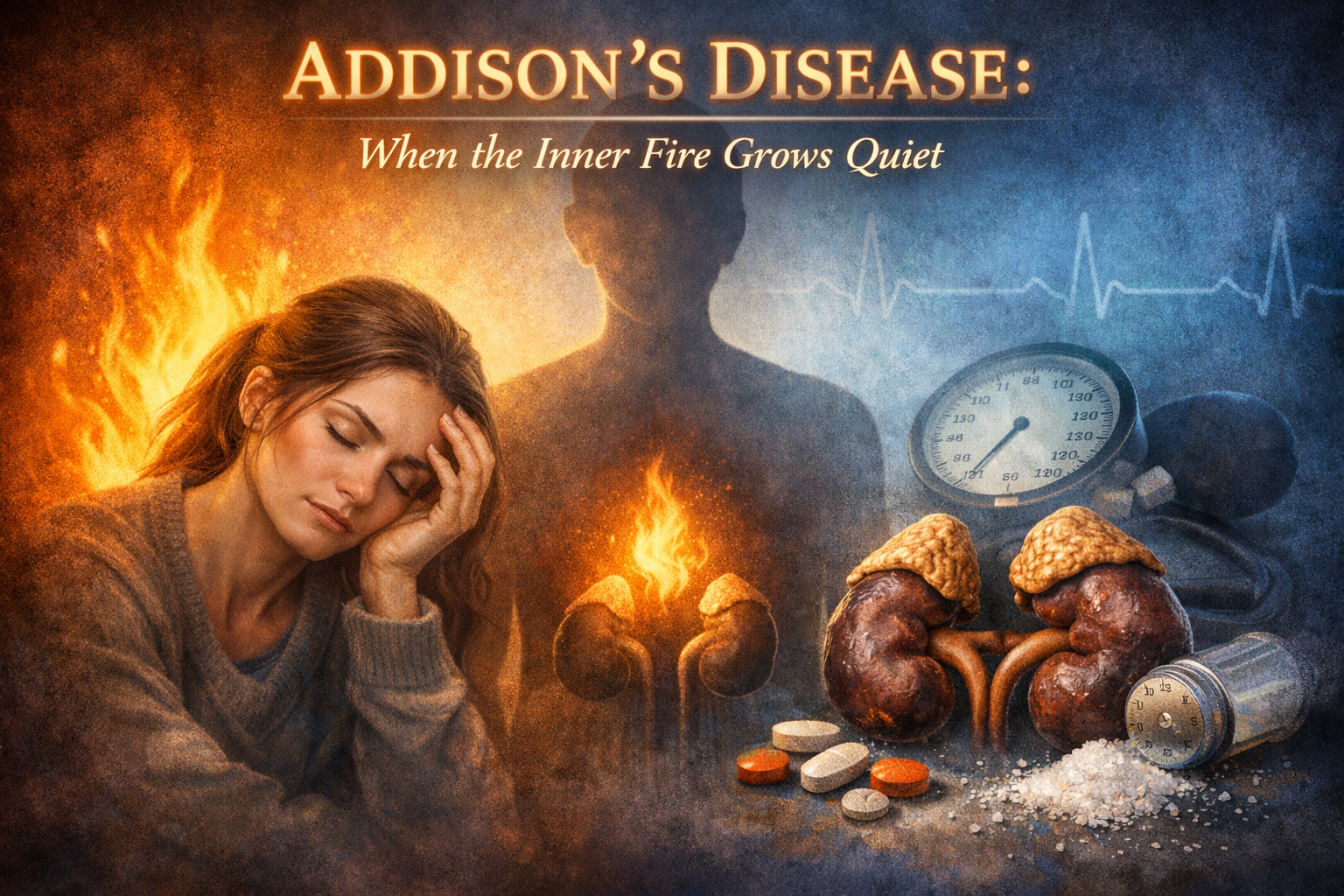
WHEN THE BODY’S INNER FIRE GROWS QUIET
Some conditions arrive not with force, but with a quiet dimming —
a soft decline in strength,
a fading of resilience,
a sense that the body’s inner flame is burning lower than it once did.
Addison’s Disease is such a condition.
It does not roar.
It whispers.
It draws the body into a slower rhythm, as if the inner fire — the adrenal energy that helps us respond to stress, wake with vitality, and move with steadiness — has grown faint.
For many, it begins with a feeling that something deep inside is tired:
A morning that feels heavier than it should…
Muscles that weaken without explanation…
Skin that darkens slightly in the creases…
Salt cravings that speak of a body trying to find balance…
A dizziness that comes when rising…
A sadness, a softness, a vulnerability in the heart.
Addison’s Disease is the story of the adrenal glands growing quiet —
and the body asking gently to be understood, supported, and held with care.
Understanding the Condition
Addison’s Disease occurs when the adrenal glands — small organs that sit atop the kidneys — cannot produce enough cortisol and sometimes aldosterone.
These hormones are the body’s guardians of balance:
- Cortisol helps us respond to stress, inflammation, and energy needs.
- Aldosterone helps maintain salt, blood pressure, and fluid balance.
When these hormones fall silently low, the body’s ability to cope weakens.
Common causes include:
- Autoimmune destruction of the adrenal tissue
- Long-term infections
- Genetic conditions
- Bleeding or injury to the adrenal glands
This is not a condition someone causes.
It is the body’s immune system misreading its own tissues,
or life circumstances impacting an organ that works tirelessly in the background.
How It Feels — The Human Experience of Addison’s Disease
The symptoms are often subtle at first — woven into daily life so quietly that they are easy to overlook.
- A deep, unrelenting fatigue
Not the tiredness of a long day — a tiredness of the soul, a sense of inner depletion. - Weakness in the muscles
Even simple tasks may feel heavier. - Weight loss, despite good eating habits
- Dizziness or faintness, especially when standing
- Salt cravings — the body pleading for mineral balance
- Bronzing or darkening of the skin in folds, scars, or exposed areas
Emotionally, the condition may bring:
- Quiet sadness
- Anxiety or vulnerability
- Irritability from exhaustion
- A sense of being overwhelmed by life’s smallest tasks
And during times of stress, the adrenal glands cannot rise to meet the moment —
leading to crisis if not supported.
Addison’s Disease is not just physical.
It is a tender emotional journey — a longing to feel steady again, to feel the inner fire return.
Why It Happens
At its heart, Addison’s Disease is a condition of adrenal insufficiency —
the glands no longer produce what the body needs to maintain equilibrium.
Often, the immune system mistakenly targets the adrenal cortex, gradually diminishing hormone production.
Other times, infection, hemorrhage, medications, or genetics play a role.
But one truth remains:
It is not the person’s fault.
Nothing they did caused this quiet decline.
The condition is a call for support — medical, emotional, and spiritual.
The Homeopathic Perspective: Restoring the Inner Flame
Homeopathy views Addison’s Disease as a deep constitutional imbalance —
a long-standing depletion of the vital force,
a sinking of the body’s energy,
a fatigue that begins at the core.
The aim is not to replace hormones — that is medical and essential —
but to strengthen the inner vitality, emotional resilience, and the body’s adaptive capacity.
A homeopath listens to:
- The tone of the fatigue
- The fears or sadness beneath it
- Sensitivities to heat, cold, stress
- Cravings and aversions
- Personality traits and emotional wounds
- The story of how depletion unfolded
Commonly Considered Remedies
Arsenicum Album
For deep exhaustion with anxiety, restlessness, and a need for warmth and reassurance.
Natrum Muriaticum
For those who carry emotional pain quietly, crave salt, and feel drained by grief.
Calcarea Carbonica
For slow, steady exhaustion with sensitivity to cold, worry, and physical weakness.
Phosphoric Acid
For profound fatigue after emotional or physical shock — a sense of being “burned out.”
Sepia
For hormonal imbalance with irritability, sadness, and a desire for solitude.
Gelsemium
For weakness, trembling, and a heavy, “drooping” tiredness.
(Always taken under the guidance of a qualified homeopath. Homeopathy complements but does not replace medical treatment.)
Gentle Daily Care for Addison’s Disease
The body needs tenderness — and steady, compassionate support.
Nourish with intention
Warm foods, mineral-rich meals, broths, leafy greens, lentils, nuts, and moderate salt intake (as advised by a physician).
Honor your limits
Rest when tired.
Pause when overwhelmed.
The adrenal body does not respond well to pushing.
Gentle movement
Stretching, slow walking, yoga — movements that nourish without draining.
Emotional softness
Journaling, meditation, spiritual reflection, supportive conversations.
Regular medical care
Monitoring hormone levels, adjusting medications, and guarding against adrenal crises.
Stress reduction
Calm routines, deep breathing, grounding practices help the nervous system rest and restore.
The goal is not to force energy, but to invite it back, slowly and kindly.
A Closing Reflection
Addison’s Disease is the story of a flame that has burned too long without rest —
a body that has given more than it had,
a spirit that has carried burdens quietly,
a nervous system that has lived in the shadows of exhaustion.
But healing is possible.
Balance can return.
Strength can rise again — softly, steadily, faithfully.
This journey asks for gentleness,
for patience,
for deep listening to the body’s smallest whispers.
And within that slow unfolding, something beautiful emerges —
a renewed relationship with oneself,
a deeper understanding of one’s limits,
and a quiet awakening of the inner fire that never truly went out.
You are not weak.
You are healing.
And your body, even now, is learning to burn bright again — in its own time, in its own rhythm, with its own quiet wisdom.


Leave a Reply