
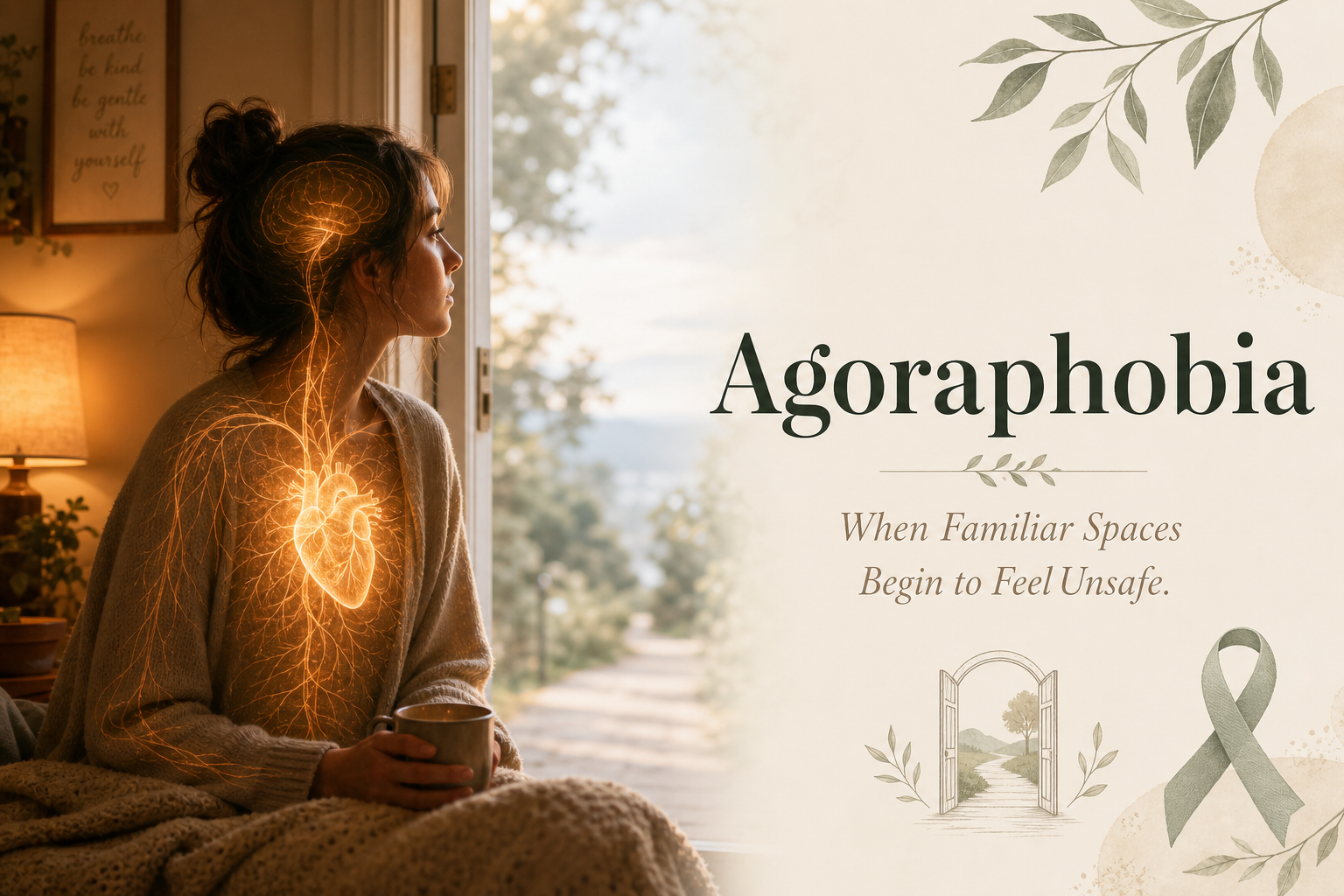
When Familiar Spaces Begin to Feel Unsafe
Some fears do not announce themselves with thunder or warning.
They arrive quietly, like a shadow in familiar spaces, growing until even leaving the house feels heavy, risky, or impossible.
Agoraphobia is like this — a fear of being in situations where escape feels difficult, or where help may not be near, and it touches both the body and the mind in ways that are deeply real.
It may begin subtly.
A hesitation to enter crowded places.
A fluttering heart when leaving home.
A constant, underlying worry about what might happen outside familiar walls.
Sometimes it starts after a panic attack, sometimes it grows slowly, unnoticed until it shapes daily life.
Yet this is not weakness.
It is the body and mind asking for understanding, support, and gentle care.
Understanding the Experience
Agoraphobia is more than fear.
It is a complex response of the nervous system and the mind to situations perceived as unsafe.
It affects movement, choices, and the rhythm of daily life.
Even ordinary errands or social outings can feel impossible.
From a homeopathic perspective, agoraphobia reflects heightened sensitivity, nervous tension, and imbalance in the vital force.
The body is alert to danger, sometimes overestimating risks.
This is not fault.
It is a signal that safety, grounding, and support are needed.
How It Feels
Living with agoraphobia can feel like being trapped inside both the mind and the world.
Physically, the body may tighten, the heart race, and stomach or breathing become tense.
Emotionally, fear can dominate — a sense of dread, panic, or extreme discomfort.
Thoughts may loop endlessly about what could go wrong.
Even leaving home for short periods can feel like climbing a mountain.
For loved ones, it can feel frustrating or confusing.
For the person experiencing it, guilt or shame often accompanies fear.
All of this is real.
All of it deserves compassion and gentle understanding.
Why It Happens
Homeopathy sees agoraphobia as arising from constitutional tendencies, nervous system sensitivity, emotional experiences, and sometimes past trauma.
It is not caused by laziness or weakness.
The mind and body are responding to perceived risk in the only way they know — seeking protection and safety.
The Homeopathic Understanding: Supporting Courage and Calm
Homeopathy works with the whole person, supporting balance in mind, body, and spirit.
It helps the nervous system regain calm and confidence, and the vital force to feel safe again.
Remedies are chosen individually, based on the person’s fears, energy, temperament, physical symptoms, and emotional responses.
The aim is not to eliminate caution, but to restore a sense of safety and freedom.
Some remedies a trained homeopath may consider include:
- Aconitum Napellus – for sudden, intense fear, panic, and anticipatory anxiety.
- Argentum Nitricum – for nervous tension, anticipatory worry, and fears of crowds or public spaces.
- Gelsemium – for weakness, trembling, and freezing in situations of fear.
- Phosphorus – for anxiety with sensitivity to surroundings and fear of being alone.
- Arsenicum Album – for restlessness, perfectionism, and constant worry about safety.
Each remedy is chosen carefully, tailored to the individual’s unique needs.
Gentle Daily Care
Living with agoraphobia requires patience, small steps, and grounding:
- Start with manageable goals — brief outings, familiar spaces, gradual exposure.
- Practice slow breathing, mindfulness, or gentle meditation to calm the nervous system.
- Maintain predictable routines for meals, rest, and activity.
- Engage in gentle movement at home to release tension.
- Seek support from trusted friends, family, or professionals.
Every small step — opening the door, walking to the corner, or stepping outside — is meaningful and courageous.
Living with Compassion and Patience
Agoraphobia teaches that fear is a signal, not a weakness.
It asks for gentleness, understanding, and self-compassion.
You are not defined by the spaces you fear.
You are defined by the care, courage, and persistence you bring to yourself each day.
Healing is not about rushing courage.
It is about nurturing trust, creating safety, and moving gently through the world — quietly, patiently, and fully human.


Leave a Reply