
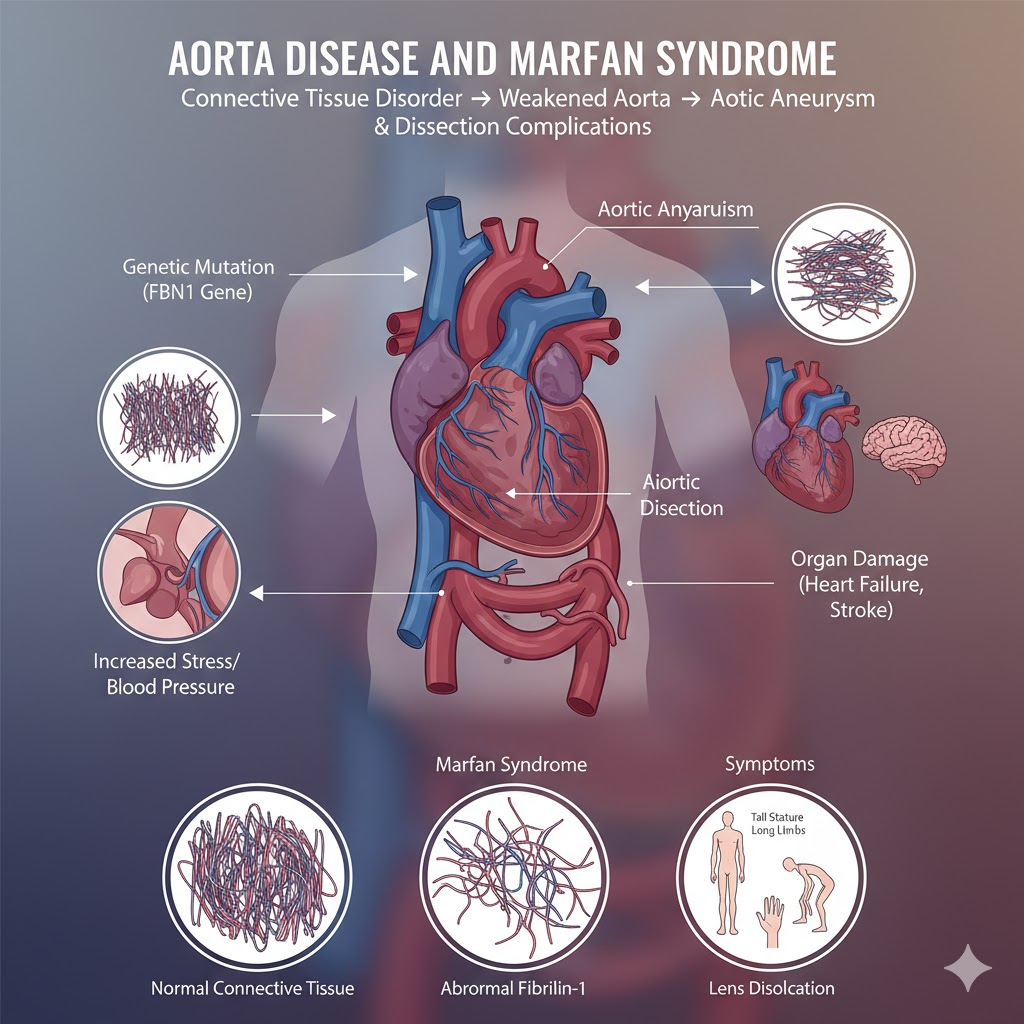
When the Aorta Speaks: A Holistic View of Marfan Syndrome
There are parts of the body that work quietly, faithfully, almost invisibly — and the aorta is one of them.
It carries the very essence of life, moving blood from the heart to every corner of the body.
Yet when the aorta weakens, stretches, or tears, the experience can shake a person deeply, not only physically but emotionally.
Marfan syndrome, a connective tissue disorder, is one of the stories that often touches the aorta. It is a condition born into the body, written into the genetic fabric, shaping the heart, the skeleton, the eyes, and sometimes the spirit.
Behind every diagnosis is a human being — someone trying to understand what their body is saying, trying to find steadiness in the midst of uncertainty.
Understanding Aortic Disease
The aorta can change in a few ways:
- It may dilate (become larger than normal), known as an aortic aneurysm
- It may dissect, meaning the inner layers begin to tear
- It may weaken, making it more vulnerable to pressure
These changes often develop quietly. There may be no warning, no pain, no sign — until the body suddenly asks for attention.
Risk factors include:
- Genetic conditions (especially Marfan syndrome)
- High blood pressure
- Connective tissue disorders
- Long-term stress on the heart
- Aging
- Smoking
Aortic conditions deserve deep care because the aorta is not just a vessel — it is the main path of life’s circulation.
Understanding Marfan Syndrome
Marfan syndrome is a condition that affects the connective tissue — the body’s internal scaffolding.
It can influence:
- The aorta
- The eyes
- The skeleton
- The joints
- Heart valves
- Lungs
People with Marfan often have a tall frame, long limbs, flexible joints, chest shape differences, or vision difficulties — but each person’s story is unique.
Beyond the physical, many people with Marfan syndrome live with a quiet awareness of their body — an understanding that they must move through life with gentleness, mindfulness, and self-attention.
How It Feels in Daily Life
Living with aortic disease or Marfan syndrome can carry emotional layers:
A subtle fear of the unknown.
A hesitancy in movement.
A deep awareness of the heartbeat.
A longing for normalcy.
A desire to trust the body again.
There can also be strength — a quiet resilience that grows over time as the person learns their limits, their power, and their ability to adapt.
A Holistic & Homeopathic Perspective
From a homeopathic viewpoint, these conditions are not only structural but energetic — a reflection of deeper patterns in the connective tissue of the body and the emotional fabric of the person.
Homeopathy does not “cure” genetic conditions but can gently support:
- Emotional steadiness
- Circulatory comfort
- Nervous system balance
- Fatigue
- Anxiety related to the heart
Commonly Considered Remedies
1. Aurum Metallicum
For people who feel deep internal pressure, heart awareness, or emotional heaviness around responsibility.
2. Baryta Carbonica
Supports those with vascular weakness or early arterial dilation tendencies.
3. Calcarea Fluorica
For connective tissue laxity, vessel weakness, and structural fragility.
4. Arnica Montana
For people who feel bruised, overstrained, or vulnerable within the cardiovascular system.
5. Lycopodium
For anxiety, digestive tension, and circulatory irregularities, especially in tall, slender individuals.
6. Natrum Muriaticum
For those who carry emotional burdens quietly, who appear strong but hold fragility inside.
(Homeopathic remedies should always be chosen by a qualified practitioner who understands both the condition and the person.)
Daily Care and Healing Practices
Even though aortic and connective tissue conditions require medical monitoring, you can support yourself with daily acts of compassion:
1. Gentle Movement
Avoid strain. Choose slow, mindful activities — walking, stretching, breathing.
2. Emotional Grounding
Living with a lifelong condition can feel heavy; talk therapy, journaling, and deep conversations help lighten the heart.
3. Nourishment with Intention
Foods rich in minerals, antioxidants, and healthy fats support connective tissues and calm inflammation.
4. Regular Medical Monitoring
Imaging and check-ups help you stay ahead of changes — not from fear, but from empowerment.
5. Rest as Medicine
People with connective tissue disorders often need more rest than others. Honor that need.
6. Avoid High-Strain Activities
Weight-lifting, sudden pressure changes, or intense sports can stress the aorta.
A Quiet Closing Reflection
The aorta carries life, and Marfan syndrome teaches a unique lesson — that strength is not always in rigidity, but in flexibility, in adaptation, in knowing one’s limits and honoring them.
If you are living with this condition, your journey is not one of weakness but of deep awareness.
Your body asks for gentleness, and you have every right to give it.
Healing may not mean changing your genetics — healing may simply mean living with them in a way that feels peaceful, supported, and whole.
You are not defined by your diagnosis.
You are defined by how beautifully you continue to live, breathe, and rise each day.



Leave a Reply