
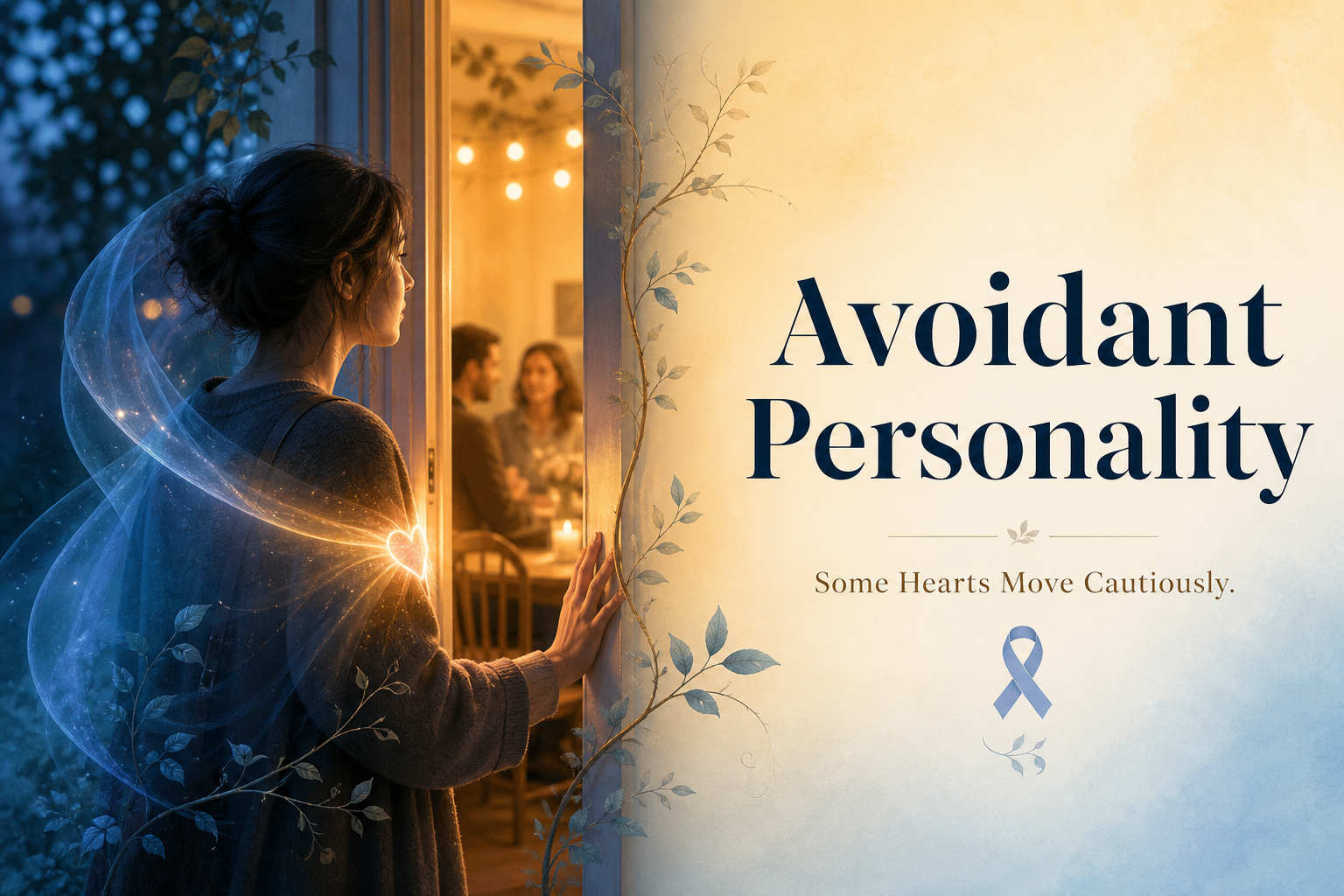
Some Hearts Move Cautiously.
Some hearts move cautiously, carrying a fear of judgment or rejection that shapes every step.
Avoidant Personality Disorder (AvPD) is not shyness or weakness.
It is a deeply human response — a protective pattern developed when the world felt unsafe, critical, or overwhelming.
This is not failure.
It is not flaw.
It is the mind and nervous system signaling a need for safety, trust, and gentle understanding.
The desire for connection exists, yet so does the fear of being hurt.
Interactions can feel like tightropes, where each word or gesture carries risk.
The world may feel large, exposing, and unpredictable.
Understanding the Experience
AvPD involves a persistent pattern of social inhibition, feelings of inadequacy, and hypersensitivity to negative evaluation.
Outward signs — avoiding social situations, hesitancy, or quiet withdrawal — are visible.
The inner experience — fear, self-doubt, longing, and anxiety — is often hidden.
Those living with AvPD may feel caught between wanting closeness and fearing exposure.
The nervous system is on constant alert, scanning for threats, judgment, or rejection.
How It Feels
Living with AvPD can feel like walking on eggshells inside one’s own body and mind.
There may be:
- Anxiety in social or professional settings
- Fear of criticism or rejection
- Avoidance of relationships or new experiences
- Intense self-consciousness
- Emotional isolation and longing for connection
Even small interactions can feel exhausting.
Yet beneath the caution is a sensitive, deeply feeling human being yearning for understanding and trust.
Why It Happens
From a homeopathic perspective, AvPD reflects a disturbance in the vital force — the inner energy that regulates emotional balance and courage.
It may develop from:
- Early experiences of criticism, neglect, or judgment
- Emotional trauma or prolonged insecurity
- Nervous system sensitivity or inherited tendencies
- A mind learning protective patterns to cope with vulnerability
The avoidance is not the problem itself; it is the mind’s attempt to protect a sensitive self.
The Homeopathic Understanding: Encouraging Courage
Homeopathy approaches AvPD with compassion, focusing on restoring inner confidence, emotional resilience, and trust.
The goal is not to force social engagement, but to support the nervous system so fear gradually softens and connection feels possible.
Remedies may be considered such as:
- Natrum Muriaticum – for shyness, sensitivity, and inward sorrow
- Silicea – for timidity, low self-confidence, and self-doubt
- Pulsatilla – for emotional dependency, need for reassurance, and mood shifts
- Argentum Nitricum – for anticipatory anxiety and fear of failure
- Lycopodium Clavatum – for insecurity, hesitation, and cautious behavior
Each remedy is chosen individually, reflecting emotional, mental, and physical patterns.
Gentle Daily Support
Living with AvPD requires patience, kindness, and gradual exposure.
Encourage small steps of social engagement in safe environments.
Offer consistent reassurance and empathy.
Provide space for reflection, creative expression, or mindfulness practices.
Promote self-care — rest, nourishing food, and gentle routines — to calm the nervous system.
Avoid judgment or pressure.
The patterns are protective, not flaws.
Living Beyond Avoidant Personality Disorder
AvPD does not define the person.
It reflects sensitivity and a need for emotional safety, not weakness or inadequacy.
With individualized homeopathic care, supportive relationships, and gradual trust-building, fear can ease.
Confidence can grow, and connections with self and others can deepen.
Courage is cultivated gently, one step at a time.
Beneath the caution is a human being capable of warmth, insight, and meaningful connection.
With patience, care, and understanding, that life can be fully embraced.






Leave a Reply