
When Sound and Sight Begin to Fade: Understanding Cogan’s Syndrome
Some mornings, the world feels quiet — not peaceful quiet, but strangely distant.
The sound of a loved one’s voice becomes faint, and the edges of vision blur as if a fog has settled over your eyes. You try to shake it off, thinking it’s just tiredness. But it keeps happening.
For many people living with Cogan’s Syndrome, this is how it begins — a slow, confusing drift between hearing and seeing clearly, and then not.
It’s rare. It’s unpredictable. And it’s deeply personal. But understanding it can bring comfort — and a path forward.
What Is Cogan’s Syndrome?
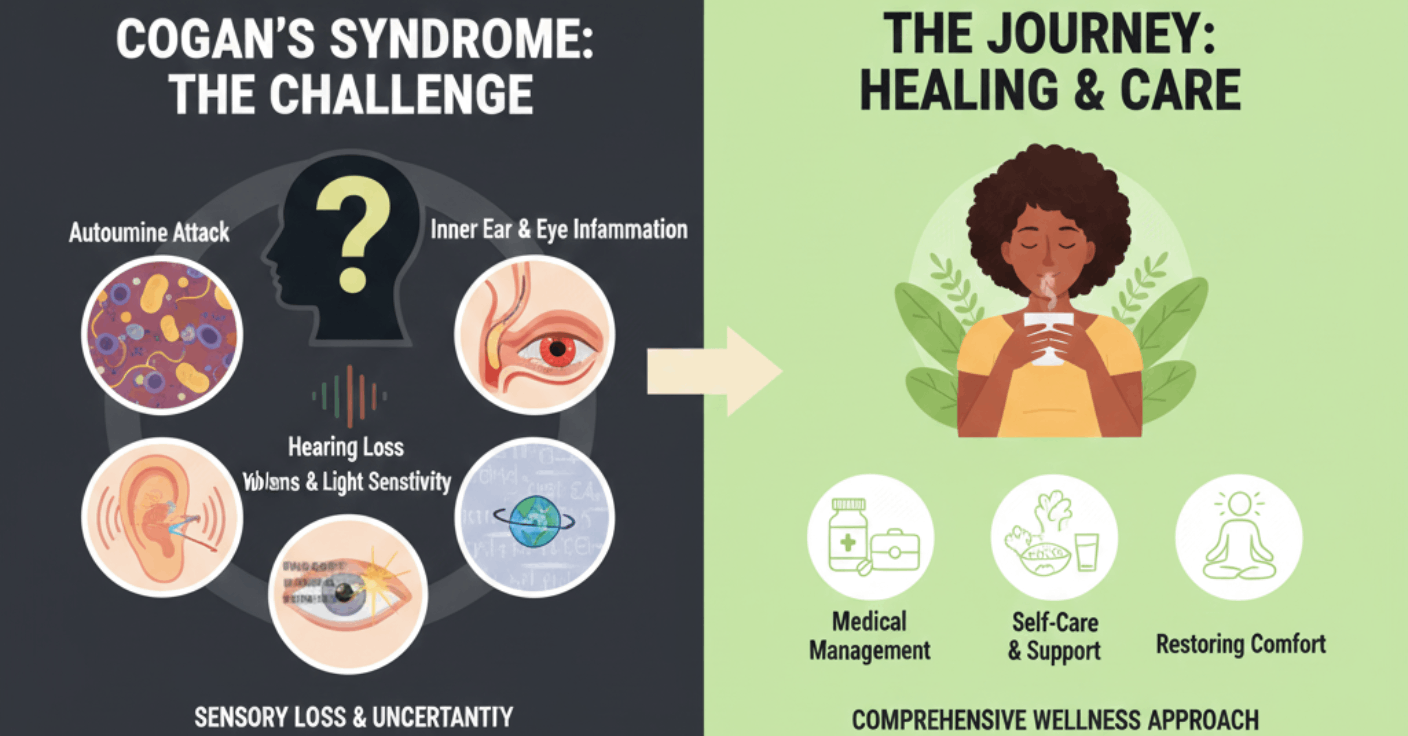
Cogan’s Syndrome is an autoimmune condition, which means the body’s defense system mistakenly attacks its own tissues — in this case, the eyes and the inner ear.
The eyes become inflamed, leading to redness, pain, or blurred vision.
The inner ear becomes affected too, causing dizziness, ringing in the ears, and sometimes hearing loss.
The attacks may come and go. Some days are better; others are hard to explain.
For those going through it, it can feel as if the world has become unstable — too quiet, too blurry, too uncertain.
How It Feels to Live With It
Cogan’s Syndrome doesn’t shout. It whispers — through headaches, fatigue, and a sense that something inside just isn’t right.
People often describe:
- Episodes of dizziness that make it hard to walk straight
- Hearing that fades in one ear, then both
- Eyes that sting or ache with light
- Sudden ringing or pressure inside the ears
- Exhaustion that doesn’t match the day’s effort
And beneath all of that — a quiet fear of losing connection to the world through sound or sight.
But you are not your symptoms. They are signals, not sentences.
Why Does It Happen?
No one fully understands why Cogan’s Syndrome appears.
What is known is that the immune system — meant to protect — becomes overactive, attacking tissues it should leave alone.
Sometimes, it starts after a viral infection. Other times, it seems to appear without warning.
Stress, emotional strain, or exhaustion can make symptoms worse, though they aren’t the cause.
It isn’t your fault. And it isn’t something you caused.
It’s your body’s confused attempt to defend itself — and it can be guided back to balance.
A Homeopathic View: Calming the Body’s Confusion
In homeopathy, the goal isn’t to silence the symptoms — it’s to understand what your body is trying to say.
Cogan’s Syndrome, from this view, isn’t just an illness of the eyes and ears. It’s a story of imbalance, where the body’s own energy is misdirected and needs gentle guidance back to harmony.
Homeopathy approaches this with sensitivity — focusing on the whole person: the way the pain feels, the emotional state, sleep, fears, and patterns of reaction.
Some commonly used remedies (chosen only after careful individual study) may include:
- Phosphorus – for sensitivity to light and sound, and deep fatigue.
- China Officinalis – when weakness and hearing loss follow inflammation.
- Gelsemium – for dizziness and blurred vision that worsen with motion.
- Mercurius Solubilis – for recurring eye irritation linked to ear pressure.
- Sulphur – when eye redness and burning return again and again.
(Always work with a trained homeopath for personalized guidance.)
Homeopathy doesn’t replace medical care — it complements it. It aims to reduce inner inflammation, restore balance, and support the natural healing rhythm.
Living With Cogan’s Syndrome
Daily life with Cogan’s Syndrome asks for gentleness — not only in treatment, but in how you treat yourself.
- Protect your eyes from harsh light and screens.
- Rest when your body asks for it — fatigue is your signal, not a weakness.
- Avoid loud environments when balance or hearing feels fragile.
- Eat simply, drink plenty of water, and create a calm routine.
- Talk openly with your healthcare team — both conventional and homeopathic — so that all sides of care work together.
Healing doesn’t mean the illness never existed. It means learning to live in balance again, even after imbalance.
A Gentle Message of Hope
Cogan’s Syndrome can feel like losing the world in pieces — first sound, then sight, then confidence.
But you can rebuild those connections. Slowly. Patiently. With understanding.
Your body isn’t broken. It’s confused, trying its best to protect you in the only way it knows.
Homeopathy offers a softer language for healing — one that listens before it acts.
Recovery isn’t just about restoring function. It’s about restoring peace — between the body and the mind, between fear and faith.
If this feels like your story, know this: you’re not alone, and this is not the end.
With the right care, balance can return — and life, in all its color and sound, can feel whole again.


Leave a Reply