
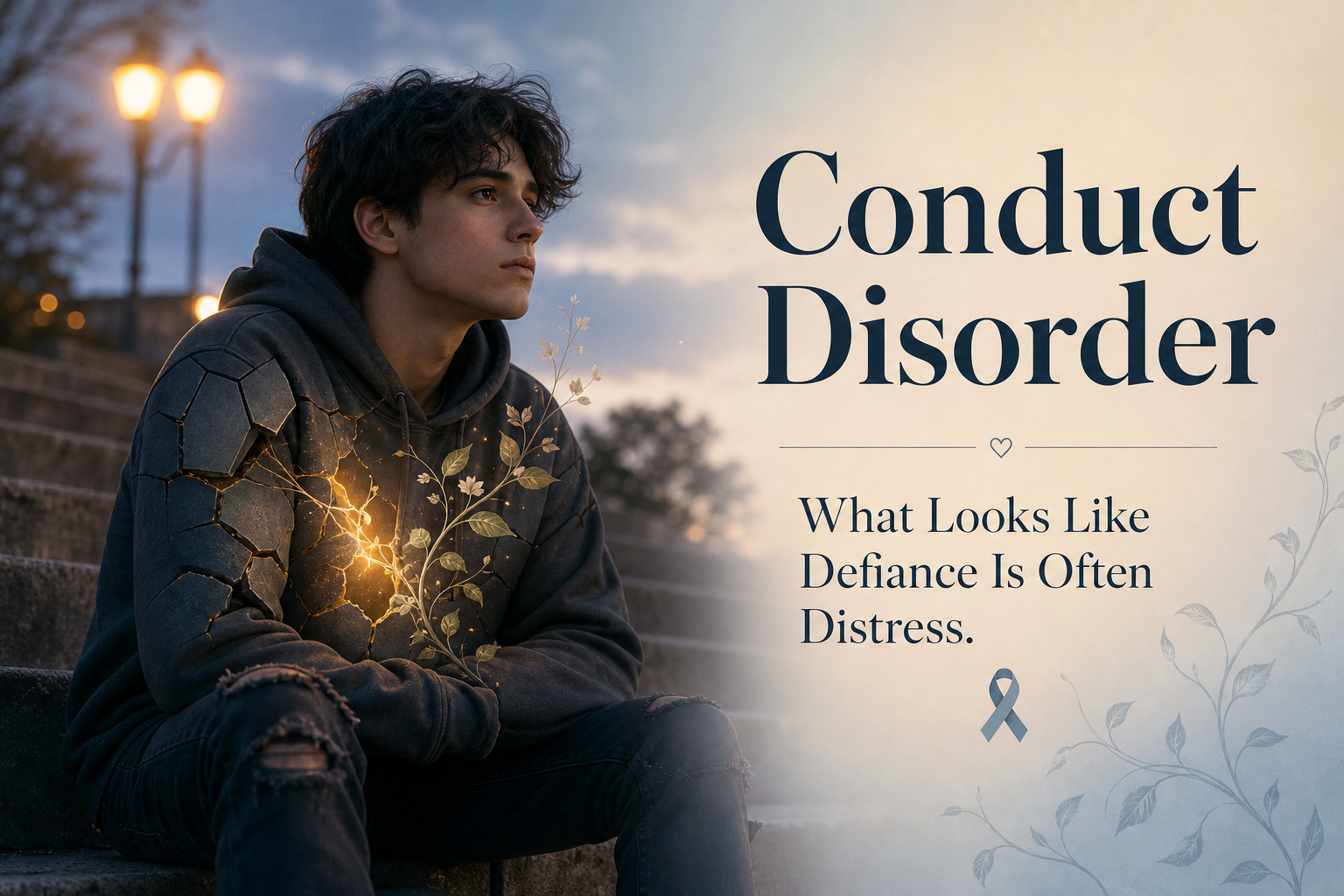
What Looks Like Defiance Is Often Distress.
Some struggles are seen only through behavior.
Actions become the story, while the person beneath them disappears.
Conduct Disorder is often spoken about in terms of rules broken and lines crossed, yet rarely in terms of the inner life that led there.
This is a condition that carries heavy judgment.
Words like bad, dangerous, or out of control are used too easily.
But behind these actions is often a child or adolescent who has learned to survive in ways that others do not understand.
What looks like defiance is often distress asking to be noticed.
Understanding the Experience
Conduct Disorder involves repeated patterns of behavior that go against social expectations — aggression, rule-breaking, dishonesty, or disregard for others’ boundaries.
But behavior does not arise in isolation.
It grows within a nervous system shaped by experience.
For many, these actions are not driven by pleasure or cruelty.
They are responses — to insecurity, to unmet needs, to environments that felt unsafe or unpredictable.
The behavior becomes language when words were never enough.
How It Feels Inside
Inside the person with Conduct Disorder, there is often confusion and contradiction.
A need for control mixed with a deep sense of powerlessness.
Anger that feels familiar because it is easier than vulnerability.
Distrust of authority that once failed to protect.
Some feel emotionally numb.
Some feel constantly on edge.
Some feel guilt but do not know how to express it safely.
They may want connection but expect rejection.
They may test boundaries because boundaries were once absent — or too harsh.
This inner world is rarely calm.
Why These Patterns Develop
From a homeopathic perspective, Conduct Disorder reflects a deep disturbance in emotional development and nervous system regulation.
It may arise from:
- Early emotional neglect or inconsistency
- Trauma or chronic stress
- Lack of secure attachment
- Repeated experiences of feeling unheard or unsafe
- Inherited sensitivity combined with harsh environments
- Emotional needs that were never met or acknowledged
The body and mind learn to protect themselves through hardness.
Aggression becomes armor.
Rule-breaking becomes control.
This is not a moral failure.
It is adaptation.
The Homeopathic Understanding: Rebuilding Inner Safety
Homeopathy looks beyond the behavior and listens to the person’s emotional pattern.
The aim is not to punish or suppress actions, but to restore inner balance — so reactions soften and trust can begin to grow.
A qualified homeopath considers:
- Emotional history
- Sensitivity to authority
- Anger patterns
- Fear, insecurity, or detachment
- Physical and emotional temperament
Remedies that may be considered include:
- Stramonium – when aggression is intense and fear-driven
- Belladonna – when reactions are sudden, violent, and impulsive
- Hyoscyamus – when behavior is disinhibited and socially inappropriate
- Nux Vomica – when irritability and inner pressure lead to defiance
- Anacardium Orientale – when there is inner conflict between conscience and action
Each remedy is chosen individually, with deep attention to the whole child or adolescent — not the diagnosis.
Gentle Daily Support
Consistency creates safety.
Clear boundaries offered calmly — not harshly — help regulate the nervous system.
Connection matters more than control.
Moments of genuine presence build trust slowly, but powerfully.
Movement helps discharge stored tension.
Predictable routines reduce internal chaos.
Most importantly, avoid defining the person by their behavior.
Labels can harden what understanding could soften.
Living Beyond the Diagnosis
Conduct Disorder does not define a lifetime.
It reflects a chapter — one shaped by survival, not by lack of humanity.
With patient, compassionate support and individualized homeopathic care, the nervous system can settle.
Aggression can soften.
Empathy can emerge when safety is restored.
Healing here is not about obedience.
It is about helping the person feel secure enough to choose differently.
Beneath the behavior is a human being — still capable of care, connection, and change.
And when that humanity is finally seen, healing has somewhere to begin.


Leave a Reply