
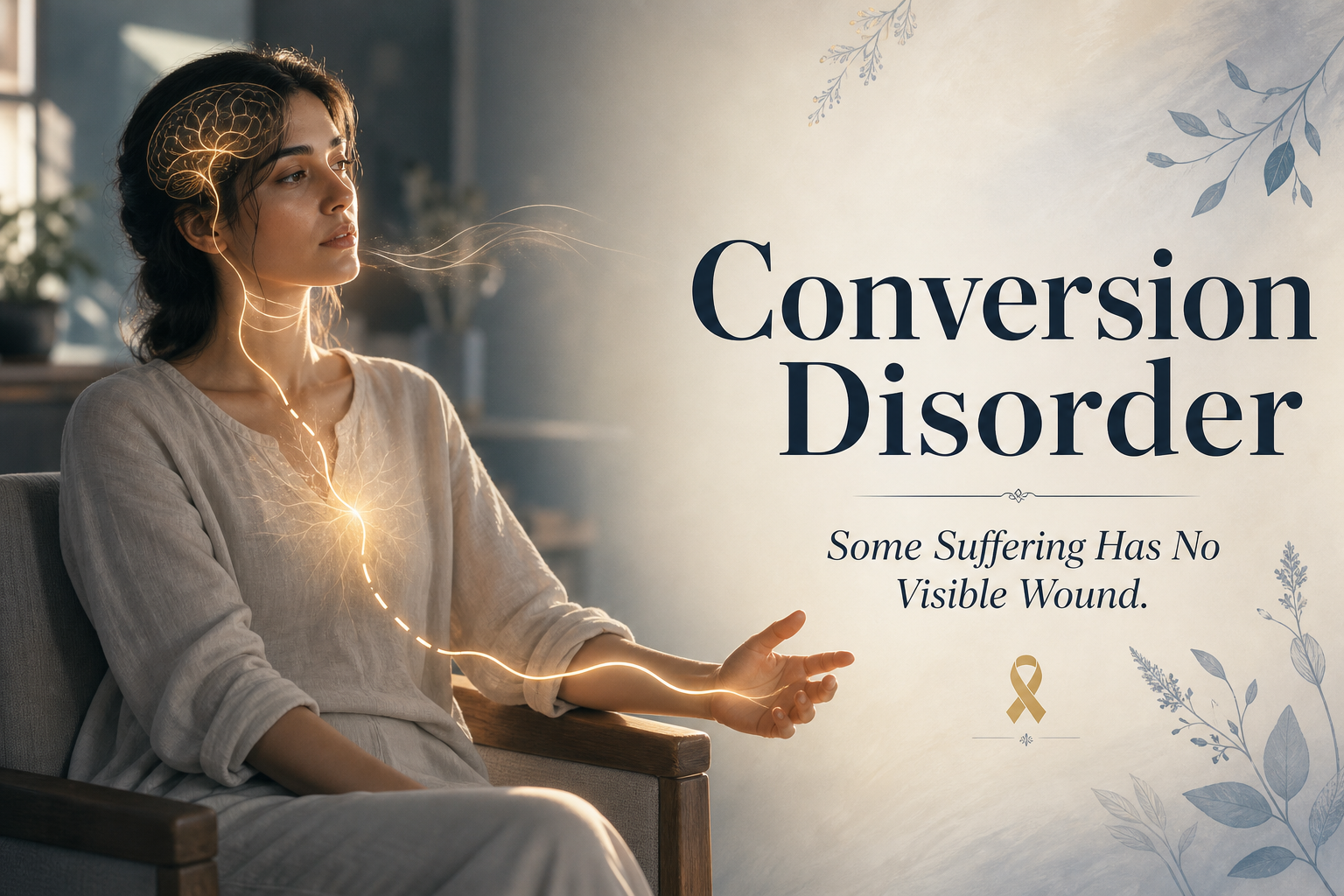
Some Suffering Has No Visible Wound
Some suffering has no visible wound.
No scan to point to.
No test to explain what the body is carrying.
And yet, the experience is real — deeply real — felt in muscles, nerves, movement, and sensation.
Conversion Disorder lives in this quiet space, where the body speaks when words have been held for too long.
It may appear suddenly.
A limb that feels weak or unresponsive.
A voice that falters or disappears.
Seizure-like movements without a neurological cause.
Blindness, numbness, difficulty walking — all arriving without warning.
And with them, confusion, fear, and often disbelief from others.
This is not pretending.
This is not imagination.
This is the body communicating distress in its own language.
Understanding the Experience
Conversion Disorder, also known as Functional Neurological Symptom Disorder, arises when emotional pain is expressed through physical symptoms.
The nervous system becomes overwhelmed.
What cannot be processed consciously finds expression through the body.
The symptoms are involuntary.
They are not chosen.
The person is not in control of when they appear or how they unfold.
Often, this condition follows emotional trauma, long-standing stress, grief, conflict, or experiences that felt too intense, too sudden, or too unsafe to process at the time.
The body steps in, carrying what the mind could not hold alone.
How It Feels
Living with conversion disorder can feel frightening and isolating.
There is the fear of losing control over one’s own body.
The frustration of symptoms that come and go without explanation.
The pain of not being believed — of being told “nothing is wrong” when everything feels wrong.
Many people feel ashamed.
Confused.
Disconnected from their bodies.
There may be grief for the life that feels interrupted, and anxiety about whether the symptoms will return.
Yet beneath all of this is a body that is not failing — it is protecting.
Why It Happens
From a homeopathic perspective, conversion disorder reflects a deep imbalance in the vital force, where emotional shock or unresolved stress disrupts the normal flow between mind and body.
The body chooses expression over collapse.
It converts emotional overload into physical experience as a form of survival.
This is not weakness.
It is adaptation — a response to pain that once had no safe place to go.
The Homeopathic Understanding: Listening to the Body’s Language
Homeopathy approaches conversion disorder with respect and patience.
It does not question the reality of symptoms.
It listens to the whole person — their history, emotions, fears, temperament, and physical expressions.
The goal is not to force symptoms away.
It is to gently restore communication between mind and body, allowing stored tension and trauma to release safely.
Some remedies a trained homeopath may consider include:
- Ignatia – when symptoms follow grief, emotional shock, or suppressed sorrow.
- Causticum – for paralysis, weakness, or voice loss linked with emotional strain and injustice.
- Gelsemium – when weakness, trembling, or heaviness arises from fear or anticipation.
- Natrum Muriaticum – when emotions are deeply held inside, and the body carries silent pain.
- Platinum – when symptoms are linked with inner conflict, suppressed emotion, or identity strain.
Each remedy is chosen with care, honoring the story the body is telling.
Gentle Daily Care
Healing conversion disorder requires safety, not pressure.
Create environments where emotions can be expressed without fear.
Move gently — slow walks, stretching, grounding practices that reconnect you with your body.
Avoid self-blame; symptoms are not your fault.
Seek supportive care that validates both emotional and physical experiences.
Recovery does not happen by force.
It happens when the body feels heard.
Living with Trust and Compassion
Conversion disorder reminds us that the body remembers what the mind tries to forget.
That silence has weight.
That healing begins not with explanation, but with understanding.
You are not broken.
Your body has been protecting you in the only way it knew how.
And with patience, gentleness, and care, it can learn new ways to feel safe again.
Healing is not about returning to who you were before.
It is about becoming whole — with your story, your body, and your humanity held together, not apart.


Leave a Reply