
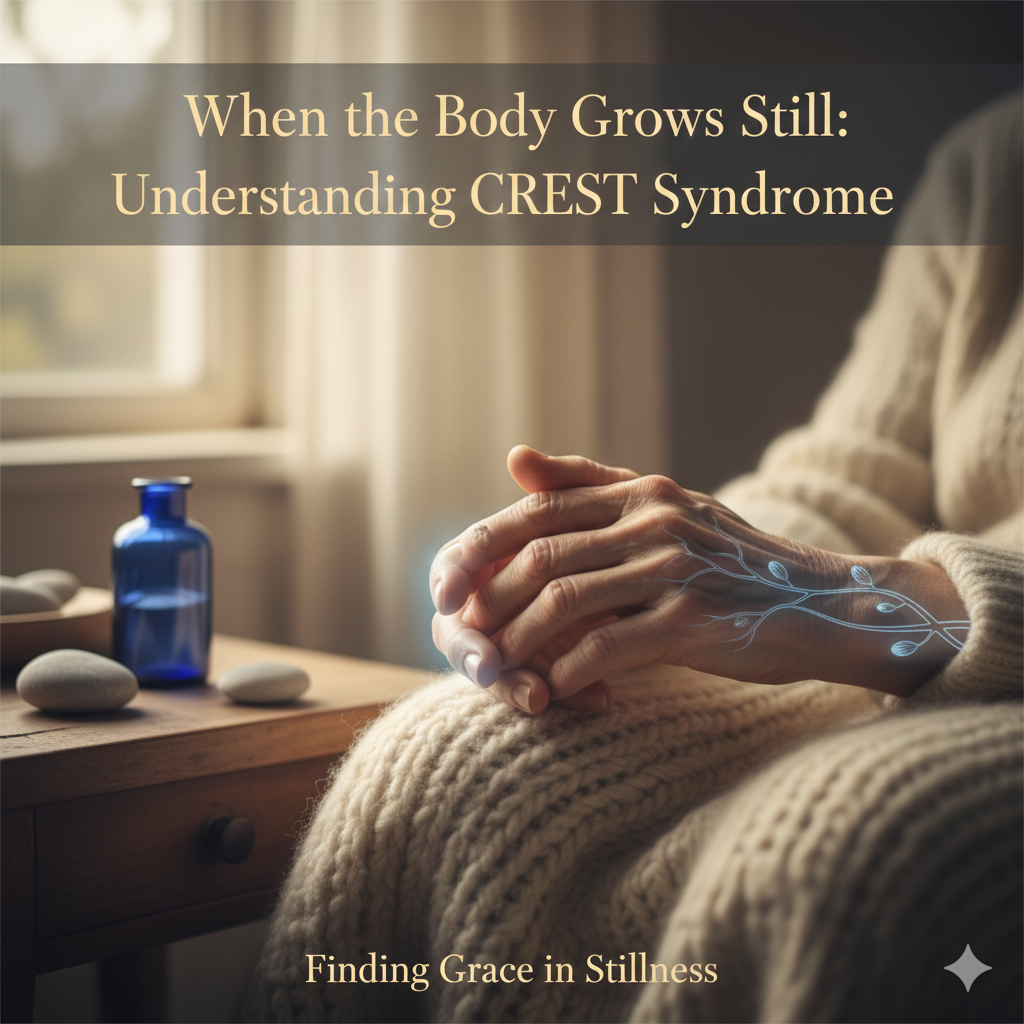
When the Body Grows Still: Understanding CREST Syndrome
Sometimes, healing begins with noticing what the body is quietly trying to say — the tightness in the fingers, the chill that doesn’t fade, the skin that feels different than it used to.
For some, these are the early whispers of CREST Syndrome — a condition that moves slowly, shaping the skin, the vessels, and the body’s inner rhythm.
It’s not simply about the skin tightening or the hands growing stiff — it’s about learning to live inside a body that changes pace, texture, and warmth, yet still carries strength within it.
What Exactly Is CREST Syndrome?
CREST Syndrome is a form of limited systemic sclerosis, an autoimmune condition where the body’s immune system begins to act beyond its balance.
Instead of protecting, it starts to create too much collagen — the protein that gives structure to skin and tissue.
Over time, this buildup causes parts of the body to tighten or harden, especially around the skin, fingers, and internal organs.
The word CREST comes from the five main features of the condition:
- C – Calcinosis: calcium deposits under the skin that may feel like small nodules.
- R – Raynaud’s Phenomenon: fingers or toes turning white or blue in response to cold or stress.
- E – Esophageal Dysmotility: difficulty swallowing or heartburn from the esophagus moving more slowly.
- S – Sclerodactyly: thickening or tightening of the skin on the fingers.
- T – Telangiectasia: small red spots from widened blood vessels, often on the face or hands.
Though these symptoms seem separate, they share a common story — the body’s tissues holding tension where there should be flow.
How It Feels
CREST doesn’t appear overnight. It builds slowly, softly, as if the body is hardening in places it once felt supple.
People often describe:
- Fingers that tighten or curl, especially in the cold
- Skin that feels thick or stretched
- Heartburn or discomfort after meals
- Tiny red spots on the skin that weren’t there before
- A sense of fatigue or heaviness in the body
For some, it remains mild and manageable. For others, it becomes a long conversation with their own body — learning its limits, and gently encouraging movement, warmth, and ease where stiffness tries to settle.
Why It Happens
The exact cause of CREST Syndrome isn’t fully understood.
It’s believed to be linked to the immune system — that intricate balance that sometimes turns against its own tissues when overstimulated or confused.
Genetics may play a part, as can environmental triggers or long-term stress that unsettles the immune system’s natural calm.
But it isn’t something a person causes or deserves — it’s a complex shift that happens within, often for reasons science can’t yet name.
What matters most is how we respond — not with fear, but with patience, understanding, and steady care.
Homeopathic Approach: Soothing the Body’s Inner Firmness
Homeopathy views CREST not as an enemy to fight, but as a signal — the body asking to be softened, balanced, and heard.
Rather than forcing symptoms away, the goal is to encourage flexibility from within — to remind the tissues and immune system how to move with ease again.
Each person’s journey with CREST is different — the pace of progression, the emotional tone, the kind of pain or stiffness they feel. A good homeopathic approach is deeply personal.
Commonly considered remedies include:
- Calcarea Fluorica – for hard or thickened tissues that need softening.
- Silicea – to support slow, deep healing in connective tissue.
- Sepia – for fatigue, chilliness, and emotional withdrawal often seen in long-term illness.
- Carbo Vegetabilis – for sluggish circulation, especially when the hands and feet feel cold or lifeless.
- Pulsatilla – for those who feel better in warmth and comfort, but worse with cold and isolation.
Always consult a trained homeopath for individual guidance, especially when using these.
Gentle Ways to Support Healing
Living with CREST means learning how to care for the body’s boundaries — softening what has grown tense, warming what has gone cold.
- Keep the body warm, especially the hands and feet.
- Avoid sudden temperature changes.
- Eat slowly and mindfully to ease digestion.
- Massage the skin gently to encourage circulation.
- Stretch lightly each day to maintain mobility.
- Rest deeply — healing thrives in stillness.
- Stay connected with your doctors and healers — each plays a part in your recovery.
Finding Grace in Stillness
CREST Syndrome can be a slow teacher. It asks for patience, compassion, and a softer way of living.
It reminds us that movement doesn’t always mean rushing forward — sometimes it means finding flow within stillness.
Your body is not hardening against you; it’s adapting, protecting, and asking for warmth — physical and emotional.
With the right care, support, and time, many people learn to live fully and peacefully with this condition.
Because even when the body feels rigid, the spirit remains fluid — capable of warmth, healing, and quiet strength.
And that, more than anything, is what true recovery looks like.


Leave a Reply