
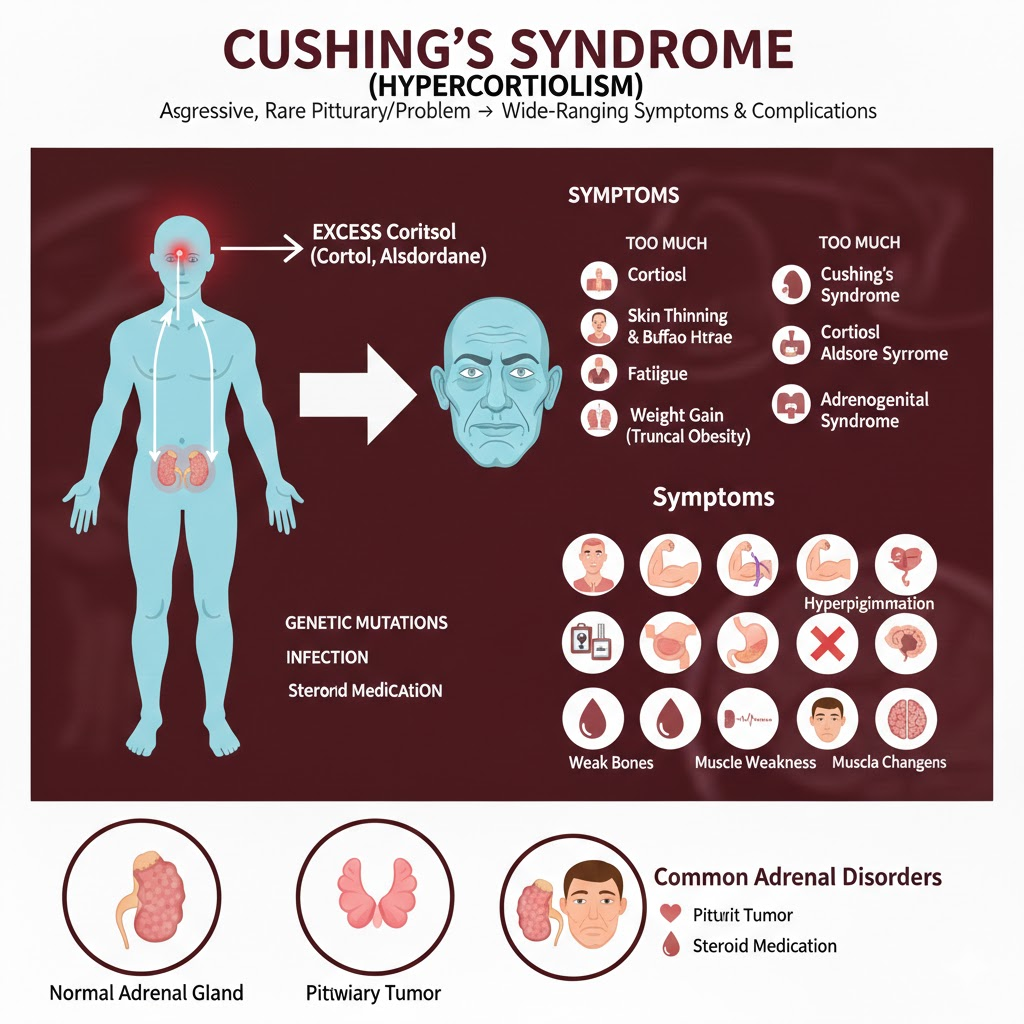
When the body carries more than it was meant to bear
There are moments in life when the body begins to change in ways we cannot quite understand — slowly at first, then unmistakably.
Weight gathers around the middle.
The face grows fuller.
The skin bruises with surprising ease.
Energy slips away like a tide pulling back into the sea.
Cushing’s Syndrome is one of those conditions that rises quietly but leaves a deep imprint on daily life.
It comes from the body holding too much cortisol, the hormone of stress and survival — the hormone that helps us protect, endure, and push through.
But when cortisol stays high for too long, the body begins to whisper:
“I am carrying too much.”
“I am overwhelmed.”
“I need rest.”
Cushing’s Syndrome is not a failure.
It is the body’s way of asking for gentleness after too many months — or years — of strain.
Understanding the Condition
Cortisol is vital.
It helps regulate blood pressure, metabolism, immune function, and the body’s response to stress.
But in Cushing’s Syndrome, cortisol rises beyond what the body can balance.
This can happen due to:
- A benign tumor on the pituitary gland
- An adrenal gland tumor
- Long-term use of steroid medications
- Rare tumors producing ACTH
This excess cortisol slowly reshapes the body.
Not because the body is weak,
but because it is trying — desperately — to manage more stress signals than it can handle.
How It Feels — The Inner Experience
Cushing’s is not only a physical journey;
it is an emotional one, too.
Physical signs may include:
- Weight gain around the abdomen
- A rounded, full “moon face”
- Purple stretch marks
- Fragile, bruising skin
- Weak, thinning muscles
- High blood pressure
- Difficulty sleeping
- Bone pain or fractures
- Increased blood sugar
- Persistent tiredness, even after rest
Emotionally, many describe:
- Feeling unlike themselves in their own body
- Waves of irritability or sadness
- Anxiety that rises without a clear reason
- A sense of being overwhelmed
- Mood swings that feel unfamiliar
- A quiet fatigue that settles deep inside
It is not just cortisol affecting the body —
it affects the mind, the emotions, the spirit.
Many people say they feel like they are living behind a mask —
their body changing while their inner self stays quietly the same.
Why It Happens — A Deeper View
Cushing’s Syndrome often reflects a deeper exhaustion in the body’s stress-management system.
Cortisol is the hormone of survival.
Too much of it for too long sends a message:
“I have been in survival mode for too long.”
This excess may come from:
- Long-term medications
- Tumors
- Hormonal imbalance
- Chronic stress that strained adrenal function
It does not reflect weakness of character.
It reflects how protective — and overworked — the body has become.
The Homeopathic Understanding — Restoring the Inner Rhythm
Homeopathy sees Cushing’s Syndrome not only as a hormonal imbalance,
but as a disturbance in the vital force — the inner energy that governs harmony.
A homeopath listens not only to symptoms, but to the story:
- When did your body first begin to change?
- What emotional burdens were carried then?
- Do you feel pressured, overwhelmed, exhausted?
- How long have you been “pushing through” life?
- What fears sit quietly in the background?
- What was happening in your life before these changes began?
From this deeper picture, remedies are selected.
Homeopathic Remedies Often Considered
1. Adrenalinum
For symptoms of adrenal overload: anxiety, palpitations, over-alertness, trembling, and inability to relax.
2. Nux Vomica
For individuals driven by stress, irritability, perfectionism, or long-term overexertion.
3. Natrum Sulphuricum
For hormonal imbalance with swelling, weight gain, heaviness, and emotional sensitivity.
4. Graphites
For sluggish metabolism, weight gain, dryness of skin, and emotional heaviness.
5. Calcarea Carbonica
For exhaustion, weight gain, sweating, and fearfulness — especially when feeling overwhelmed by responsibility.
6. Arsenicum Album
When anxiety, restlessness, fear of decline, and a need for reassurance dominate.
7. Lycopodium
For abdominal bloating, digestive imbalance, irritability, and feelings of inadequacy masked by confidence.
(Homeopathic remedies support emotional and energetic balance, and should be guided by a qualified homeopath.)
Gentle Daily Care — Supporting the Body’s Return to Ease
1. Honor Rest
Fatigue in Cushing’s is deep.
Let your body slow down without guilt.
2. Nourish with Softness
Warm meals, light vegetables, herbal broths, and foods that support balanced blood sugar.
3. Reduce the Stress Load
Cortisol rises with emotional strain.
Soft music, journaling, calming breathwork, slow walks — these soothe the overworked system.
4. Tend to the Skin
Gentle moisturizers, warm compresses, and avoiding harsh rubbing help fragile skin heal.
5. Herbal Allies
Under guidance, herbs like ashwagandha, holy basil, skullcap, and chamomile may support calmness.
6. Emotional Holding
Cushing’s changes the body visibly.
This can affect identity, self-esteem, and relationships.
Kindness toward yourself is essential.
A Closing Reflection
Cushing’s Syndrome is a condition of imbalance, burden, and hormonal chaos —
but also a message:
“Your body needs ease.
Your heart needs gentleness.
You deserve rest.”
Healing is a journey back to balance,
back to your own rhythm,
back to a version of yourself that feels steady again.
Even in moments of heaviness or fear,
your body continues to try — every single day — to find harmony.
You are not alone.
You are not broken.
You are a human being moving through a difficult moment with courage, patience, and quiet endurance.
And slowly, softly, balance can return.






Leave a Reply