
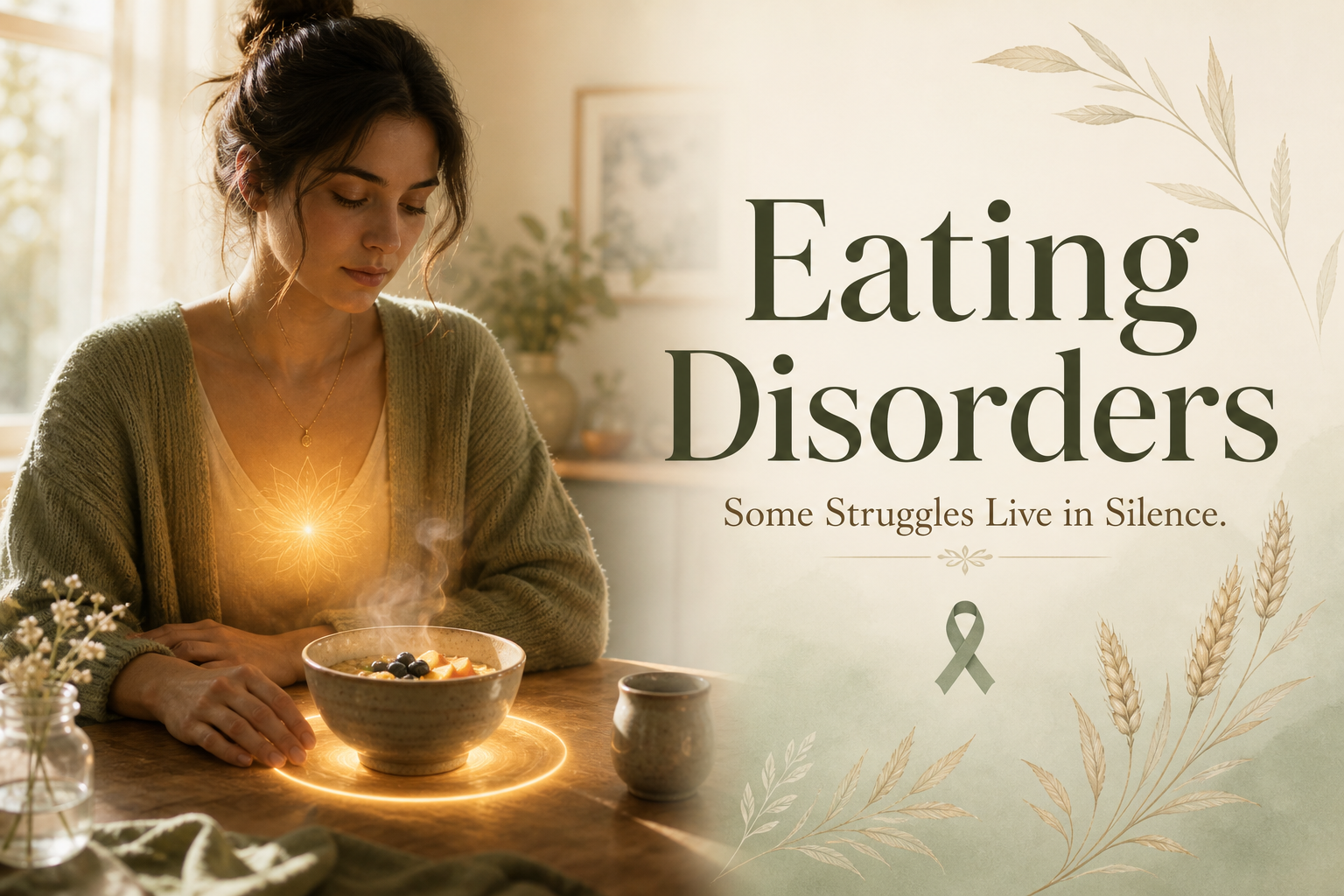
Some Struggles Live in Silence
Some struggles do not live only in the body.
They live in silence, in rituals carried out alone, in thoughts that circle food, control, and worth.
Eating disorders are not about hunger alone.
They are about longing — for safety, for control, for relief from feelings that feel too large to hold.
They often begin quietly.
A skipped meal.
A rule about food.
A moment of relief when the body feels lighter, emptier, more manageable.
What starts as coping slowly becomes confinement, and the body becomes the place where unspoken pain is stored.
Understanding the Experience
Eating disorders are not choices.
They are adaptations.
For some, food becomes comfort when comfort was missing.
For others, restriction becomes a way to feel powerful in a world that once felt overwhelming.
Binging, purging, starving, or obsessing over food are not the problem — they are signals.
The body is speaking when words once felt unsafe.
An eating disorder is often the body’s way of saying:
I am trying to survive something you cannot see.
How It Feels
Inside, there is often constant noise.
Thoughts about food, weight, control, guilt, and shame weave through the day and night.
There may be moments of calm — after restriction, after purging, after control is regained.
But they do not last.
They are followed by fear, self-blame, exhaustion, and a deep sense of being trapped.
Many people feel disconnected from their bodies.
Hunger feels confusing.
Fullness feels threatening.
The mirror becomes an enemy.
And beneath all of this is often a quiet grief — for ease, for peace, for a relationship with food that does not hurt.
Why It Happens
From a homeopathic perspective, eating disorders reflect a deep disturbance in the vital force, often shaped by emotional trauma, perfectionism, control struggles, loss, neglect, or unresolved fear.
The body learns to manage overwhelming emotions through food behaviors because other forms of regulation were not available or safe.
This is not vanity.
It is not weakness.
It is a survival strategy that has stayed too long.
The Homeopathic Understanding: Rebuilding Safety Within
Homeopathy does not force the body to change.
It listens.
It seeks to understand the person’s inner world — their fears, attachments, control patterns, self-image, and emotional history.
The aim is to restore balance so the individual no longer needs food behaviors to cope.
Some remedies a trained homeopath may consider include:
- Natrum Muriaticum – when emotions are held inward, grief is private, and self-denial feels familiar.
- Ignatia – when eating patterns are linked to loss, shock, or unresolved emotional pain.
- Calcarea Carbonica – when there is deep insecurity, fear of losing control, and a need for structure.
- Sepia – when there is emotional numbness, withdrawal, and disconnection from the body.
- Pulsatilla – when eating struggles are tied to emotional dependency, sensitivity, and a need for reassurance.
Each remedy is chosen for the person, not the diagnosis.
Gentle Daily Care
Healing asks for patience.
Rigid rules must be softened, not shattered.
The nervous system needs safety before change is possible.
Eat in calm environments when possible.
Warm, simple foods help the body feel less threatened.
Avoid forcing hunger cues — trust builds slowly.
Rest matters.
So does kindness toward the body, even when trust feels fragile.
Most importantly, allow support.
Eating disorders thrive in isolation.
Healing grows in gentle connection.
Living Beyond the Disorder
An eating disorder is not who you are.
It is something you learned when you needed protection.
As healing unfolds, the body begins to feel less like an enemy and more like a companion.
Food slowly becomes nourishment instead of negotiation.
Control loosens into trust.
You are not broken.
You adapted.
And with the right care — compassionate, patient, and deeply human — the body can remember how to feel safe again.


Leave a Reply