
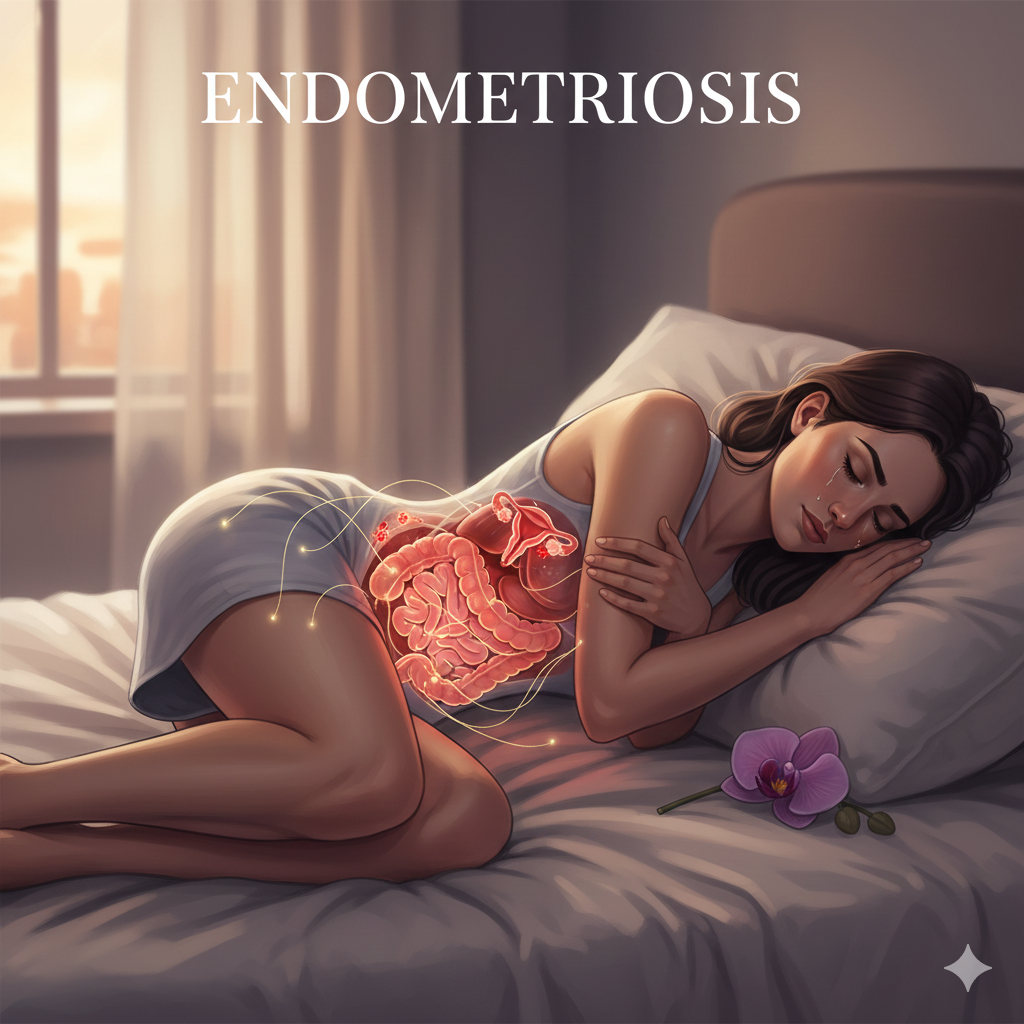
When the Body Speaks in Pain: Understanding Endometriosis
There are pains that live deep — not loud, but steady.
They visit month after month, reshaping how one moves, plans, or even breathes through the day.
For many women, this is what Endometriosis feels like — a condition that weaves itself quietly into life, testing strength, reshaping identity, and asking for gentleness where there’s been endurance for far too long.
It’s a story not just of the womb, but of the whole being — of resilience, exhaustion, and the long, brave search for relief.
What Exactly Is Endometriosis?
Endometriosis is more than a “women’s health issue.” It is the presence of endometrial-like tissue — the kind that normally lines the uterus — growing in places it doesn’t belong: on the ovaries, fallopian tubes, bladder, or intestines.
Each month, this tissue reacts to hormonal changes — swelling, bleeding, and inflaming — but because it’s outside the womb, there’s no natural way for it to leave the body.
What follows is pain, scarring, and a slow, inward tug that affects far more than the physical body.
Endometriosis is the body’s quiet rebellion — a deep expression that something within has been unsettled for too long.
How It Feels
The pain of endometriosis doesn’t always shout. Sometimes it sighs, sometimes it hums beneath the surface — but it’s always there.
Many women describe:
- Cramping that feels deeper than normal, pulling into the pelvis or lower back
- Pain before, during, or after menstruation — the kind that drains energy and color from the face
- Discomfort during intimacy, a tenderness that replaces ease
- Fatigue that lingers, as though every cell has been working too hard for too long
- Bloating or nausea that makes the body feel heavy and unfamiliar
But beyond the symptoms, there is the quiet emotional ache — the frustration of being misunderstood, of hearing “It’s just period pain,” of living in a body that others cannot see hurting.
This is not imagined.
It is real, it is deep, and it deserves tenderness — not dismissal.
Why It Happens
Science tells us that hormones, immunity, and inflammation play a part.
But the story is more complex — and more human.
Sometimes, endometriosis emerges where stress has been unspoken, where exhaustion has become routine, or where emotional pain has been quietly stored in the body.
Possible factors include:
- Retrograde menstruation (when menstrual blood flows backward into the pelvis)
- Immune imbalance or overactive inflammation
- Hormonal imbalances, especially with estrogen
- Emotional and physical stress over time
- Genetic predisposition
Whatever the mix of causes, one thing is certain: this is not the woman’s fault.
It is not caused by weakness or worry.
It is simply the body’s way of saying — something inside needs peace.
Homeopathic Approach: Listening, Not Fighting
In homeopathy, Endometriosis is not treated as an enemy to be battled, but as a messenger — a sign that the body’s rhythm has been lost, and the goal is to help it find its way back.
Healing begins not by silencing the pain, but by understanding it.
Each case is unique, shaped by where the pain settles, how it flows, and what emotions accompany it.
Commonly chosen remedies include:
- Lachesis Mutus – for pain that worsens before the period and feels better once bleeding begins.
- Sepia Officinalis – for deep pelvic heaviness, fatigue, and the feeling of being emotionally “worn thin.”
- Magnesia Phosphorica – for spasmodic cramps eased by warmth and pressure.
- Pulsatilla Nigricans – for shifting pain with hormonal sensitivity and emotional softness.
- Belladonna – for sudden, intense, throbbing pains with heat and tension.
(Always work with a trained homeopath for personalized guidance.)
Gentle Ways to Care for Yourself
Endometriosis often teaches slowness — a lesson many of us resist until the body insists.
- Rest when you need to. Pain is not laziness — it’s the body’s plea for pause.
- Use warmth. A warm compress or bath can loosen the tightness within.
- Nourish gently. Eat foods that ease inflammation — fresh vegetables, seeds, greens, warm broths.
- Move softly. Gentle yoga or stretching can bring blood flow and relief.
- Release emotions. Crying, writing, or speaking helps unburden what the body holds.
- Work with both your homeopath and doctor. Healing thrives when care is shared, not divided.
Remember — you are not meant to endure in silence. Healing begins when you stop apologizing for your pain.
Finding Peace in the Body Again
Endometriosis is not just a medical condition — it’s a long conversation between the body and the soul.
It asks for listening, for slowing down, for a kind of self-compassion that many women forget to give themselves.
There will be hard days — days when the pain feels too much, when you’re tired of explaining, when hope feels thin.
But there will also be gentler days — when the body softens, the pain quiets, and you remember that you are not your illness.
Healing doesn’t mean the story disappears.
It means the story changes tone — from suffering to understanding, from pain to presence.
Your body is not betraying you.
It’s speaking — through cycles, through pain, through exhaustion — asking you to care for it the way you would care for someone you love.
And when you begin to listen, truly listen,
you may find that the very place that hurt the most
becomes the place where your strength begins.


Leave a Reply