
When the Blood Grows Too Full
There are times when the body does not fade or weaken — but instead gathers too much, as though it is trying to strengthen itself beyond measure.
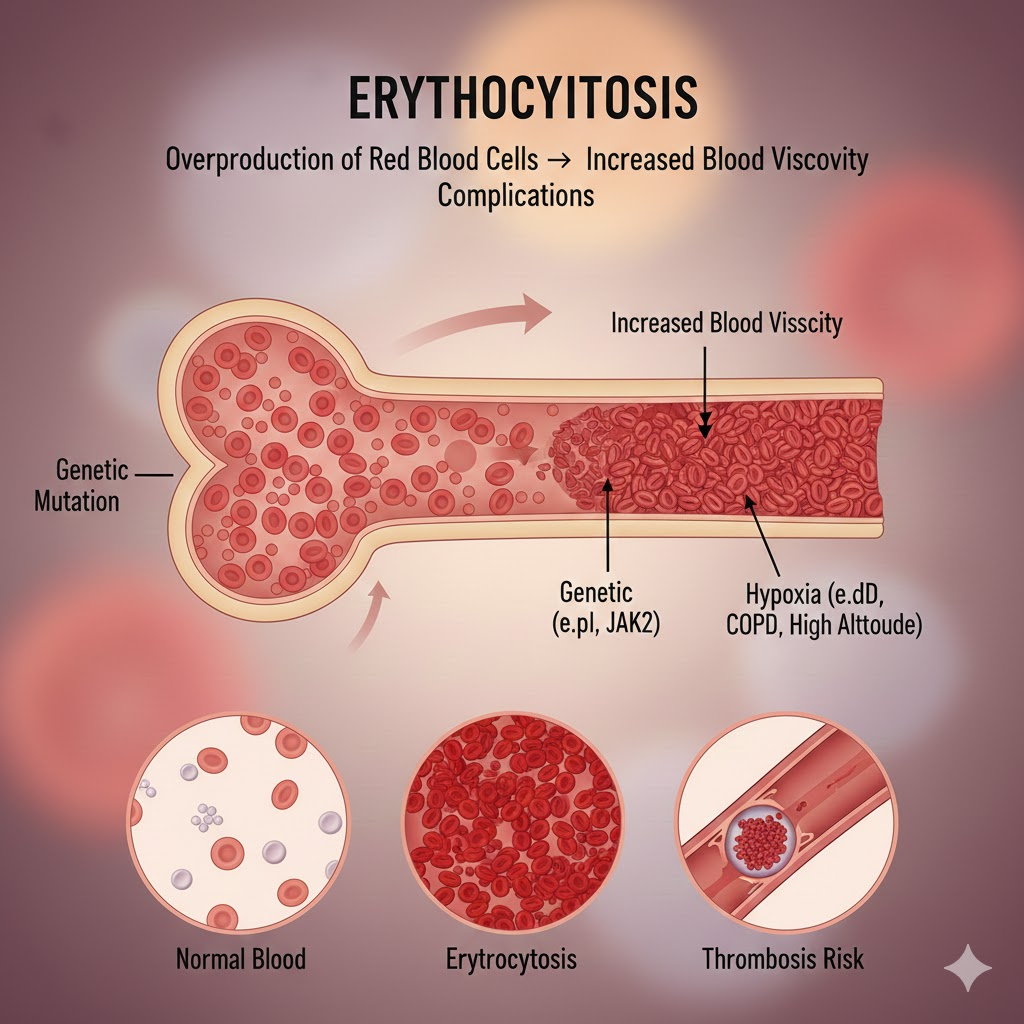
Erythrocytosis is one of these quiet imbalances.
It is the body’s way of holding more than it needs —more red blood cells, more thickness, more pressure within the silent currents of circulation.
It does not always feel dramatic.
It may not shout through symptoms or alarms.
But within the bloodstream, there is a subtle heaviness — a sense of fullness, a tightening of the inner river that carries life to every cell.
For some, it is discovered during a routine test.
For others, it begins with a simple knowing:
headaches that pulse more strongly,
a warmth in the face,
a fatigue that feels weighted,
a pressure somewhere deep inside.
These are the early whispers of a body carrying more blood than it can flow with ease.
How It Feels
The experience of Erythrocytosis can be subtle or pronounced.
A fullness in the head
Headaches that feel like internal pressure,
sometimes accompanied by dizziness or a sense of heaviness behind the eyes.
A warmth or flushing of the face
As though the blood moves too strongly to the surface.
Fatigue
Not from lack, but from excess —
a tiredness that comes from blood that is too thick to flow easily.
Shortness of breath
Especially during exertion, when the body struggles to regulate oxygen more efficiently.
Itching after warm showers
A curious symptom, more common in primary forms,
reflecting heightened sensitivity in the blood vessels.
Numbness or tingling in the hands and feet
A quiet sign that circulation is moving with more effort.
Emotionally, this can bring its own unease:
a sense of being “too full,”
irritability,
restlessness,
or a feeling that something inside is pushing harder than necessary.
Why It Happens
Erythrocytosis is the body’s response to a perceived need:
- When oxygen levels drop, even slightly, the body makes more red cells.
- When bone marrow becomes overly sensitive, it may create too many cells.
- When chronic illness alters the body’s chemistry, cell production may rise.
- When lifestyle or environment changes oxygen flow, the body answers with overproduction.
It is compensation —
an attempt to fix something,
an effort to protect,
a misinterpretation that leads to excess.
This condition does not reflect weakness,
but rather the body’s strong, sometimes misguided determination to survive and support us.
The Homeopathic Understanding: Balancing the Inner Flow
Homeopathy looks at Erythrocytosis through the lens of overactivity —
a vital force that is pushing too strongly,
too fast,
creating an inner abundance that becomes burdensome.
The goal is not merely to reduce cell counts,
but to soften the inner drive that fuels this overproduction.
A homeopath listens deeply:
What emotions run beneath the fullness?
Where does one hold heat, pressure, or internal tension?
Is there unresolved anger?
Long-held stress?
A constitution that tends toward excess or intensity?
From this deeper picture, remedies are chosen.
Important Remedies Often Considered
Belladonna
For a sense of fullness, pounding headaches, flushed face, and heat rising rapidly.
Aconitum Napellus
For restlessness, sudden warmth, agitation, and internal pressure that comes in waves.
Nux Vomica
For individuals who push themselves too hard — driven, tense, easily overheated, overworked in body and mind.
Sulphur
For heat in the blood, itching after warm showers, redness, and a tendency toward internal congestion.
Lachesis
For fullness and pressure that worsens with heat; emotional intensity, strong circulation, and sensitivity.
Phosphorus
For those who are warm, open, sensitive, and easily affected by internal changes — with quick circulation and heightened warmth.
(As always, individualized consultation with a qualified homeopath is essential — remedies must match the person, not just the diagnosis.)
Gentle Daily Care
Healing begins not with force,
but with softness —
with habits that encourage balance in the bloodstream and calm in the nervous system.
Stay well-hydrated
Thin the blood naturally with steady, gentle hydration.
Support oxygenation
Slow, deep breathing
fresh air
gentle walks
practices that help the lungs expand calmly.
Reduce exposure to altitude or smoking
Allow oxygen levels to regulate without intense adaptation signals.
Nourish lightly
Fruit, greens, whole grains — foods that cool, soften, and soothe the bloodstream.
Rest from intensity
Overexertion fuels the body’s drive to produce more.
Gentle pacing helps the marrow quiet its urgency.
Emotional tending
Address tension, anger, frustration, or internal heat —
all of which mirror the physiological pattern of “too much.”
Herbal supports such as hibiscus, nettle, and cooling botanicals may offer gentle balancing — always with medical guidance.



Leave a Reply