
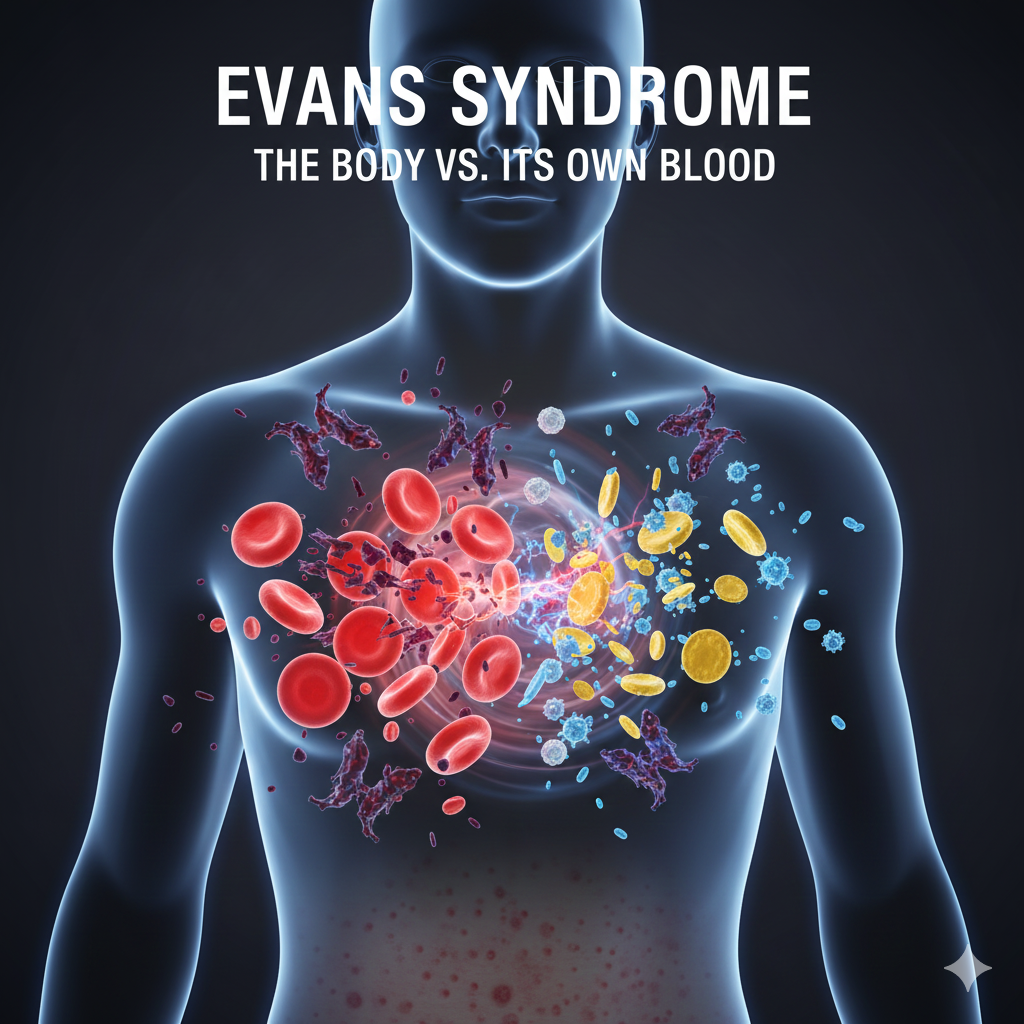
When the Blood Fights Itself: Understanding Evans Syndrome
Sometimes, illness doesn’t arrive as an outsider — it rises quietly from within, when the body begins to confuse its own for its enemy.
Evans Syndrome is one of those rare conditions — not loud or visible at first, but deep and unsettling, a story written quietly in the blood.
For those living with it, the experience often feels like an ongoing tug-of-war inside — strength fading, color draining, and the body asking softly, “Why am I attacking myself?”
It’s not a failure of the body. It’s a cry for balance, for understanding, for peace within the very system meant to protect.
What Is Evans Syndrome?
Evans Syndrome is a rare autoimmune disorder in which the immune system mistakenly destroys the body’s own blood cells — both red cells (which carry oxygen) and platelets (which help stop bleeding).
Sometimes, it also targets white blood cells, the defenders against infection.
It’s a double confusion — the body’s protector turning against its own life force.
Because of this, Evans Syndrome often shows up as a combination of two conditions:
- Autoimmune Hemolytic Anemia (AIHA) — when red blood cells are destroyed faster than they’re made.
- Immune Thrombocytopenia (ITP) — when platelets are attacked, leading to easy bruising or bleeding.
This overlap makes the illness unpredictable — a shifting landscape of fatigue, weakness, and vulnerability.
How It Feels
Life with Evans Syndrome can feel like moving between opposites — days of strength followed by sudden exhaustion, color returning to the face only to fade again.
People often describe:
- Severe tiredness or dizziness from anemia
- Pale or yellowish skin
- Shortness of breath or rapid heartbeat
- Unexplained bruises, nosebleeds, or gum bleeding
- Small red or purple dots (petechiae) on the skin
- Headaches or weakness
- Fluctuating symptoms — times of calm followed by sudden flare-ups
For some, the physical changes come with a quieter ache — the emotional weight of living with a condition that feels unpredictable, invisible, and beyond control.
There’s fear, yes, but also resilience — the slow learning of how to live gently in a body that’s trying its best to find balance again.
Why It Happens
Evans Syndrome doesn’t always come with a clear reason.
In some, it appears after infections or alongside other autoimmune conditions such as lupus. In others, it simply arises — the immune system losing its way.
What’s known is that the body’s defense system begins attacking healthy blood cells, mistaking them for invaders.
Over time, this leads to low blood counts and the symptoms that follow.
It’s not something anyone causes. It’s not contagious or inherited in most cases.
It’s simply the body in confusion — trying too hard to protect, but forgetting who it’s protecting.
The Homeopathic Approach: Teaching the Body to Remember Itself
Homeopathy views Evans Syndrome as a deep imbalance of self-recognition — where the body’s vital energy has become disoriented.
The goal is to gently re-educate the immune system, helping it rediscover what belongs and what does not.
Treatment focuses on the person as a whole — not just the lab values or blood counts, but how the illness feels, what emotions accompany it, what triggers flares, and how the spirit holds resilience.
Commonly considered remedies include:
- Phosphorus – for weakness, bleeding, and deep fatigue with emotional sensitivity.
- Arsenicum Album – for exhaustion, restlessness, and anxiety about health.
- China (Cinchona) – for weakness from blood loss, dizziness, and pale complexion.
- Natrum Muriaticum – for those who hold emotions inward, feeling drained but dignified.
- Carbo Vegetabilis – for faintness, coldness, and loss of vitality.
A skilled homeopath chooses a remedy not from a list, but from listening — to the tone of the patient’s life, to the subtleties of what this condition means to them.
Because healing is not only about correcting blood counts — it’s about reuniting the body with its own trust.
Gentle Care and Daily Healing
Living with Evans Syndrome means learning tenderness — learning how to live softly in a body that sometimes feels fragile.
Small, steady acts can support the journey:
- Eat nourishing foods — rich in iron, vitamins, and calm energy.
- Avoid exhaustion — both physical and emotional; rest is as vital as medicine.
- Protect from infections, since immunity can be low.
- Keep warm — cold often strains circulation and drains vitality.
- Seek emotional balance — anxiety and grief can unsettle the immune system.
- Work closely with your doctor and homeopath, monitoring with care and compassion.
Healing is slow, but it’s also steady — a quiet unfolding that happens with patience and trust.
Finding Peace Within the Blood
Evans Syndrome can feel like a betrayal — when the very system meant to defend you becomes your source of harm.
But underneath that confusion lies a truth: the body is still trying to protect you. It has only forgotten its way.
Healing begins when that memory returns — when the immune system learns, gently, to recognize home again.
And with the right care — medical, emotional, and energetic — that recognition can come back.
Your blood is not your enemy.
It’s the river of your life — confused for now, but capable of remembering its flow.
With time, warmth, and compassion, that river will clear again —
quietly, faithfully, and beautifully.


Leave a Reply