
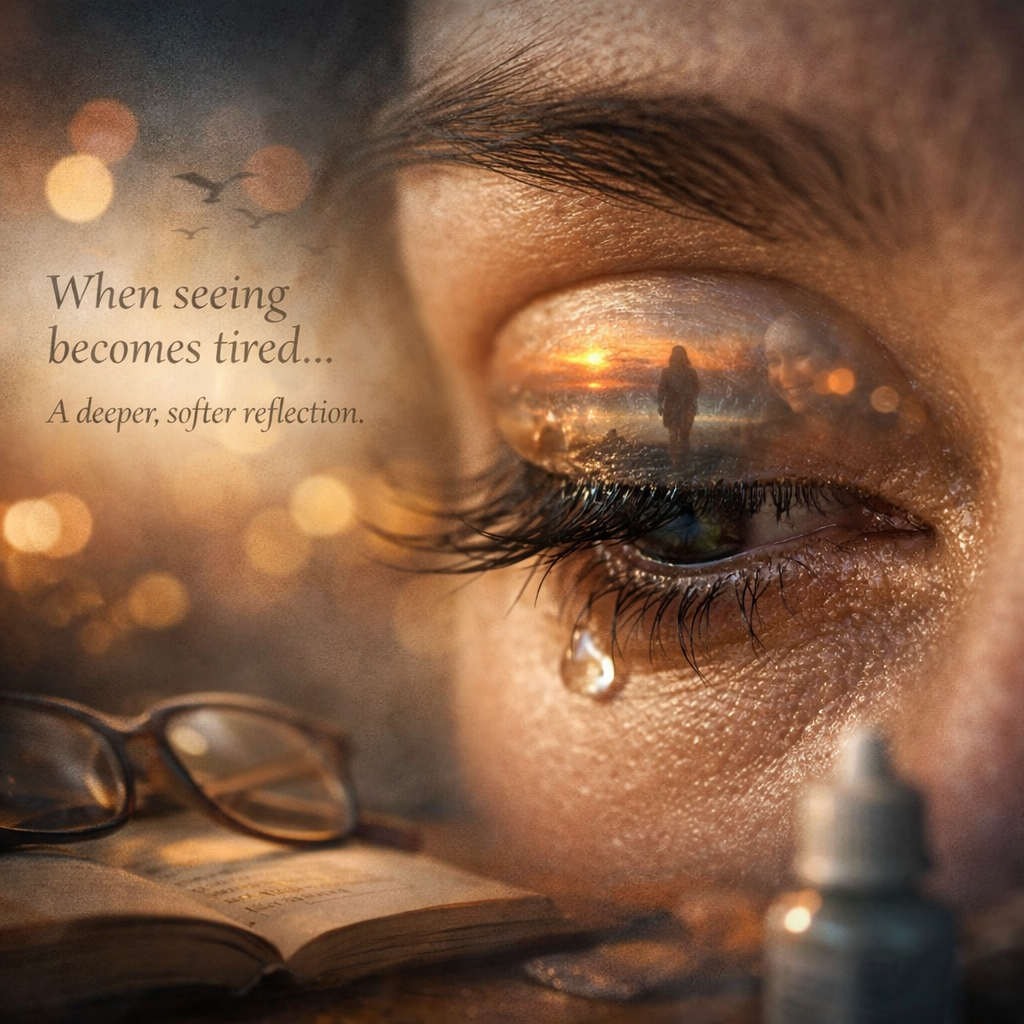
When Seeing Becomes Tired
A more human, softer, deeper reflection
The eyes never sleep completely.
Even in rest, they hold memory — of light, of faces, of movement, of moments we did not want to miss.
They wake before we do.
They work until we forget they are working.
They absorb the world quietly, faithfully, without complaint — until one day, they begin to ache.
Eye complaints are rarely sudden strangers.
They arrive as whispers:
a little blur in the evening,
a burning after long hours,
a heaviness that settles behind the eyes,
a sensitivity that makes light feel harsh.
These are not failures.
They are messages.
When the Eyes Begin to Speak
When the eyes are strained, dry, painful, or blurred, the body is often saying:
“I have been focusing for too long.”
“I have been holding more than I can release.”
“I need softness.”
Blurred vision may feel like the world slipping slightly out of reach — a reminder that clarity is not only optical, but emotional and mental as well.
Burning or dryness often appears in those who give continuously, who stay alert, who forget to blink — not only with the eyes, but with the heart.
Redness and irritation can mirror inner inflammation: stress, suppressed frustration, or long periods of overstimulation.
Watering eyes may reflect sensitivity — the body reacting, trying to cleanse, trying to protect itself from what feels too much.
Pain around the eyes can carry the weight of unexpressed tension — worry held in the forehead, grief pressed behind the sockets, pressure that has nowhere else to go.
Light sensitivity often belongs to sensitive nervous systems — people who feel deeply, think deeply, and tire easily in a loud, bright world.
How It Touches Daily Life
Eye discomfort changes how we move through the day.
Reading becomes effort.
Screens become exhausting.
Faces blur.
Colors dull.
Confidence quietly slips.
Emotionally, people may feel:
irritated by small things,
anxious about their vision,
withdrawn from activities they once loved,
afraid of what worsening symptoms might mean.
The eyes do not suffer alone.
When vision strains, the mind tightens.
When the eyes ache, the body grows weary.
A Deeper Understanding
From a human, holistic view, eye complaints are rarely just about the eyes.
They reflect:
overwork without rest,
constant mental engagement,
emotional vigilance,
unprocessed stress,
nutritional depletion,
or simply a life lived at a pace faster than the body can follow.
The eyes are part of the nervous system.
When the nervous system is tired, the eyes show it first.
Sometimes the body is not asking for stronger treatment —
it is asking to be treated more gently.
Gentle Ways to Care for Tired Eyes
Rest is not laziness.
It is repair.
Allow pauses — not just for the eyes, but for the mind.
Look away from screens.
Close the eyes without guilt.
Let darkness soothe them.
Blink slowly.
Breathe deeply.
Hydrate the body well.
Protect the eyes from harsh light and dryness.
Sleep deeply when possible.
Nourish the body — deficiency often dulls vision before it shows elsewhere.
And perhaps most importantly:
soften your inner focus.
Not everything needs to be watched, controlled, or anticipated.
A Closing Reflection
The eyes carry the world for us.
They witness joy, loss, beauty, fear, and hope — all without rest.
When they begin to struggle, it is not weakness.
It is honesty.
They are asking us to slow down,
to soften our gaze,
to rest not only our vision,
but our way of living.
When the eyes are met with compassion,
clarity often returns —
not only in what we see,
but in how we see ourselves and the world around us.


Leave a Reply