
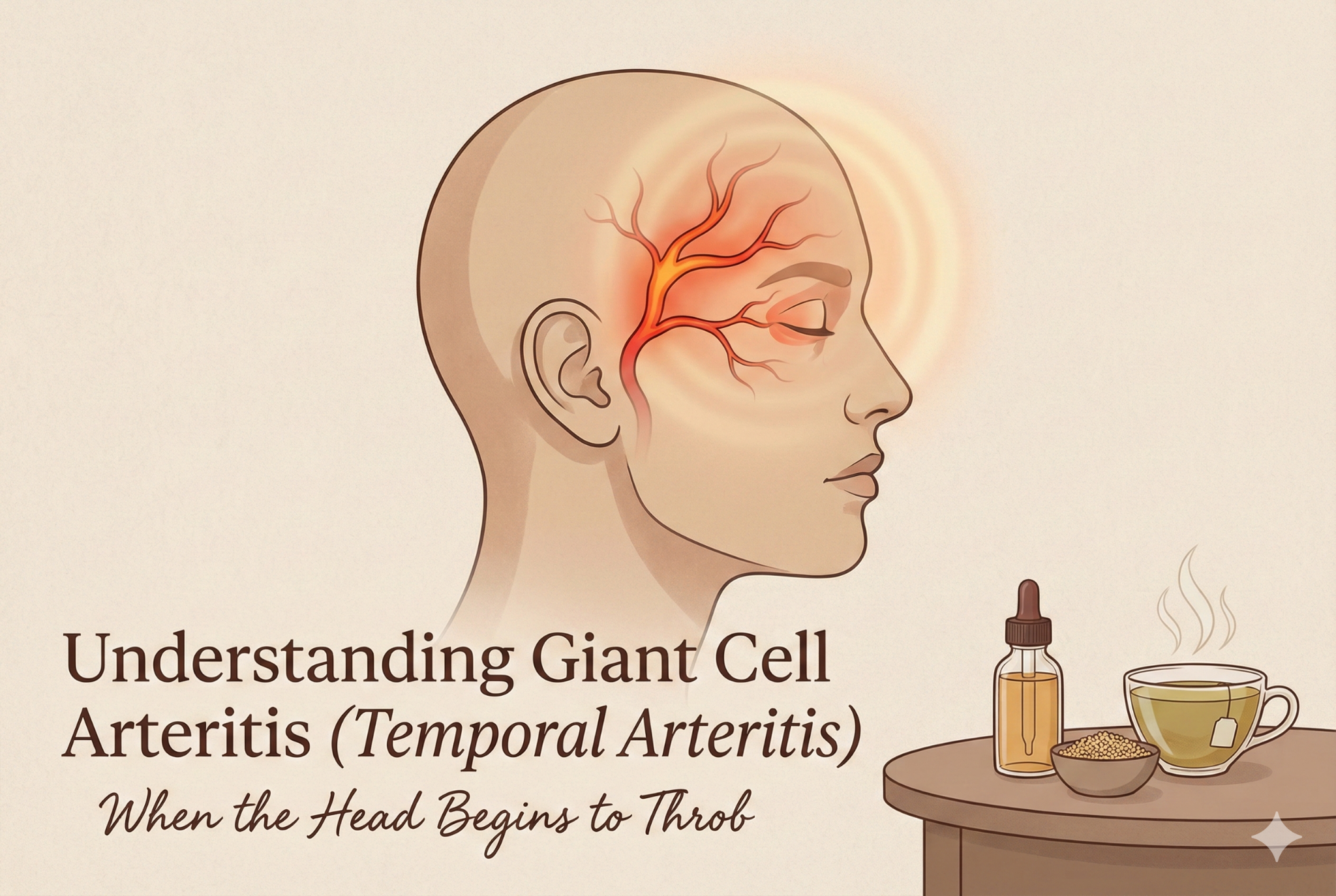
When the Head Begins to Throb: Understanding Giant Cell Arteritis (Temporal Arteritis)
Sometimes pain doesn’t come as a shout, but as a steady, pulsing ache that feels alive beneath the skin.
It creeps into the temples, behind the eyes, around the jaw — as if something deep within the vessels themselves is struggling to stay calm.
For many, this is how Giant Cell Arteritis, also known as Temporal Arteritis, first makes itself known — through a headache that carries both persistence and mystery.
It’s more than a headache, though. It’s the body’s immune system stirring against its own blood vessels — a quiet fire burning along the arteries that bring life to the head and eyes.
And when that fire flares, the body speaks — urgently, sometimes painfully — asking to be understood before harm is done.
What Is Giant Cell Arteritis?
Giant Cell Arteritis (GCA) is an inflammatory condition of the arteries, especially those near the temples.
The immune system, for reasons not entirely clear, begins to attack the walls of these blood vessels, causing them to swell and narrow.
When this happens, blood flow to the head and eyes can become reduced, leading to pain, tenderness, and in severe cases, vision problems.
It often affects people over the age of 50, more commonly women.
It’s a condition of both body and time — one that arrives later in life, when the body’s defenses sometimes grow restless, forgetting how to stay quiet.
How It Feels
GCA can start subtly — a dull pain over one temple, tiredness, or a heaviness in the head.
But over days or weeks, the pain deepens, becoming more insistent, more specific.
People often describe:
- Throbbing headache on one or both sides of the head
- Tenderness of the scalp or temples (even brushing hair can hurt)
- Jaw pain while chewing or talking
- Blurred or double vision, sometimes sudden loss of sight in one eye
- Fatigue, fever, or general unwellness
- Aching in shoulders or hips, especially if linked with polymyalgia rheumatica
It’s a pain that feels alive — rhythmic, pulsing, demanding attention.
And though invisible, it can be serious if ignored. Early recognition and care are vital to protect the eyes and the brain from complications.
What Causes It?
The exact cause remains uncertain. But like many autoimmune conditions, GCA is thought to arise from immune confusion — where the body mistakes its own tissues for invaders.
Instead of protecting, it begins to attack.
Possible triggers include:
- Age-related immune changes
- Genetic predisposition
- Viral or environmental stressors that awaken dormant inflammation
- Emotional or physical stress, which can alter immune balance
Holistically, this inflammation can be seen as the body’s way of expressing inner tension — an internal pressure that mirrors the tightening of life’s flow.
The arteries that once pulsed freely now struggle against their own constriction, asking for calm, for release.
Homeopathic and Holistic Approach: Quieting the Inner Fire
In homeopathy, Giant Cell Arteritis is viewed as more than an inflammation of arteries — it’s a deep disturbance in the body’s rhythm and flow.
The goal is to gently guide the immune system back into balance, reduce inflammation, and restore ease where tension has taken root.
Treatment is never one-size-fits-all. A homeopath listens deeply — to the nature of pain, the emotional tone, the way fatigue settles, the personality behind the symptoms.
Each remedy becomes a mirror, reflecting both the body’s struggle and its innate power to heal.
Commonly considered remedies include:
- Belladonna – for sudden, throbbing head pain with heat and redness in the temples.
- Glonoinum – for bursting, pounding headaches aggravated by the sun or heat.
- Bryonia Alba – for head pain that worsens with movement and improves with stillness.
- Gelsemium – for dull heaviness, weakness, and trembling with pressure in the head.
- Arsenicum Album – for deep restlessness, burning pain, and fatigue.
Remedies aim to calm the inflamed vessels, soothe nervous tension, and reestablish a quieter internal rhythm.
They do not replace medical management but can work alongside it — supporting recovery, easing discomfort, and restoring balance to the whole system.
(Always work with a trained homeopath for personalized guidance.)
Living with Awareness and Care
For those living with Giant Cell Arteritis, healing begins with listening — to the body’s cues, to the whispers before the ache returns.
- Rest often, especially when fatigue deepens.
- Stay well-hydrated to support blood flow and reduce inflammation.
- Nourish the body with gentle, anti-inflammatory foods — fruits, vegetables, omega-rich oils.
- Avoid extreme heat and stress, which may aggravate symptoms.
- Protect your eyes — any vision change, even brief, should be checked immediately.
- Work with both your doctor and homeopath — together they can create the safest, most balanced plan.
Healing from GCA isn’t only about reducing inflammation; it’s about restoring the body’s trust in its own flow — learning to let blood, breath, and energy move freely again.
Finding Calm Beyond the Pulse
Living with Giant Cell Arteritis can make one hyper-aware of the heartbeat — that steady throb in the temples, the rhythm that refuses to quiet.
But over time, as inflammation settles and the body learns stillness again, that pulse becomes something different — not a warning, but a reminder.
A reminder that you are alive.
That your body still speaks, still asks for care, still longs for peace.
Healing comes not from silencing the body, but from listening to it with tenderness — giving it rest, gentleness, and patience.
And in that listening, the throbbing quiets. The fire eases.
And the pulse, once painful, becomes once more what it was meant to be — a rhythm of life, steady and kind.


Leave a Reply