
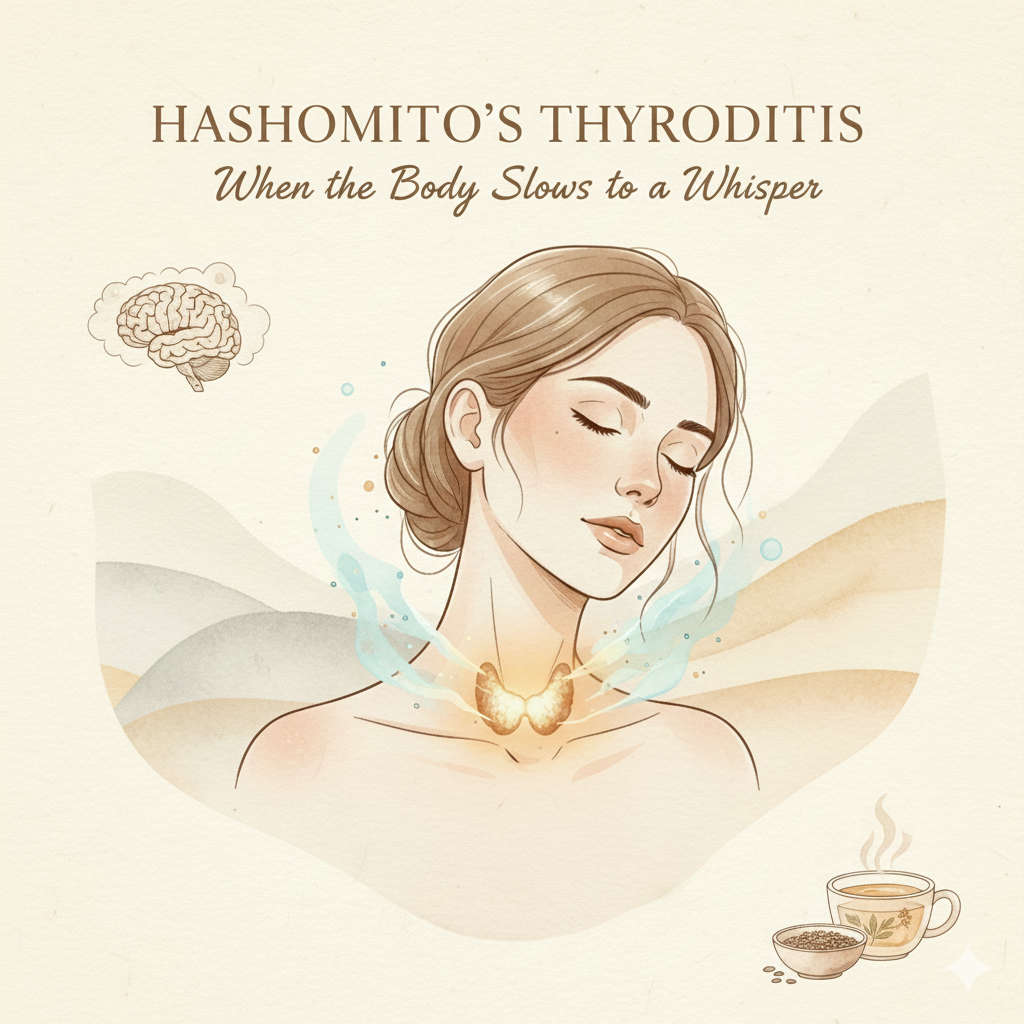
When the Body Slows to a Whisper: Understanding Hashimoto’s Thyroiditis
There are days when energy feels far away — when the body moves slower than the heart desires, when thoughts drift like mist, and warmth seems harder to hold.
For many, this gentle slowing is not simple tiredness, but a deeper imbalance — the body’s inner flame dimming under quiet inflammation.
This is the story of Hashimoto’s Thyroiditis — an illness that doesn’t shout, but softly changes the rhythm of life.
Understanding it helps transform frustration into compassion, and fatigue into an invitation to listen more closely to your body’s quiet messages.
So… What Exactly Is Hashimoto’s Thyroiditis?
The thyroid — a small, butterfly-shaped gland in the neck — governs energy, temperature, and vitality.
In Hashimoto’s Thyroiditis, the body’s immune system becomes confused and begins to attack this delicate gland, leading to inflammation and a gradual slowing of its function.
It’s not the body trying to harm you — it’s the body reacting to inner imbalance, exhaustion, or emotional strain.
It’s a call for restoration, not punishment.
How It Feels
Hashimoto’s unfolds slowly.
At first, it may be subtle — a bit more tiredness, mood changes, forgetfulness, or chill that lingers longer than before.
Then, gradually, the symptoms deepen.
People often describe:
- Fatigue that sleep doesn’t cure
- Sensitivity to cold
- Dry skin, brittle hair, or hair loss
- Weight gain despite little appetite
- Constipation or sluggish digestion
- Swelling or puffiness in the face
- Mood swings, sadness, or foggy thinking
But more than these physical shifts, there’s often an emotional undercurrent — a quiet sense of slowing not only in body, but in spirit.
It can feel as though life itself has become heavier to carry.
Why It Happens
From a homeopathic and holistic view, Hashimoto’s often emerges when the body has endured too much stimulation for too long — too much stress, overthinking, or unexpressed emotion.
The immune system, tired and confused, turns inward.
Possible influences include:
- Deep emotional strain or grief left unprocessed
- Overwork or long periods of nervous tension
- Nutritional depletion and imbalance
- Past infections or toxic load in the system
The thyroid, sensitive to emotion and energy, reflects the pace of one’s life.
When we live faster than we can breathe, it begins to whisper: slow down, please.
Homeopathic Understanding: Guiding the Body Back to Harmony
Homeopathy views Hashimoto’s not as an enemy, but as a messenger.
The inflammation is the body’s voice, asking for recalibration — for warmth, nourishment, and self-kindness.
A homeopath listens deeply to each person’s story — not just symptoms, but temperament, fears, desires, and life patterns.
Remedies are chosen to restore balance, calm the immune response, and rekindle the thyroid’s gentle flame.
Some remedies often considered include:
- Calcarea Carbonica – for exhaustion, chilliness, weight gain, and slow metabolism; often for those who feel overburdened or easily anxious.
- Sepia – for women feeling worn out, detached, or emotionally drained; better from movement or being outdoors.
- Lycopodium – for digestive sluggishness, bloating, and irritability with fatigue.
- Natrum Muriaticum – for emotional sensitivity, suppressed grief, and dryness in body and mood.
- Graphites – for dry skin, hair loss, and slow, sluggish energy with heaviness in mood.
(Always work with a trained homeopath for personalized guidance.)
The goal is not only to improve thyroid function, but to teach the immune system peace — to help the body remember its own balance and rhythm.
Nourishing Support for Body and Soul
Healing Hashimoto’s is not a quick race; it’s a slow return to warmth, patience, and presence.
Small daily choices make quiet miracles over time.
- Eat simply, warmly, lovingly. Cooked vegetables, soups, turmeric, ginger, sesame, and whole grains nurture thyroid energy.
- Avoid over-stimulation. Too much caffeine, sugar, or stress keeps the system inflamed.
- Rest as deeply as you work. The thyroid heals when the nervous system is soothed.
- Breathe with awareness. Slow breathing calms the heart and supports hormone balance.
- Protect your emotional warmth. Surround yourself with calm spaces, supportive people, and gentle routines.
Herbal companions like ashwagandha, holy basil, and rhodiola may help the body adapt to stress, while selenium, zinc, and vitamin D support immune calm.
A happy gut — supported by probiotics and natural fibers — steadies the immune system, too.
The Emotional Landscape
Hashimoto’s often carries emotional echoes — sadness, overwhelm, or the silent ache of feeling unseen.
When the thyroid slows, it can mirror an inner need to retreat, to rest, to recover from years of giving too much.
This is not weakness.
It is wisdom — the body choosing stillness as medicine.
Allow yourself to rest without guilt, to move at the rhythm your body requests.
Let tears, silence, and self-compassion become part of your healing practice.
Life After Awareness
With time, patience, and care, the fire of life returns — softer, steadier, more sustainable.
Energy rebuilds gently.
Mood lightens.
The immune system learns peace again.
Hashimoto’s becomes not a burden, but a teacher — reminding us that strength grows in slowness, that healing is found in listening.
Your body has not failed you.
It is asking for a slower song.
And when you answer with kindness, it begins to hum again — quietly, faithfully, beautifully


Leave a Reply