
When the heart grows tired, and the body asks for gentleness
A Soft Beginning
The heart is more than a muscle.
It is a rhythm,
a language,
a quiet drumbeat that has been with us since before birth.
Every emotion touches it —
joy quickens it,
grief slows it,
fear tightens it,
love opens it.
When heart disease begins to take shape,
it often arrives like a subtle change in this rhythm —
a feeling of heaviness in the chest,
a breath not as deep as before,
a tiredness that settles into daily life.
It is not always sudden.
Sometimes it is a slow whisper:
“I am working harder than you realize.”
And beneath that whisper lies a truth:
the heart, the silent companion of every step and thought,
is asking for care, tenderness, and understanding.
Understanding the Condition
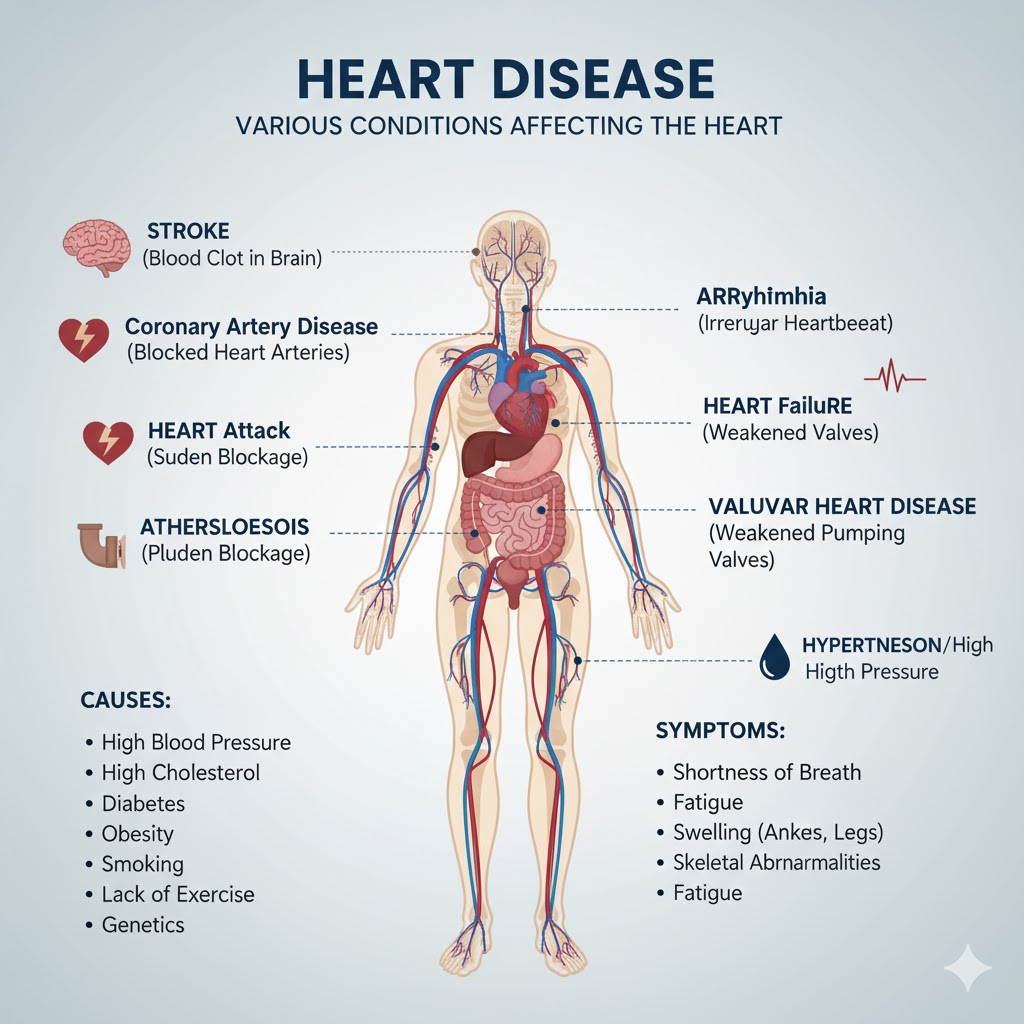
“Heart disease” is a broad term —
a family of conditions that affect how the heart beats, pumps, and nourishes the body.
It may involve:
- Blocked or narrowed arteries
- Weakened heart muscle
- Electrical rhythm disturbances
- Damaged or stiff heart valves
- Inflammation of the heart or its lining
But in all forms, heart disease reflects one thing:
the heart’s struggle to keep pace with the body’s needs.
This struggle does not happen suddenly.
It forms slowly, often shaped by years of stress, lifestyle, genetics, or chronic illness.
Yet the heart remains faithful —
pushing, compensating, working tirelessly
even as its burden grows heavier.
How It Feels
The experience of heart disease varies,
but it often expresses itself in gentle, body-wide signals:
Chest pressure or heaviness
Not always pain — sometimes a weight that lingers.
Shortness of breath
Climbing stairs, walking, or even speaking may feel harder.
Fatigue
A tiredness that feels deep, persistent, and unusual.
Palpitations
A flutter, a skip, a racing — the heart speaking its discomfort.
Swelling in legs or ankles
The body holding fluid it cannot circulate efficiently.
Dizziness or faintness
Moments when the heart struggles to deliver enough oxygen.
Feeling “not like oneself”
Emotionally heavy, anxious, or unsettled without a clear reason.
Heart disease affects not only the body,
but the spirit —
the sense of confidence, safety, and energy.
Why It Happens
Heart disease arises from many threads woven together:
- High blood pressure
- High cholesterol
- Smoking
- Diabetes
- Obesity
- Stress and emotional strain
- Aging
- Family history
- Autoimmune or inflammatory conditions
But it is important to remember:
Heart disease is rarely one person’s “fault.”
It is the result of life —
of genetics, stress, habits, and circumstances that shape the body over time.
The heart simply grows tired
from carrying more than it was designed to carry.
The Homeopathic Understanding
Supporting the heart’s rhythm at its deepest level
Homeopathy sees heart disease not only as a physical concern,
but as a disturbance of the body’s inner vitality —
often influenced by emotional strain, long-term stress, grief, or fear.
A homeopath listens carefully to the story behind the symptoms:
- When did the breath begin to shorten?
- Is there grief or worry held tightly inside?
- How does the chest discomfort feel — sharp, heavy, tight?
- What fears arise from palpitations?
- Does anxiety worsen the heartbeat?
- How does the person respond to stress, warmth, cold, rest?
Remedies are chosen to match the whole person —
their heart, their emotions, their constitution, their life story.
Commonly Considered Remedies
1. Crataegus Oxyacantha
Known as the “heart tonic” in homeopathy —
for weakness of heart muscle, fatigue, and gentle heart failure.
2. Digitalis
For slow, irregular, or overly sensitive heart rhythms
and fear that the heart may stop.
3. Aconitum Napellus
For sudden palpitations after shock, fright, or acute anxiety.
4. Cactus Grandiflorus
For chest tightness “as if the heart is gripped in a vice.”
5. Arsenicum Album
For restlessness, anxiety, breathlessness,
especially at night with fear of death.
6. Lachesis
For circulatory issues, fullness, heat,
and symptoms improving when speaking.
7. Aurum Metallicum
For deep sadness, perfectionism, heaviness of heart,
and pressure in the chest linked to emotional strain.
(Always consult a trained homeopath for safe, individualized treatment.)
Gentle Daily Care
Heart healing requires softness —
a kindness toward the self that modern life often forgets.
1. Move gently
Walking, stretching, slow breathing —
movement that strengthens without strain.
2. Nourish naturally
Warm meals, healthy fats, leafy greens, berries, whole grains —
foods that support circulation and reduce inflammation.
3. Protect emotional health
Stress and heartbreak affect the heart profoundly.
Counseling, meditation, prayer, quiet time —
all soothe the nervous system.
4. Sleep deeply
The heart recovers in silence.
5. Avoid stimulants
Caffeine, tobacco, and heavy foods place extra demand on the heart.
6. Listen to the body
Shortness of breath, chest discomfort, sudden fatigue —
all deserve attention, not dismissal.
7. Seek medical care when needed
Modern medicine and holistic care
can beautifully complement each other.
A Closing Reflection
The heart is a sacred organ —
the keeper of rhythm, energy, and emotion.
Heart disease does not mean the heart is weak.
It means the heart is tired.
It has carried more than its share of burdens,
often silently,
often without recognition.
Yet the heart remains resilient.
With care, nourishment, gentleness,
and the right support,
its rhythm can soften, strengthen, and heal.
This journey invites you to reconnect with your own pace,
your own breath,
your own life force.
To live more slowly.
More consciously.
More compassionately toward the self.
Your heart is not your enemy.
It is your companion —
asking, at last, to be heard.






Leave a Reply