
When the Body Mistakes Its Own Fragility
There are moments in the body’s quiet life when defense becomes confusion.
Moments when the immune system — our devoted guardian —
loses sight of what belongs to us.
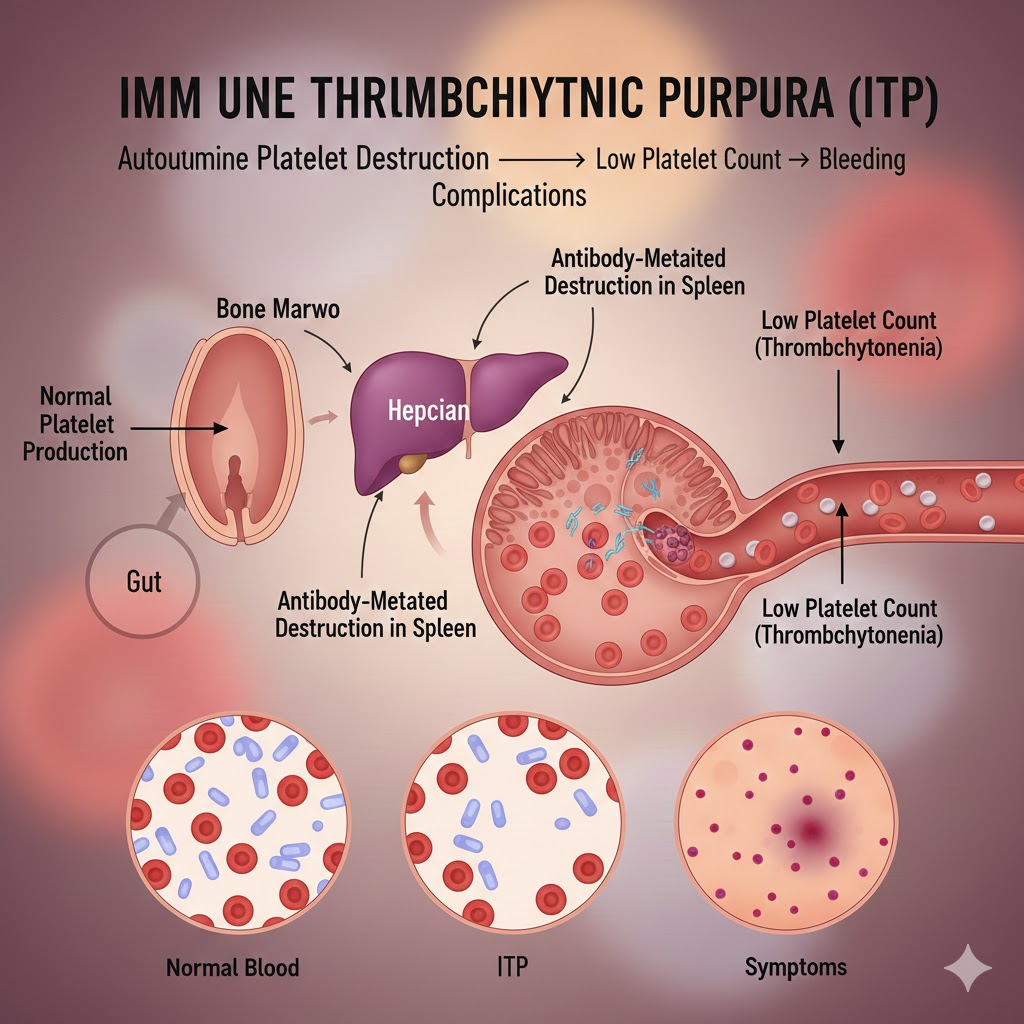
In Immune Thrombocytopenic Purpura, the body begins to break down its own platelets,
those tiny cells that seal our wounds,
stop our bleeding,
and knit together the delicate framework of protection.
This condition carries a softness,
a tendency toward easy bruising,
a whisper of vulnerability in the skin,
and an unspoken message that something within is feeling threatened —
even if the outside world appears calm.
It is not a loud illness.
It often begins quietly,
like a shifting rhythm in the blood
that only becomes visible when the body shows its marks:
purple patches,
gentle freckles of bleeding,
a bruise that blooms without cause.
Understanding the Condition
ITP is an autoimmune story.
It unfolds when the immune system —
meant to defend —
misidentifies platelets as intruders
and begins to destroy them.
This leads to a shortage of platelets,
not because the body cannot make them,
but because it cannot protect them.
The spleen,
which filters the blood,
becomes overzealous —
capturing and removing platelets as if performing a necessary duty,
while unknowingly deepening the imbalance.
This is the essence of ITP:
a miscommunication between protection and presence,
between the immune system and the blood it guards.
How It Feels
The body often speaks softly at first:
Unexplained bruises
Marks that seem to appear from nowhere —
a sign of fragile clotting.
Tiny red or purple spots (petechiae)
Like little ink drops beneath the skin,
small signals of capillaries leaking gently.
Bleeding that is harder to stop
Nosebleeds, gum bleeding, heavier menstrual flow.
Fatigue
Not always severe,
but a sense of being “worn thin,”
as though the body is quietly trying to catch up.
A feeling of fragility
Emotionally, ITP often brings a sense of tenderness —
as though the boundaries between inner and outer worlds
have become slightly more porous.
Some describe feeling more vulnerable,
more aware of their body’s limits,
more attentive to their own softness.
This emotional resonance is important.
It mirrors the physical theme of the condition:
a thinning of boundaries,
a misinterpretation of self.
Why It Happens
ITP can arise after:
- A viral infection
- A vaccination
- Pregnancy
- Stressful events
- Other autoimmune tendencies
- Or without a clear identifiable cause
In each case, the message is similar:
the immune system is reacting intensely,
perhaps from fatigue, confusion, or unresolved inflammation.
This is not a sign of the body turning against you;
it is a sign of a protective system that has lost clarity,
perhaps burdened by too many signals or prolonged strain.
The Homeopathic Perspective:
Restoring Inner Recognition**
Homeopathy views ITP as a disturbance in the vital force —
a moment where the inner intelligence cannot clearly distinguish
between self and not-self.
The journey is not just to raise platelet counts,
but to restore inner harmony,
to soften the immune system’s overreaction,
and to bring back a sense of internal recognition.
A homeopath listens for the emotional undercurrent:
- Is there suppressed grief?
- A long history of overresponsibility?
- A sense of not being protected?
- A fear of injury or vulnerability?
- A personality that gives too much and receives too little?
- Episodes worsened by stress or emotional strain?
These stories guide remedy selection.
Commonly Considered Remedies
Phosphorus
For individuals who bruise easily, bleed freely, and are open, gentle, sensitive, and emotionally porous.
China officinalis (Cinchona)
For weakness from blood loss, easy bruising, pallor, and deep sensitivity.
Crotalus horridus
For bleeding tendencies, widespread bruising, and a sense of internal disorganization.
Lachesis
For purplish discolorations, emotional intensity, talkativeness, and symptoms worse after sleep or with heat.
Arnica
For trauma — both physical and emotional — creating a tendency to bruise easily.
Carbo vegetabilis
For exhaustion, easy bleeding, and stagnation of circulation with coolness.
The remedy is chosen for the person, not the platelet count,
and it works gently to restore inner coherence.
(As always, individualized consultation with a qualified homeopath is essential — remedies must match the person, not just the diagnosis.
Daily Care and Gentle Self-Support
Healing ITP is a journey toward nourishment —
of immunity, blood, and emotional resilience.
Protect the body’s softness
Avoid unnecessary trauma, tight clothing, and harsh physical exertion.
Nourish with anti-inflammatory foods
Greens, berries, turmeric, ginger, warm soups, and grounding meals
help soothe immune overactivity.
Stay attentive to bleeding
Monitor bruising, gum bleeding, and menstrual changes.
Support the liver and spleen
Gentle herbs like milk thistle, dandelion root, and nettle leaf
can support detoxification and blood health when appropriate.
Honor emotional stress
ITP often flares with emotional strain.
Regular quiet time, breathing practices, soft walks, journaling,
and honest conversations with safe people
can help recalibrate the immune response.
Hydrate and rest
Two deeply simple but profoundly reparative acts.
A Closing Reflection
Immune Thrombocytopenic Purpura is not a story of the body betraying itself,
but of the body trying so hard to protect
that it loses clarity about what is truly self.
It is a condition that invites gentleness,
slowing down,
and re-centering.
With mindful care,
with support for both the physical and emotional landscape,
many individuals find balance again —
sometimes gradually, sometimes suddenly —
as if the immune system simply remembers
what it forgot for a while.
Healing begins when the body is reminded
that it is safe,
intact,
whole,
and deserving of its own protection.


Leave a Reply