
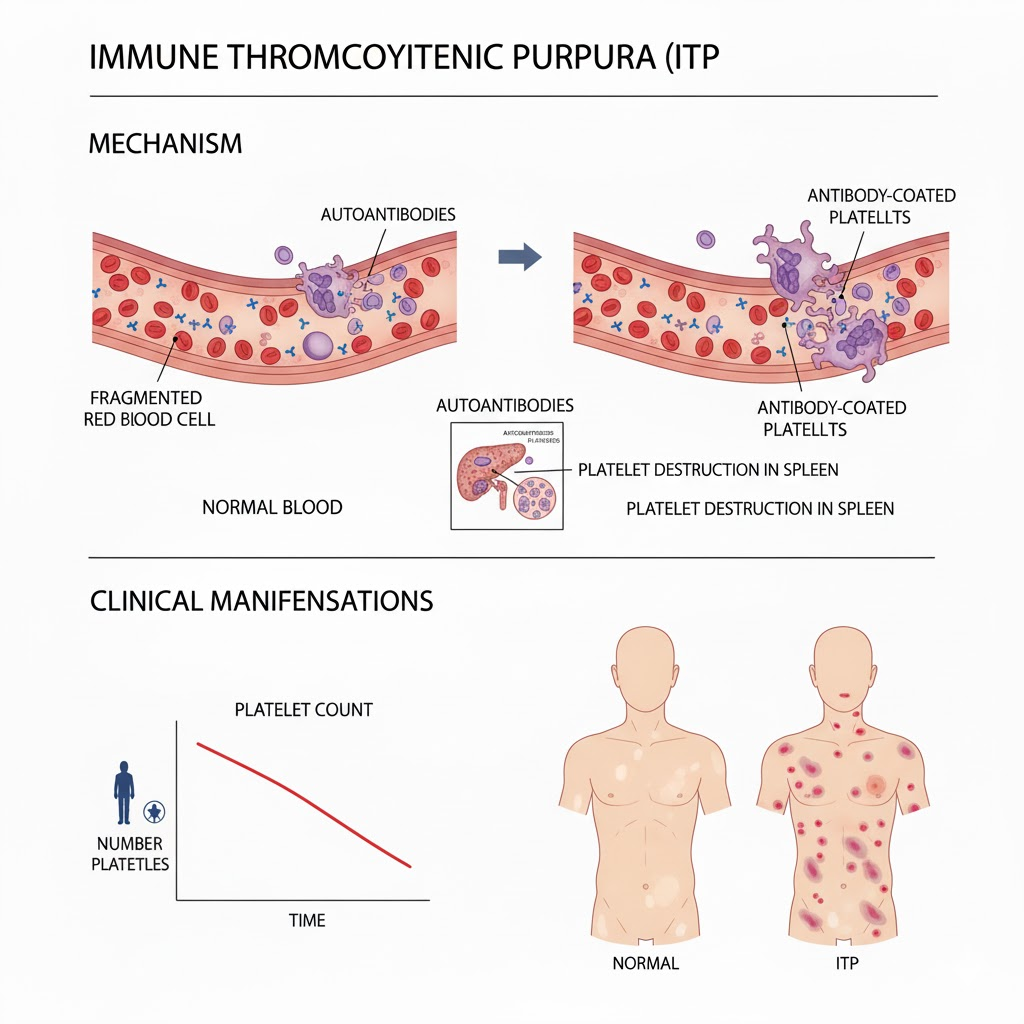
When the Body Forgets Its Own Harmony: A Homeopathic View of Immune Thrombocytopenic Purpura (ITP)
Sometimes the body begins to see its own as foreign — its own blood, its own rhythm, its own life.
In Immune Thrombocytopenic Purpura (ITP), this forgetting appears quietly, often through easy bruising, bleeding gums, or small red marks on the skin.
But beneath those physical signs lies something much deeper — a body that has turned its guard inward, a spirit worn from long-standing struggle, a system that no longer remembers what belongs to it and what does not.
Homeopathy looks at such conditions not as random mistakes, but as messages — the body’s way of saying that it has been at war for too long, that it needs to be reminded of peace.
When the Protector Turns Inward
The blood is the river of life — flowing warmth, movement, and vitality to every part of the body.
When that river is disturbed, something within has lost its balance between protection and trust.
In ITP, the body’s defense becomes confused; it begins to act against its own platelets, the tiny healers that stop bleeding and restore order after injury.
Homeopathy understands this confusion as more than biological.
It often begins in the emotional field — in those who have felt misunderstood, unsupported, or constantly pushed to stay strong despite exhaustion.
The inner protector, once gentle, becomes rigid and mistrustful.
The body begins to mirror this loss of faith — protecting too much, attacking its own peace.
The Homeopathic Perspective: Relearning Safety
The goal of homeopathy is not to suppress these reactions but to guide the body back to remembrance — to restore trust where fear has taken root.
Each remedy acts like a quiet teacher, reminding the body how to defend with wisdom instead of panic.
The homeopath listens to the whole person — their history, grief, fears, personality, and resilience.
Because ITP is not only a story of the blood — it is also a story of identity, self-worth, and fatigue.
Some remedies often considered in such cases include:
- Phosphorus – for open, sensitive souls who give too much of themselves and feel drained; they bleed easily and tire quickly.
- Arsenicum Album – for those who live with fear and restlessness, who feel they must control everything to stay safe.
- China Officinalis – for weakness following loss — whether of blood, love, or energy — and for those who feel faint or empty.
- Lachesis – for intensity that cannot be contained; for emotional or physical congestion that seeks release through pressure or bleeding.
- Natrum Muriaticum – for quiet sadness and suppressed emotion; for those who bleed within long before the body shows it.
(Always work with a trained homeopath for personalized guidance.)
Supporting the Healing Journey
True healing begins when the person feels seen, heard, and no longer needs to fight themselves.
Alongside homeopathic care, small acts of gentleness can support this return to balance:
- Rest when the body asks for it. Fatigue is not failure; it is guidance.
- Eat simply, avoiding excess stimulants that strain the system.
- Keep warmth close — both physical warmth and emotional comfort.
- Avoid worry and self-criticism; they tighten the inner flow.
- Spend time in stillness — calmness allows the body to breathe again.
Each day of quiet awareness teaches the body to trust its rhythm again.
Healing the Inner Conflict
Many who live with ITP carry a story of struggle — of being strong for too long, of holding pain that was never expressed.
In homeopathy, this emotional history is never ignored.
The condition reflects the deeper imbalance between self-protection and self-compassion.
When the right remedy touches this root, the shift is profound.
The body no longer fights itself. The blood, once fragile, grows steady and confident.
The mind softens. The person feels whole again — not in pieces, not in battle.
A Closing Reflection
The body’s wisdom is ancient. Even when it forgets, it longs to remember.
Immune Thrombocytopenic Purpura is not a curse — it is a call to pause, to listen, to heal the conflict between defense and surrender.
Through the gentle guidance of homeopathy, the body learns again what it always knew —
how to protect with peace,
how to hold without harm,
and how to let life flow freely once more.


Leave a Reply