
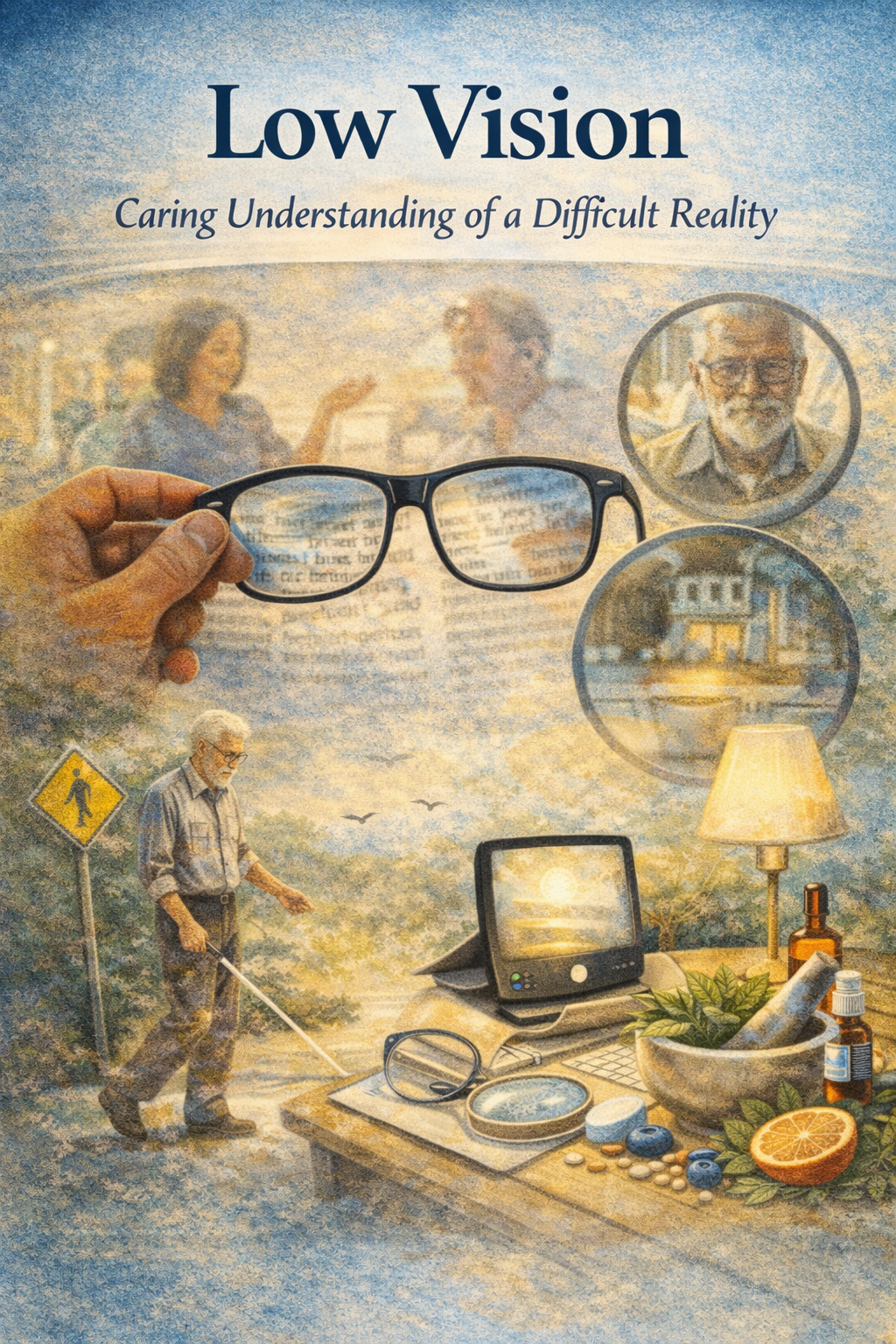
Clinical Understanding and Whole-Body Support
Low vision is a condition in which a person’s eyesight cannot be fully corrected with glasses, contact lenses, medication, or surgery. It is not total blindness, but it significantly affects daily life, making ordinary tasks like reading, recognizing faces, or moving safely a challenge.
Understanding low vision with care and empathy is as important as addressing the medical aspects.
What is low vision?
Low vision occurs when the eyes or visual pathways are damaged, resulting in reduced vision even after standard treatment. Causes include:
- Age-related macular degeneration (AMD)
- Diabetic retinopathy
- Glaucoma
- Cataract-related complications
- Inherited eye conditions
It can affect central vision (details), peripheral vision (movement awareness), or both.
How it feels
People with low vision often describe:
- Difficulty reading small print
- Trouble recognizing faces
- Needing more light to see
- Feeling unsafe in unfamiliar places
- Struggling with depth perception or mobility
Emotionally, this loss can feel isolating, frustrating, and sometimes frightening. Compassionate support is essential.
Homeopathic perspective
Homeopathy views low vision as a manifestation of systemic imbalance or constitutional weakness rather than merely an eye problem. The condition is approached by:
- Supporting the overall vitality and tissue health of the eyes
- Enhancing circulation and nourishment to the visual system
- Addressing constitutional tendencies that may contribute to progressive eye weakness
Homeopathy can complement medical care, especially in degenerative or chronic conditions, but it cannot replace essential ophthalmic evaluation or treatment.
Commonly considered homeopathic remedies
(For educational reference; individualized prescription is required)
- Phosphorus: For weakened vision with light sensitivity, retinal degeneration, or vascular fragility
- Calcarea carbonica: Often used in cases of slow degeneration, constitutional weakness, or metabolic sluggishness
- Natrum muriaticum: For progressive vision issues associated with fluid imbalance or chronic strain
- Gelsemium: For visual fatigue, headaches, and early signs of vision decline
Remedies are always chosen according to the child or adult’s overall constitution, not only based on the eye symptom.
Supportive care and lifestyle
- Optimize lighting and contrast for reading and tasks
- Magnification tools, large-print materials, or assistive technology
- Maintain blood sugar, blood pressure, and overall health
- Ensure a balanced diet rich in antioxidants, omega-3s, and nutrients supporting eye health
- Encourage eye exercises or relaxation techniques under guidance
A human-centered reflection
Low vision reminds us that sight is not only about clarity—it is about connection, independence, and safety. Supporting a person with low vision is about practical care, emotional reassurance, and holistic support.
Homeopathy can play a role in strengthening overall vitality and resilience, helping the individual navigate life with greater comfort and confidence.
If you wish, I can prepare a complete homeopathic guide for low vision, including remedies, daily routines, visual exercises, and nutritional guidance, written in a fully human-centered and compassionate style.


Leave a Reply