
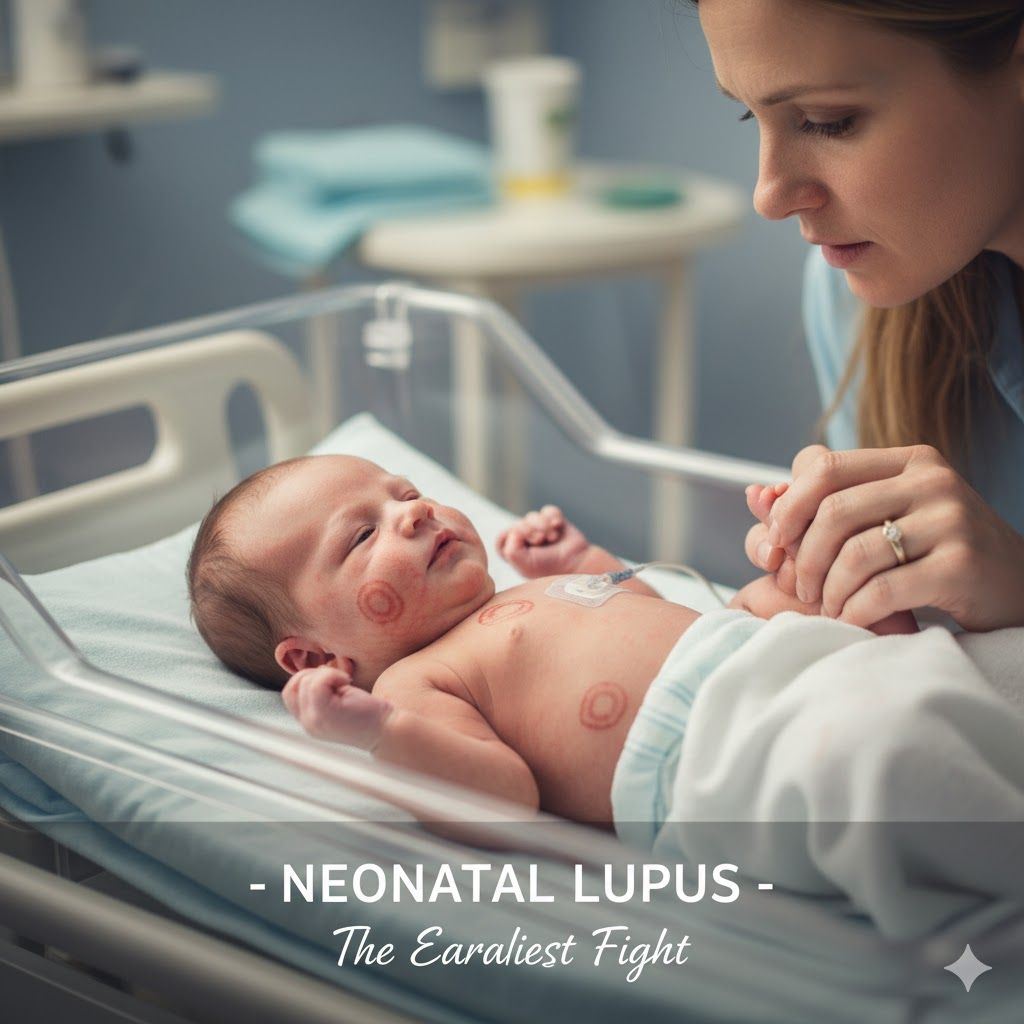
When Tiny Hearts Face Challenges: Understanding Neonatal Lupus
We all hope that the first days of a newborn’s life are soft and peaceful — filled with tiny fingers curling around ours, gentle sighs, and quiet wonder. Usually, those first days are about learning, bonding, and celebrating new life.
But for some families, the early days come with worry. A rash appears on delicate skin, a bruise shows up without explanation, or the baby seems unusually tired. For parents facing neonatal lupus, these are not minor concerns — they are daily realities that quietly shape every moment of early life.
Neonatal lupus is one of those conditions that hides behind ordinary signs — fatigue, rashes, or mild blood irregularities — until it begins to touch the rhythm of daily life.
So… What Exactly Is Neonatal Lupus?
A newborn’s body is learning how to protect and heal itself. In neonatal lupus, antibodies from the mother — sometimes without her knowing — cross the placenta and affect the baby’s skin, blood, or heart.
The body is not failing; it is simply reacting in ways that are unexpected and worrying. Often, the signs are temporary — a rash that fades, mild anemia that resolves — but sometimes the heart can be affected more seriously. The uncertainty weighs heavily on parents, making every heartbeat, every feeding, and every nap a point of constant attention.
How It Feels
Neonatal lupus does not announce itself suddenly. It creeps in quietly.
You might notice rashes appearing in sunlight, small bruises, or subtle tiredness. For the baby, these are temporary hurdles. For parents, each small symptom feels enormous. Sleep is restless, thoughts race, and moments of joy are often accompanied by worry. It is a quiet exhaustion, watching a tiny life face challenges you cannot fully control.
Some days feel manageable. Others feel like a step backward. The uncertainty, more than the symptoms themselves, can be deeply draining.
Why It Happens
Neonatal lupus occurs when maternal antibodies interact with the baby’s cells. It is not caused by anything a parent did or did not do. There is no fault, no shame, no blame. It is simply a body navigating a temporary imbalance, asking for careful attention, patience, and love.
Homeopathic Approach: Supporting the Baby’s Natural Resilience
Homeopathy views neonatal lupus not only as rashes or fatigue, but as a signal that the baby’s delicate system needs gentle support. Instead of suppressing symptoms, homeopathy focuses on calming the body, encouraging natural healing, and restoring balance.
A homeopath looks at the baby as a whole — body, energy, and emotional needs — to find remedies that match the unique experience. Remedies are not universal; they are chosen carefully to support gentle recovery.
Daily Care That Helps
- Handle the baby gently, creating soft, comforting routines.
- Protect sensitive skin from sunlight and friction.
- Observe changes calmly, noting patterns without panic.
- Seek emotional support as a parent, sharing fears and leaning on loved ones or professionals.
- Work alongside medical guidance while nurturing the baby’s natural resilience at home.
Healing happens gradually. Every tiny improvement — a fading rash, renewed energy, or a peaceful nap — is proof of the baby’s strength.
Life Beyond the Diagnosis
Receiving a neonatal lupus diagnosis can feel overwhelming. The future may seem uncertain, and your newborn may feel fragile.
But this condition does not define your child — it is only part of their story. Many babies recover beautifully with time, care, and support. Every small milestone is a victory. Every quiet moment of rest, every tiny smile, is proof that the body is learning to heal.
Neonatal lupus teaches patience, trust, and the power of presence. The baby is not broken. They are growing, healing, and finding their balance — and with gentle, compassionate care, so is the parent.






Leave a Reply