
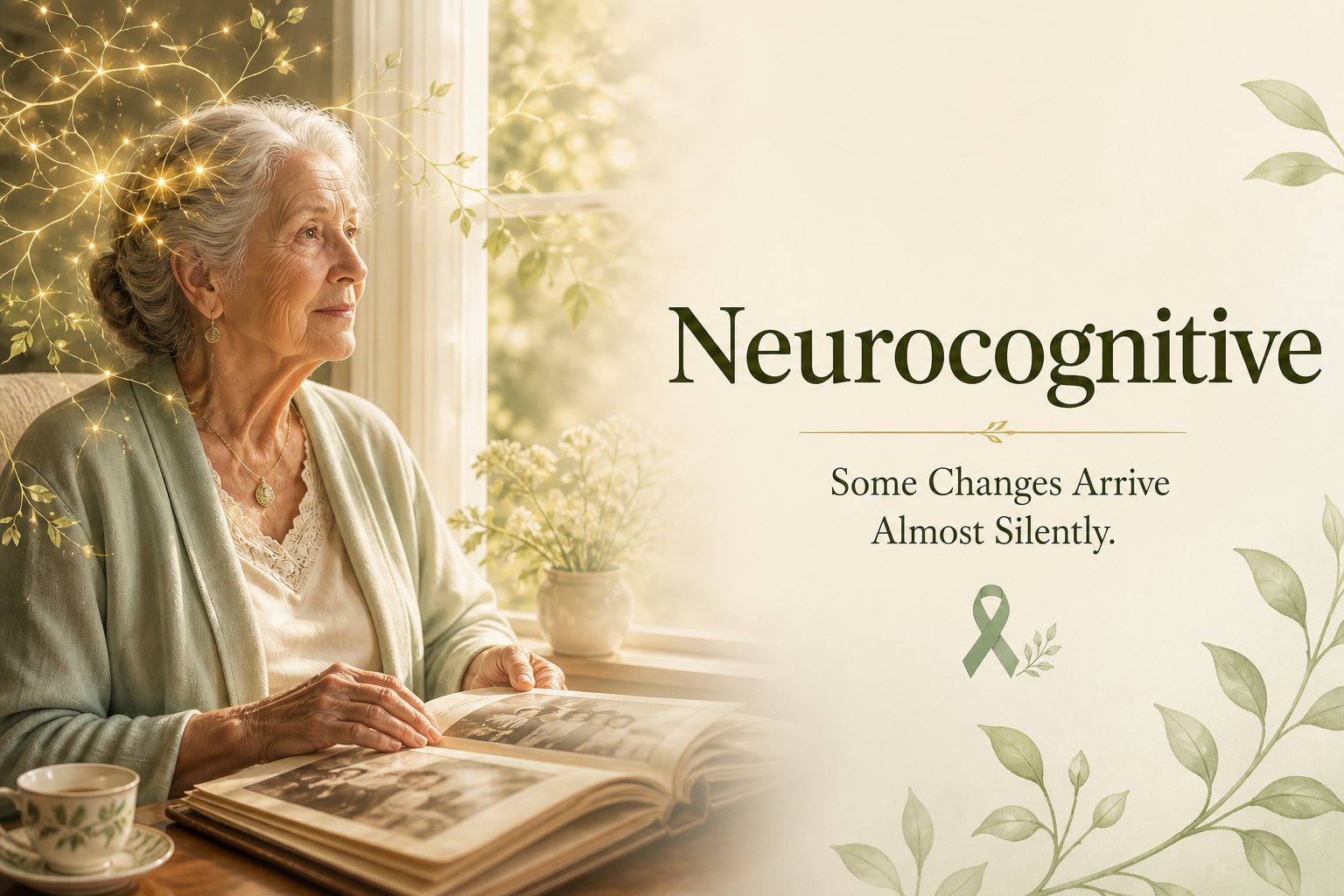
Some Changes Arrive Almost Silently.
Some changes arrive slowly, almost imperceptibly, until the world begins to feel unfamiliar.
Neurocognitive disorders are not a reflection of willpower, memory, or intelligence.
They are a sign that the nervous system, the brain, and the vital force are experiencing disruption — a gentle whisper that balance has shifted.
This is not weakness.
It is not a failure of character.
It is a human experience of the body and mind asking for care, patience, and understanding.
The mind may feel foggy.
Thoughts may slip through like water.
Moments may be forgotten, and routines may feel unfamiliar.
Understanding the Experience
Neurocognitive disorders involve a decline in cognitive functions such as memory, attention, reasoning, or problem-solving.
The outward signs — forgetfulness, confusion, difficulty completing tasks — may be noticeable.
The inner experience — frustration, anxiety, fear, or sadness — is often silent.
Those affected may feel a quiet grief for the mind they once knew.
This is natural.
It is the nervous system signaling that the brain’s pathways require support and compassion.
How It Feels
Living with a neurocognitive disorder can feel disorienting and exhausting.
There may be:
- Difficulty recalling recent events or names
- Confusion in familiar environments
- Trouble concentrating or making decisions
- Emotional sensitivity, irritability, or withdrawal
- Anxiety about memory loss or changes in thinking
Each day may feel unpredictable.
Moments of clarity may be followed by uncertainty.
Yet within this challenge, there can also be a gentle awareness, a patient recognition of life as it unfolds.
Why It Happens
From a homeopathic perspective, neurocognitive disorders reflect a disturbance in the vital force — the inner energy that maintains physical, emotional, and mental balance.
They may develop from:
- Aging and natural changes in brain function
- Past illness, injury, or trauma
- Chronic stress or emotional strain
- Nutritional deficiencies or physical depletion
- Genetic or constitutional predispositions
The brain’s slowing is not a failure.
It is a signal that care, nourishment, and gentle support are required.
The Homeopathic Understanding: Supporting the Mind
Homeopathy approaches neurocognitive disorders with respect and empathy.
The goal is not to reverse every change instantly, but to strengthen the vital force so memory, attention, and reasoning can function as fully as possible.
A homeopath may consider remedies such as:
- Baryta Carbonica – for mental slowing, forgetfulness, and hesitation
- Lycopodium Clavatum – for low confidence, mental fatigue, and forgetfulness
- Anacardium Orientale – for confusion, memory lapses, and inner frustration
- Nux Vomica – for mental strain, irritability, and overwork
- Gelsemium – for mental fatigue, tremulousness, or anxiety accompanying cognitive changes
Each remedy is chosen individually, addressing the person’s mind, emotions, and constitution.
Gentle Daily Support
Living with neurocognitive disorders requires patience and compassion.
Rest and nourishment support the brain and body.
Gentle mental exercises, creative activities, and calm routines stimulate cognition without pressure.
Connection with loved ones, social interaction, and emotional expression nourish the mind and spirit.
Avoid frustration or judgment.
Each step, each memory retained, each moment of clarity, is progress.
Living Beyond the Diagnosis
Neurocognitive disorders do not define the person.
They are a sign that the brain and nervous system need care, not a measure of value.
With homeopathic support, patience, and compassionate routines, cognitive function can be strengthened.
Moments of clarity, connection, and joy can still flourish.
The mind and spirit remain alive, capable of learning, feeling, and experiencing life fully.
Healing is not about rushing or forcing recovery.
It is about honoring the nervous system, nurturing the brain, and allowing life to continue with dignity, care, and humanity.
Beneath the challenge is a human being — capable of wisdom, love, and presence.
With support and patience, that life can be fully embraced.






Leave a Reply