
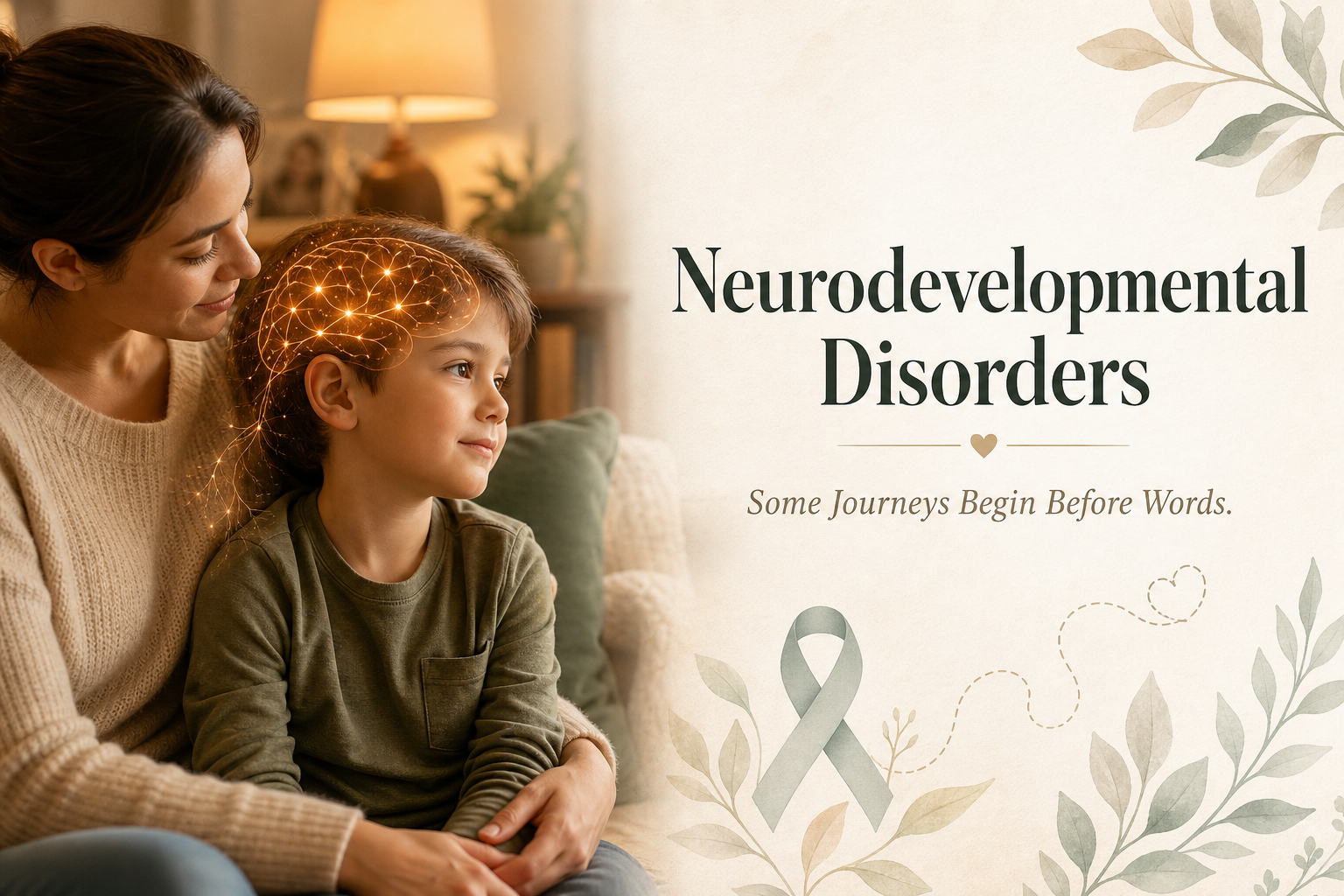
Living with Neurodevelopmental Disorders
Some journeys begin long before words can describe them.
They unfold in early childhood, sometimes even before birth, shaping how a person thinks, feels, learns, and connects with the world.
Neurodevelopmental disorders often arrive this way — quietly, gradually, noticed first in small differences rather than clear signs.
A child who does not meet milestones as expected.
Speech that comes late, or not at all.
Movements that seem awkward or repetitive.
Emotions that feel intense, unpredictable, or hard to regulate.
For parents and caregivers, these moments can bring confusion, worry, and a deep ache of not knowing what lies ahead.
Yet this is not a story of failure.
It is a story of difference — and of learning to listen more deeply.
Understanding the Experience
Neurodevelopmental disorders affect how the brain grows and organizes itself.
They influence communication, behavior, learning, attention, and social interaction.
Each child experiences this differently.
No two journeys are the same.
From a homeopathic perspective, these conditions reflect the child’s unique constitutional makeup — the way their nervous system, emotions, and vitality interact with the world.
It is not about something “missing” or “broken.”
It is about a nervous system that functions in its own rhythm, asking for understanding and gentle support.
How It Feels
Living with a neurodevelopmental disorder — or caring for someone who does — carries a particular emotional weight.
For the child, there may be frustration at not being understood, sensitivity to noise or touch, difficulty expressing needs, or overwhelming emotions that spill out unexpectedly.
For parents and families, there may be exhaustion, worry, grief for imagined futures, and fierce love all at once.
Some days feel hopeful.
Some days feel heavy.
Often, there is a quiet strength growing beneath it all — a resilience built through patience, repetition, and unconditional care.
Why It Happens
Homeopathy understands neurodevelopmental disorders as arising from complex layers — inherited tendencies, early developmental influences, emotional environment, and the child’s innate sensitivity.
The nervous system may be overstimulated, under-responsive, or easily overwhelmed.
This is not about blame.
It is not about something done wrong.
It is about recognizing that the child’s system is responding to life in the only way it knows how.
The Homeopathic Understanding: Honoring the Child’s Rhythm
Homeopathy does not aim to change who a child is.
It seeks to support the child’s vital force — the inner intelligence that governs growth, learning, and emotional balance.
Remedies are chosen with great care, based on the child’s behavior, sensitivities, fears, sleep, digestion, emotional expression, and overall temperament.
The goal is not suppression.
It is support — helping the nervous system feel safer, calmer, and more organized.
Some remedies a trained homeopath may consider include:
- Calcarea Carbonica – for children who are slow to develop, sensitive, easily fatigued, or overwhelmed.
- Baryta Carbonica – for delayed speech, shyness, and developmental immaturity.
- Tuberculinum – for restlessness, strong emotions, and sensitivity to change.
- Stramonium – when fear, agitation, or intense reactions dominate.
- Carcinosin – for highly sensitive children who feel deeply and try hard to please.
Each remedy is selected individually, honoring the child’s unique nature and needs.
Gentle Daily Care
Supporting a child with neurodevelopmental differences requires patience and steadiness.
Create predictable routines that offer safety and structure.
Allow space for rest and quiet.
Limit overstimulation when possible.
Offer nourishment — not only through food, but through presence, touch, and calm attention.
Progress may be slow and uneven.
Every small step matters.
Every moment of connection counts.
Living with Compassion and Hope
Neurodevelopmental disorders invite a different understanding of growth and success.
They teach us to measure progress not by comparison, but by presence.
Not by speed, but by sincerity.
A child is not defined by diagnosis or delay.
They are defined by their essence — their curiosity, their sensitivity, their way of being in the world.
Healing is not about making a child fit a mold.
It is about supporting them as they unfold — gently, patiently, and with deep respect for who they are.
This journey asks for love that listens, care that adapts, and hope that grows quietly — deeply human, and profoundly meaningful.


Leave a Reply