
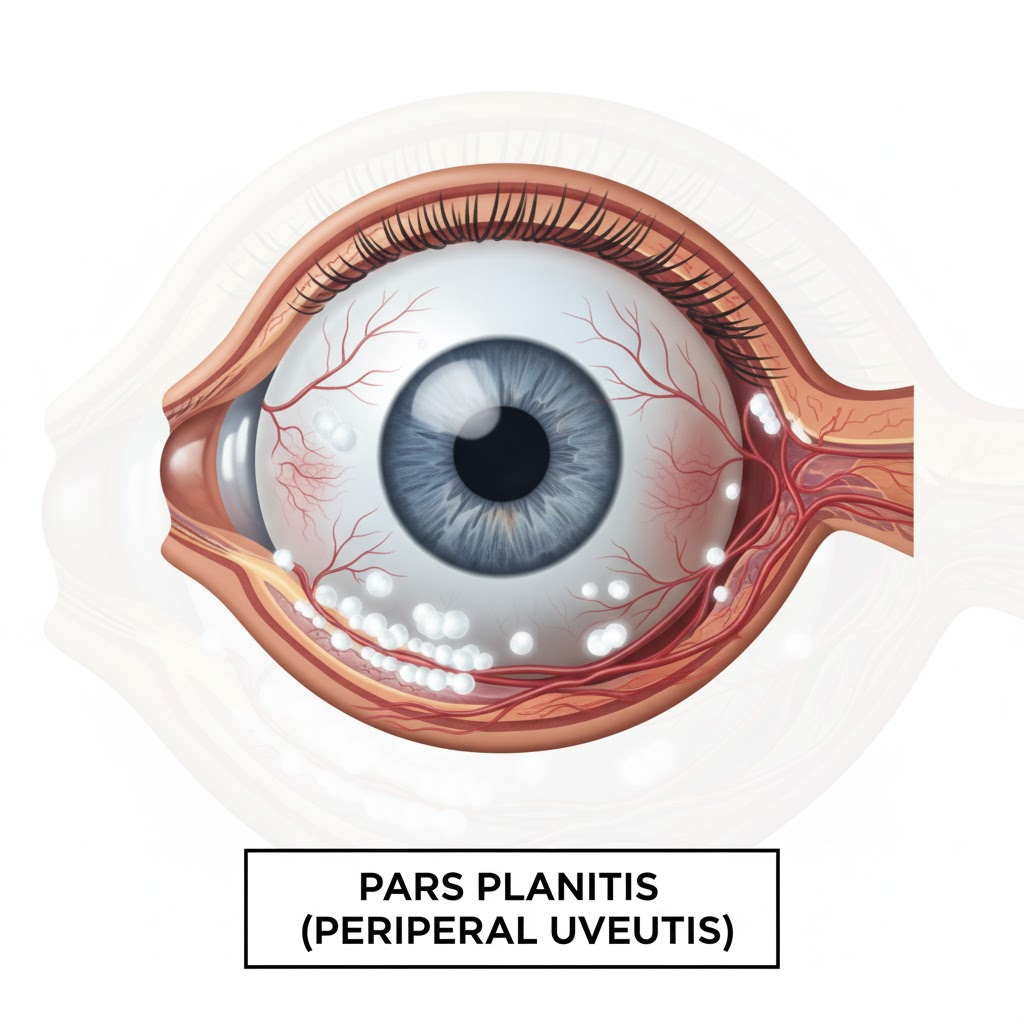
When the Eye Hums with Silence: Understanding Pars Planitis
Some illnesses speak loudly — fever, pain, sudden swelling. Others whisper, slowly reshaping life in ways that are subtle yet profound.
Pars Planitis is one of these quiet conditions. Also called peripheral uveitis, it is an inflammation of the eye’s delicate structures that can creep in gently, often unnoticed until it affects vision.
It may begin with blurry patches in your sight, floaters drifting across your vision, or occasional discomfort.
You might dismiss it as tired eyes, stress, or age catching up. But gradually, the eye signals that something deeper is happening — the body’s own defenses are quietly inflaming the tissue meant to let you see the world clearly.
Though it is often slow-moving, its impact is felt deeply — in the eyes, yes, but also in the heart, mind, and daily life.
What Is Pars Planitis?
Pars Planitis is a type of uveitis that affects the peripheral part of the retina, the part of the eye responsible for side vision.
Here, inflammation occurs without an obvious infection or external trigger — it is the immune system, quietly overactive, affecting the eye’s own tissues.
It is not contagious. It is not your fault.
It is the body quietly miscommunicating, where the protective forces meant to heal instead create irritation.
How It Feels
Pars Planitis can feel like a subtle cloud passing over your world:
- Floaters drifting across your vision like tiny shadows.
- Blurred or dim vision, sometimes only in one eye.
- Occasional eye discomfort, sensitivity to light, or mild pain.
- The emotional ripple: anxiety over changing vision, fear of the unknown, and the quiet weight of relying on doctors and treatments to protect what feels fragile.
It can be isolating because it is invisible to others, yet ever-present for you. Yet, even here, people find resilience — a new attentiveness to their sight, their inner pace, and the quiet signals of their body.
Why It Happens
The exact cause of Pars Planitis is not fully understood, but it is often linked to the immune system:
- The body’s defenses may mistakenly attack the eye’s own tissues.
- It may appear on its own, or alongside other autoimmune conditions.
The inflammation is not punishment or failure; it is a signal that the eye needs care, protection, and gentle support.
The Homeopathic Understanding: Supporting the Eye’s Inner Balance
Homeopathy sees Pars Planitis not only as a structural inflammation but as a deeper disharmony of the body’s vital rhythm.
The goal is to restore subtle communication, helping the body remember its own capacity to calm, repair, and protect.
Some remedies often considered include:
- Ruta Graveolens – for eye strain, inflammation, and fatigue of the eye muscles.
- Phosphorus – for sensitivity to light, blurred vision, and nervousness around sight.
- Euphrasia Officinalis – for watery, irritated eyes and discomfort from inflammation.
- Belladonna – for sudden eye pain, redness, and throbbing sensitivity.
Each remedy gently works to support the body’s own rhythm of repair and clarity. (Always consult a qualified homeopath for individualized guidance.)
Gentle Daily Care
- Protect your eyes – sunglasses in bright light, avoiding excessive screen time, and rest when vision feels strained.
- Nourish your body – vitamins A, C, and omega-3s support eye health; hydration keeps tissues soft and resilient.
- Reduce stress – emotional calm can help modulate immune activity.
- Follow up carefully – regular ophthalmologist visits ensure early detection of changes; homeopathy can complement, not replace, medical oversight.
Healing is not rushing. It is moving with patience, presence, and gentle support for the eyes that see your world.
Life Beyond the Diagnosis
Living with Pars Planitis invites presence in every glance:
- Noticing the light that filters through leaves, the subtle movements at the edge of your vision.
- Finding calm in routines, trust in treatment, and gratitude for what the eyes can still capture.
- Learning resilience in patience, compassion for your body, and acceptance of imperfection.
The eye is a mirror of the body’s whispers. Even when inflamed, it is still working, still protecting, still trying.
Every moment of clear vision, every day of gentle care, is proof that healing is possible.
You are not simply enduring Pars Planitis — you are learning to see life with quiet mindfulness, tender awareness, and profound human resilience.


Leave a Reply