
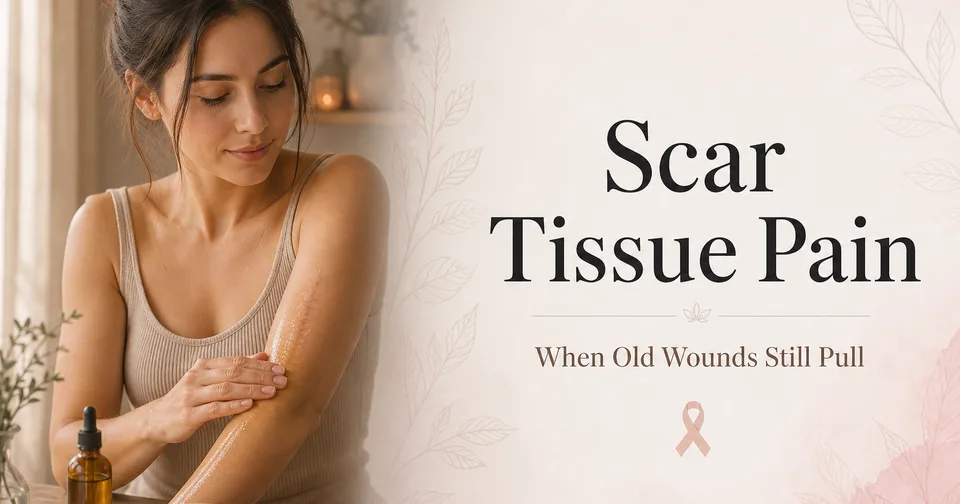
WHEN THE MEND PULLS AT MEMORY
Scars are proof of repair—and sometimes they ache, tug, itch, or tighten long after the calendar says “healed.” Scar tissue pain after trauma or surgery can feel like a rope under the skin, a weather vane, or a hypersensitive stripe that flares when clothing brushes past. Movement may catch at adhesions; emotions may rise when the mark is touched or seen.
This exploration keeps medical review available for unusual scar behaviour and presents homeopathy as complementary support for the person’s experience—not a promise to erase scars or cure pain.
Understanding the Condition
Normal scars mature over months, often becoming softer and less pink. Concerning signs include rapidly expanding keloid growth with functional limit, signs of infection, wound reopening, severe restriction of joint motion, or neuropathic burning that suggests nerve entrapment—seek clinical assessment.
Physiotherapy techniques, silicone strategies, and medical treatments exist for problematic scars; choice depends on scar type and location. Self-aggressive deep tissue digging can worsen irritation.
In Canada, timely medical evaluation remains essential when red-flag signs appear: severe or rapidly worsening pain, numbness or weakness, loss of bowel or bladder control, chest pain or breathing difficulty, signs of infection, unexplained swelling that spreads, deformity, inability to bear weight, or any sudden neurological change. Homeopathy may be considered only as complementary, individualized supportive care alongside diagnosis, emergency assessment, imaging, physiotherapy, or other treatments recommended by a qualified physician. It is not a substitute for standard medical care and is not described here as a cure.
People living with scar tissue pain often notice patterns such as:
- Pulling sensations when the scar crosses a moving joint…
- Itch or burn along the scar line in heat or stress…
- Sensitivity that makes seatbelts or waistbands intolerable…
- Emotional activation when looking at or touching the mark…
Holding both the tissue story and the person’s whole context helps care feel more precise and more humane.
How It Feels — The Human Experience
Scar tissue pain is physical and symbolic. People may hide marks, avoid pools, or feel their body tells a story they did not choose to publish. Partners’ curiosity can feel invasive. Progress is slow, measured in softness and tolerance rather than dramatic overnight change.
Common human experiences include:
- Self-consciousness in changing rooms or intimacy…
- Irritation when weather seems to “talk” through the scar…
- Fear that adhesions will permanently limit sport or work…
- Frustration with advice to “just massage it harder”…
- Quiet satisfaction when clothing stops catching…
Loved ones can help by listening without minimizing, offering practical support with daily tasks, and respecting the injured person’s pace. Recovery is not only about tissues knitting; it is also about restoring trust in movement.
The Homeopathic Understanding — Supporting the Vital Force
Homeopathy regards scar-related discomfort through the vital force’s language: sensation quality, modalities, and the person’s broader constitution and emotional response to the injury story.
In supportive care for scar tissue pain, a homeopath may explore:
- Burning, stitching, numb, or tight-pulling sensations
- Worse from touch, cold, heat, or emotional recall of trauma
- Itching that worsens at night
- Associated joint stiffness near the scar
- Mood themes—grief, anger, or vulnerability about the mark
Two people with the same injury label may receive different remedies because their lived picture differs. The intention is gentle support of the vital force’s ordering intelligence—never force, never one-size-fits-all prescribing, and never a claim to cure conditions that require ongoing medical management.
Commonly Considered Remedies
The following remedies are sometimes considered in homeopathic practice when the symptom picture matches. This list is educational and not a prescription:
- Graphites — traditionally discussed in some scar and skin-sensitivity pictures—strictly individualized.
- Silicea — sometimes considered when scars feel troublesome in certain constitutional patterns.
- Hypericum perforatum — explored when nerve-like pains run along or from scarred areas.
- Staphysagria — occasionally matched when incision scars remain exquisitely sore to touch.
- Thiosinaminum — historically mentioned in some adhesive scar discussions—professional guidance essential; not a cure claim.
(All remedies must be individualized by a qualified homeopath. Self-prescribing for chronic or serious concerns is not advised. Continue any medically necessary care unless your physician advises otherwise. Homeopathy in Canada is complementary supportive care and is not presented here as a cure.)
Gentle Daily Care
Gentle daily care for scars emphasizes hydration of skin as advised, sun protection, and mobility that encourages glide without aggression.
- Follow clinician guidance on when massage or silicone products are appropriate…
- Moisturize mature scars if recommended; protect from sun to reduce irritation…
- Keep neighbouring joints moving through full comfortable range…
- Choose soft clothing seams away from hypersensitive lines…
- Address sleep positions that stretch or compress the scar uncomfortably…
Any home program should follow clinician guidance, especially after fracture, surgery, nerve injury, burns, or complex regional patterns.
A Closing Reflection
Scar tissue pain reminds us that healing reorganizes tissue—it does not always restore the original map. Medical options exist for problematic scars; patience and gentle care serve many others; complementary homeopathy may support the individual sensory story. The mark can become quieter company.


Leave a Reply