
When the Blood Learns to Bend Under Burden
There are times in the body’s long journey when the very shape of life — the red blood cell — begins to change.
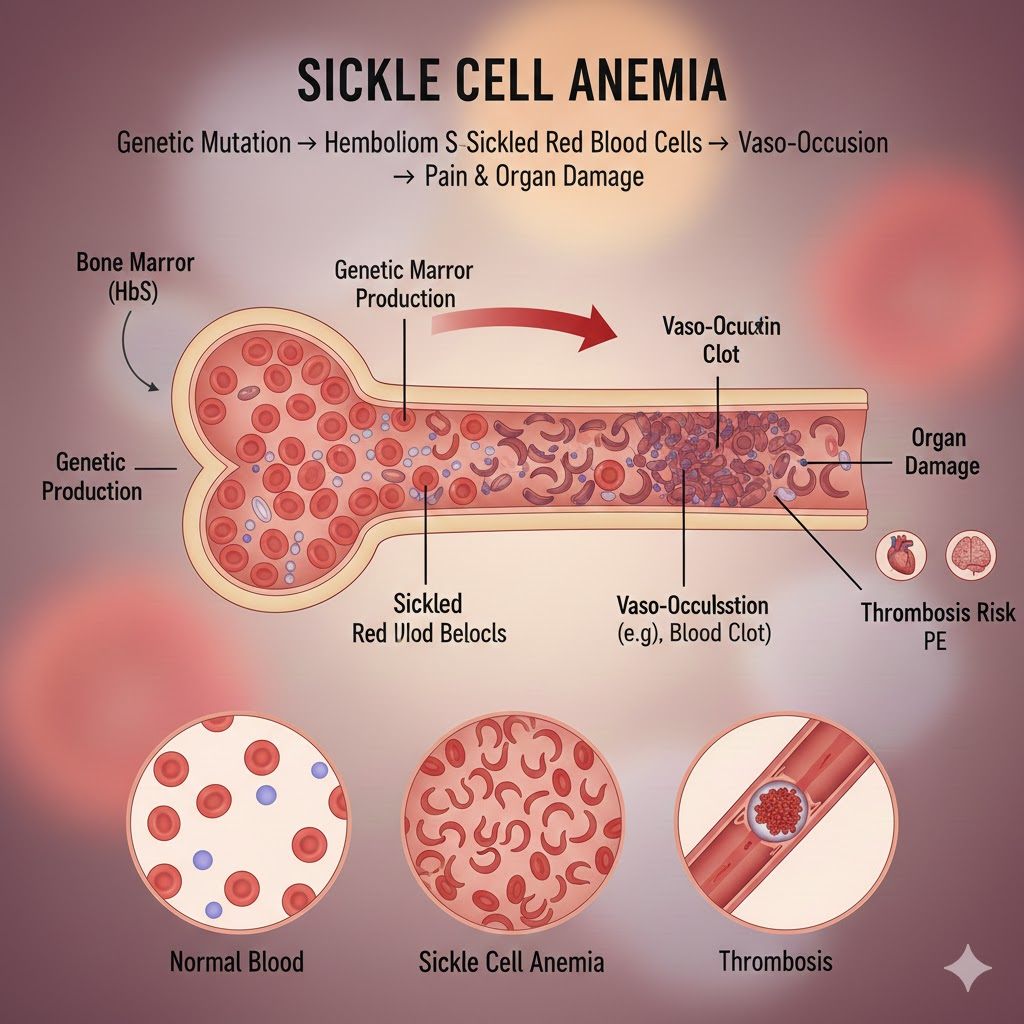
Sickle Cell Anemia is one of those conditions where the blood reshapes itself in response to a genetic inheritance, forming not the soft, round discs meant to glide smoothly through the veins, but curved, rigid “sickle-shaped” cells that struggle to move with ease.
It is a condition written into one’s blood from birth, yet it reveals itself over time — through pain, fatigue, and moments when the body feels caught between strength and fragility.
It is not a failure of the body.
It is a story of endurance, resilience, and an ancient genetic adaptation trying to protect against malaria, yet creating its own challenges.
Understanding the Condition
Sickle Cell Anemia is a genetic hemoglobin disorder.
A mutation in the gene for hemoglobin (HbS) causes red blood cells to change shape when stressed, dehydrated, or deprived of oxygen.
Instead of staying soft, flexible, and round, these cells become:
- curved
- stiff
- fragile
- prone to breaking
These sickle-shaped cells:
- clog small blood vessels
- block oxygen flow
- break apart faster than they are made
- trigger intense pain crises
- leave the body chronically anemic
This is not a condition you “catch” — it is inherited, carried in the blueprint of life.
How It Feels
The experience of Sickle Cell Anemia is often described in waves — periods of calm stability followed by sudden storms.
Pain Crises
Sharp, deep, pulsating pain in the bones, joints, chest, or abdomen —
pain that arrives suddenly, often without warning,
pain born from tiny vessels blocked by sickled cells.
Chronic Fatigue
A tiredness that sits inside the bones —
not from lack of sleep, but from the body constantly working to replace broken red cells.
Breathlessness
Moments when even gentle activity feels heavy.
Jaundice
A golden-yellow tint to the eyes or skin as red cells break down rapidly.
Delayed Healing & Vulnerability to Infection
Because the spleen becomes overworked and damaged.
Emotional Weight
Living with a chronic genetic condition carries its own quiet burden:
the unpredictability, the pain, the longing for ease, the resilience built over years.
Sickle Cell is not only a physical journey —
it touches the heart, emotions, identity, and daily life in deep ways.
Why It Happens
At the heart of Sickle Cell Anemia is the hemoglobin S mutation.
When oxygen levels drop — during dehydration, stress, infection, cold, or exertion —
the hemoglobin molecules inside red blood cells stick together, bending the cell into a stiff sickle shape.
This leads to:
- Blockages in tiny vessels
- Severe pain
- Tissue damage
- Chronic anemia
- Organ strain
- Increased risk of infection
The body is constantly trying to repair, renew, and breathe despite the challenges.
The Homeopathic View: Strengthening the Vital Force
Homeopathy approaches Sickle Cell by supporting:
- resilience
- circulation
- oxygenation
- pain relief
- emotional steadiness
- the body’s inner vitality
It cannot change the genetic code,
but it can support the individual, soften crises, and improve vitality.
A homeopath listens deeply:
- How often do crises occur?
- What triggers them?
- What emotions accompany the pain?
- How does the person cope with fatigue?
- What sensations, fears, and patterns shape their journey?
From this whole-person understanding, remedies are chosen.
Phosphorus
For individuals who feel warm, sensitive, exhausted, easily depleted, craving cold drinks, with deep weakness.
Arsenicum Album
For restlessness, anxiety, burning pains, and exhaustion relieved by warmth.
Carbo Vegetabilis
For extreme fatigue, breathlessness, and the feeling of “not enough air.”
Ferrum Phosphoricum
For chronic anemia with paleness, easy tiredness, and low-grade inflammation.
China Officinalis
For profound weakness after crises, fluid loss, or prolonged fatigue.
Natrum Mur
For emotional sensitivity, suppressed grief, and fatigue worsened by heat.
Medorrhinum
For chronic tendencies, deep-seated inherited conditions, and individuals who feel “pressed by fate.”
(Always consult a qualified homeopath; remedies must match the person, not just the diagnosis.)
Gentle Daily Care
Living with Sickle Cell requires tenderness —
a steady honoring of the body’s needs.
Hydration is Life
Frequent, warm or room-temperature fluids help prevent sickling.
Avoid Extreme Temperatures
Cold can trigger sickling; heat can dehydrate.
Rest Deeply
Fatigue is not weakness —
it is the body doing its best with limited red cells.
Nutritious Foods
Gently supportive meals: greens, beets, berries, dates, iron-rich foods, folate, warm soups.
Breathing Practices
Slow, mindful breathing encourages better oxygenation.
Emotional Support
Living with chronic pain and unpredictability requires space for:
- compassion
- expression
- counseling
- community
Infection Prevention
Regular care, warmth, hygiene, and medical follow-up help prevent triggers.
A Closing Reflection
Sickle Cell Anemia is a lifelong companion,
a condition that shapes one’s strength, patience, and courage in ways the world often cannot see.
It teaches resilience —
how to endure pain, how to rise after exhaustion, how to find softness in a life that demands so much.
Yet within this journey, there is beauty:
the body’s determination,
the spirit’s endurance,
the quiet bravery that emerges again and again.
Healing here is not the absence of illness —
it is learning to live fully, gently, and lovingly within the body you have.
You are not defined by the shape of your cells.
You are defined by your strength, your softness, your story —
and the quiet, powerful life force that continues to carry you forward.


Leave a Reply