
When the Eyes Remember Each Other’s Pain
There are few illnesses as poetic and tragic as Sympathetic Ophthalmia — a condition where one eye suffers an injury, and somehow, the other eye begins to grieve too.
It is as though the body cannot separate the story of one part from another, as though both eyes share a single memory of pain.
This rare autoimmune condition reminds us that the body is not made of separate pieces — it is one whole, deeply connected being. When one part is hurt, another may feel it, even in silence.
Understanding the Condition
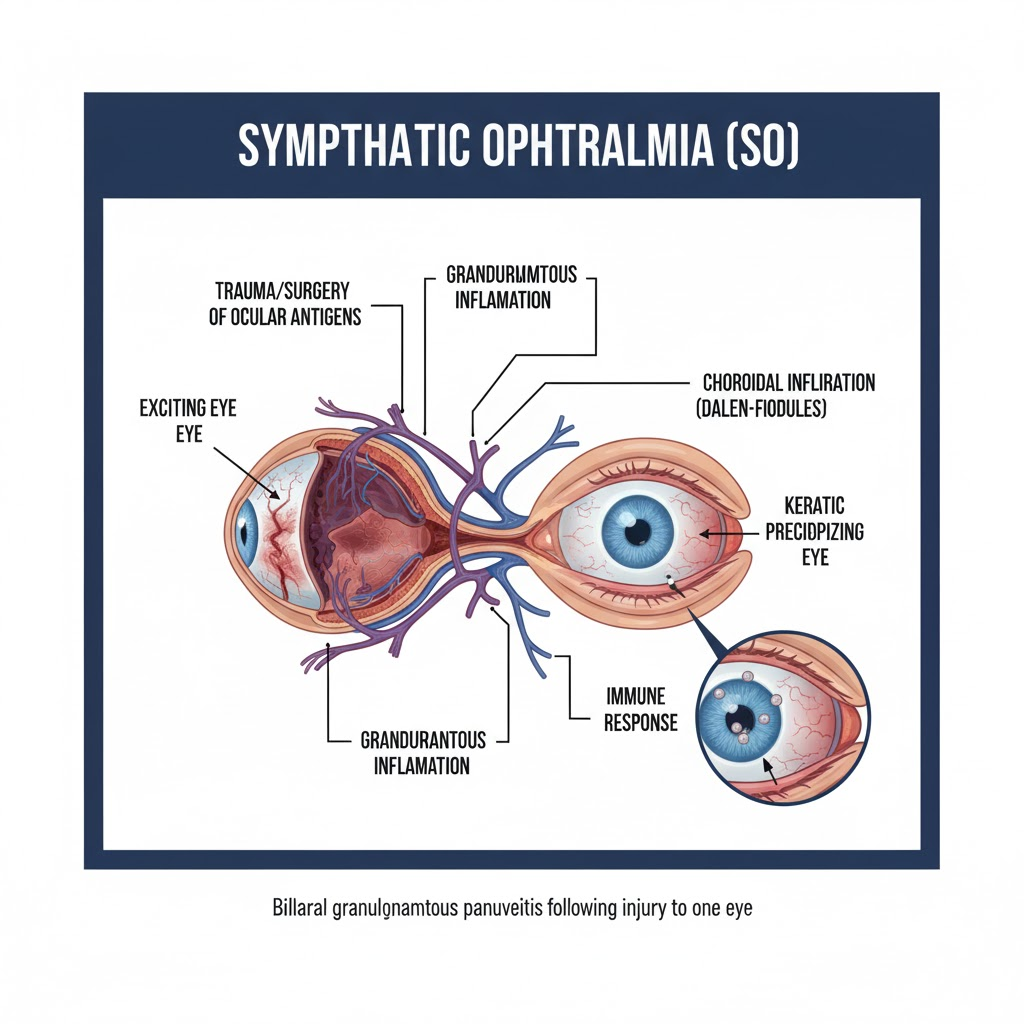
Sympathetic Ophthalmia (SO) is a rare, inflammatory disorder of the eyes that appears after an injury or surgery to one eye.
After such trauma, the immune system — in its effort to protect — becomes confused. It begins to recognize the eye’s inner tissues as foreign, attacking them in both the injured (exciting) eye and the uninjured (sympathizing) one.
The result is inflammation inside the eyes — called uveitis — which can lead to blurred vision, light sensitivity, floaters, or pain. The condition can appear days or even years after the initial trauma.
But beneath the medical terms lies something deeply human — the story of how our body, in its longing to protect, sometimes forgets what belongs to itself.
How It Feels
It often begins subtly — with light becoming too bright, colors dimming, or vision blurring in the uninjured eye.
There may be pain, redness, or a feeling that something unseen is changing within.
And then comes the realization: the eye that was once untouched has joined in the suffering of the other.
Emotionally, this can be unsettling. There is grief not only for sight that is fading, but for the strange tenderness of a body that remembers — one part echoing the other’s pain.
Many people describe a sense of betrayal, confusion, and deep fatigue — both physical and emotional. Yet, within that vulnerability often lies a quiet strength, a soft courage that grows out of the wish to protect one’s vision and hope.
Why It Happens
At its root, Sympathetic Ophthalmia is an autoimmune miscommunication.
The tissues inside the eye — the retina, the uvea — are usually hidden from the immune system. But when injury or surgery exposes them, the immune cells may see them for the first time and mistakenly label them as invaders.
This “mistaken identity” sets off a chain of inflammation, spreading to both eyes.
It is not the body’s cruelty — it is confusion, a kind of misguided devotion. The immune system, meant to guard, overreaches. It tries to defend, but ends up wounding what it was meant to protect.
The Homeopathic Understanding: Healing the Inner Connection
In homeopathy, Sympathetic Ophthalmia is seen as a disturbance not only of the eyes but of the inner harmony between perception and protection.
The eyes are more than organs of sight — they are the windows through which we experience the world and the soul’s sensitivity.
When inflammation takes hold here, it speaks of an inner tension — between seeing too much and wanting to close off, between pain and the longing to heal.
Gentle remedies may help restore that lost dialogue, supporting both physical and emotional healing.
- Phosphorus – for those whose eyes are sensitive to light, with burning and blurred vision; helps reawaken vitality and calm overstimulation.
- Belladonna – for sudden inflammation, redness, and throbbing pain that comes and goes in waves.
- Euphrasia – for burning, watering, and tired eyes; supports clarity and gentle cleansing.
- Mercurius Solubilis – for deep inflammation, sensitivity to light, and healing after injury.
- Arsenicum Album – for fear, restlessness, and exhaustion when the body feels fragile.
Each remedy is chosen not only by symptoms but by the person’s story — their emotions, fears, and inner strength. The goal is not to fight the body, but to guide it back to recognition and peace.
(Always seek care from a qualified homeopath and ophthalmologist working together.)
Gentle Daily Care
- Protect your eyes. Avoid bright light; wear gentle shades if needed.
- Rest deeply. Healing requires calm — both physical and emotional.
- Eat nourishing foods. Support your immune system with warm, simple meals rich in antioxidants.
- Manage stress softly. Fear can tighten the body’s defenses; gentle breathing, nature, or quiet music can help.
- Keep close contact with your care team. Early and consistent treatment can preserve sight and balance.
A Reflection
Sympathetic Ophthalmia reminds us that the body listens — that one part can feel the echo of another’s pain.
In this, there is both sorrow and beauty — the kind of deep connection that speaks to our shared humanity.
Perhaps the eyes, in their quiet wisdom, are teaching us something larger: that empathy lives not just in the heart, but in every cell that remembers another’s suffering.
Healing, then, becomes not only about restoring vision — but about restoring trust between the parts of ourselves that once turned against each other.
And even in that fragile reconciliation, there is light — softer now, but still enough to see by.


Leave a Reply