
When the Body’s Message Travels Through the Spine
Some illnesses arrive like a whisper in the nerves — quiet, confusing, and unexpected.
Transverse Myelitis is one of those rare and profound conditions that remind us just how delicately our bodies carry communication.
It begins deep within the spinal cord — the pathway through which every movement, every sensation, and every message flows. When inflammation touches that space, everything changes: movement, feeling, balance, even the quiet awareness of one’s own body.
For many, it begins suddenly — tingling in the feet, a heavy feeling in the legs, or numbness spreading like a shadow up the body. Then come weakness, stiffness, pain, or even paralysis. The world shifts in a day.
Understanding Transverse Myelitis
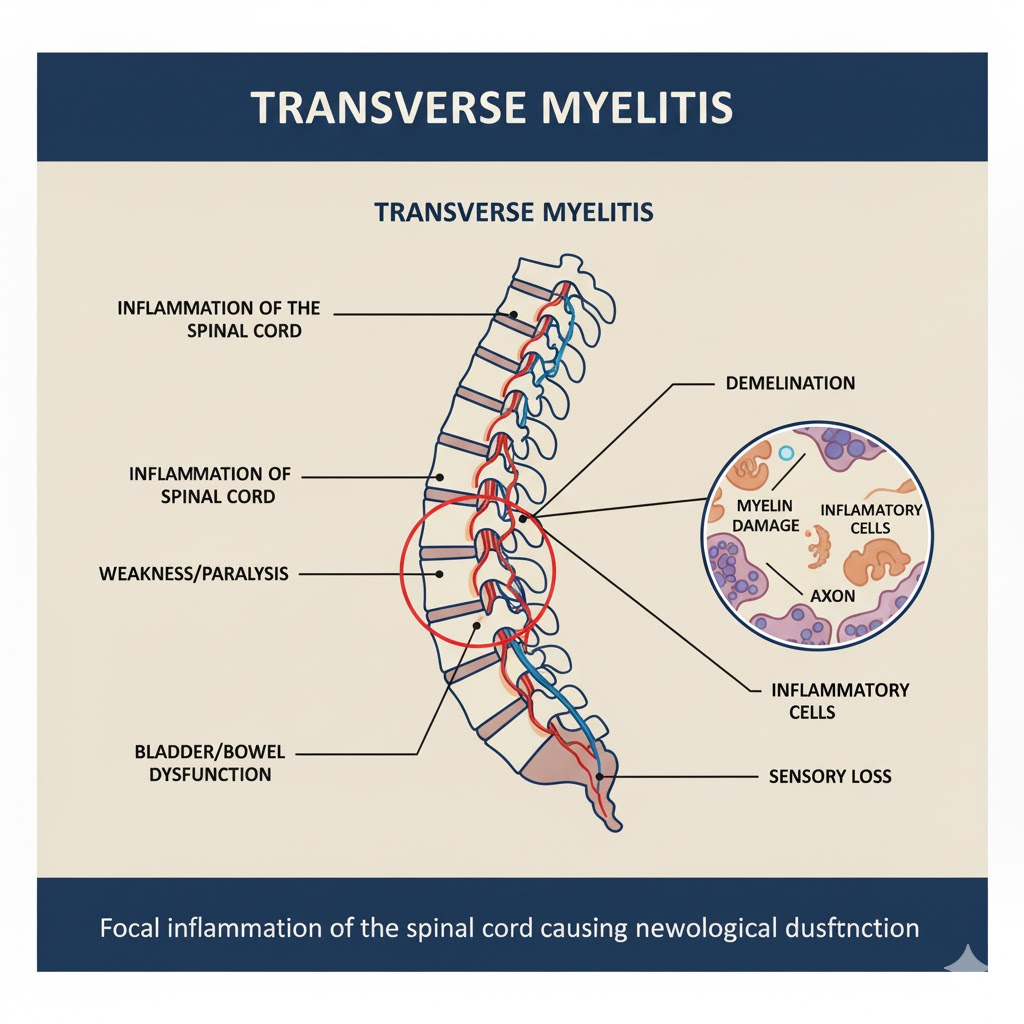
Transverse Myelitis (TM) is an inflammatory condition affecting the spinal cord, a vital communication bridge between the brain and the body.
When inflammation strikes, it damages the protective myelin sheath — the coating around nerve fibers that helps transmit signals.
Without that protection, the messages between the brain and body become distorted or lost, leading to weakness, numbness, or pain.
The term “transverse” refers to how the inflammation often spreads across the width of the spinal cord, disrupting movement and sensation on both sides of the body.
TM can occur on its own or as part of another autoimmune condition, such as multiple sclerosis (MS), neuromyelitis optica (NMO), or systemic lupus erythematosus (SLE).
It is not caused by stress or lifestyle, and it is never anyone’s fault — it is the body’s way of expressing an inner imbalance, a sudden storm in the nervous system.
How It Feels
Living through Transverse Myelitis is like learning your body all over again.
There may be numbness that spreads upward, tingling sensations like static under the skin, or burning pain that comes without warning.
Walking may become difficult, balance uncertain, and the body — once steady and reliable — may begin to feel foreign.
There’s also the emotional landscape: the fear of losing control, the grief of sudden change, and the deep vulnerability of depending on others for what once felt simple.
But amid this, there often emerges a quiet courage — a rediscovery of strength, patience, and trust in the body’s slow path toward recovery.
Why It Happens
In most cases, Transverse Myelitis is autoimmune — meaning the body’s immune system, meant to protect, becomes confused and attacks its own tissues.
Viruses, infections, or even vaccinations may sometimes trigger it, but the deeper cause lies in the immune system’s loss of recognition — the body mistaking self for other.
This misunderstanding causes inflammation that disrupts the spinal cord’s ability to send and receive messages, leading to the array of symptoms.
The body, in essence, forgets its own harmony — and begins to fight what it was meant to protect.
The Homeopathic Perspective: Restoring Inner Communication
In homeopathy, Transverse Myelitis is seen as a break in the body’s inner dialogue — where the nervous system’s messages are interrupted, and the body no longer moves in harmony with itself.
The goal is not to suppress the inflammation, but to remind the system of its coherence — to help the body remember its rhythm of communication, calmness, and self-recognition.
Some homeopathic remedies often considered include:
- Causticum – for paralysis or stiffness, especially in the lower limbs; for weakness after emotional strain.
- Gelsemium – for trembling, heaviness, and loss of coordination linked with fear or fatigue.
- Plumbum Metallicum – for deep, slow paralysis, with a sense of heaviness and inward pulling.
- Lathyrus Sativus – for spinal weakness with unsteady gait and trembling.
- Phosphorus – for nerve inflammation with burning pain, sensitivity, and emotional openness.
(These remedies are chosen individually; guidance from a professional homeopath is essential.)
Gentle Care and Healing Practices
- Rest deeply. Allow the nervous system time to repair; exhaustion slows recovery.
- Physical therapy helps retrain the body, rebuild confidence, and restore coordination.
- Stay nourished. Warm, whole foods rich in vitamins B and D support nerve repair.
- Hydrate and breathe. The spinal cord thrives on circulation and oxygen.
- Emotional care. Anxiety and frustration are natural — gentle mindfulness, journaling, or talking with a trusted friend can help release them.
Healing is not a straight path; it’s a dialogue between patience and persistence.
A Closing Reflection
Transverse Myelitis teaches us how fragile, and yet how resilient, the body truly is.
It invites us to slow down, to listen more closely to the messages carried through every nerve and fiber.
Even when movement is limited or sensation is altered, life continues to flow — quietly, persistently, through the will to heal.
Recovery, though often gradual, reveals something profound: that the body, even when misunderstood by its own immune system, remembers its wholeness.
And when we walk again — whether with steps, with effort, or with faith — we are walking not as before,
but with a deeper awareness of the strength that lives within stillness.






Leave a Reply