
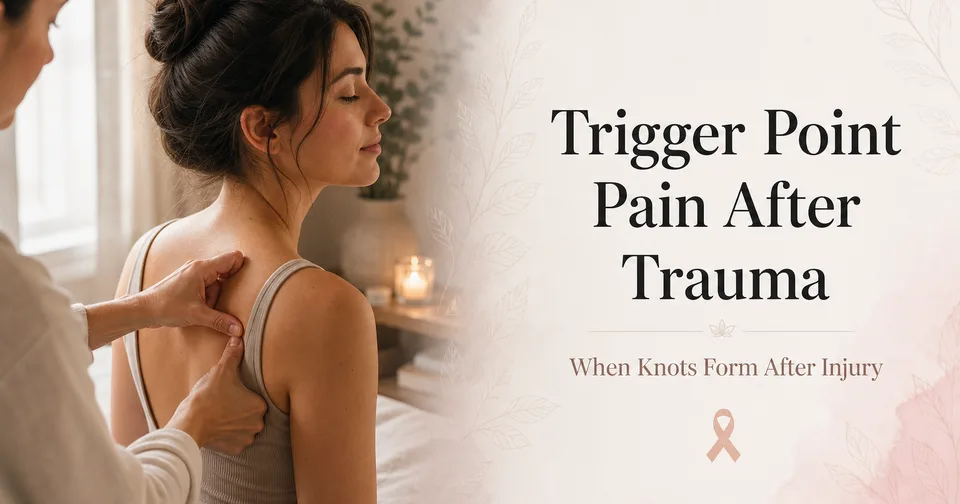
WHEN KNOTS ECHO THE INJURY
After trauma, muscles may develop irritable spots—trigger points—that refer pain in surprising maps: a shoulder knot that sparks headache, a glute point that mimics sciatica, a calf band that fools people into fearing deeper injury. Trigger point pain after trauma is the muscle’s unfinished bracing pattern, still gripping long after the threat has passed.
Medical evaluation still rules out nerve root and joint causes. Homeopathy may complement individualized support.
Understanding the Condition
Myofascial trigger points are hyperirritable spots in taut muscle bands. They often follow guarding after sprain, strain, whiplash, or surgery. Red flags—progressive neurological loss, bowel/bladder change, fever, trauma with fracture risk—need medical assessment rather than massage-first approaches.
Treatment may include physiotherapy, graded movement, dry needling where appropriate, and load correction. Aggressive digging into acute tears can harm.
In Canada, timely medical evaluation remains essential when red-flag signs appear: severe or rapidly worsening pain, numbness or weakness, loss of bowel or bladder control, chest pain or breathing difficulty, signs of infection, unexplained swelling that spreads, deformity, inability to bear weight, or any sudden neurological change. Homeopathy may be considered only as complementary, individualized supportive care alongside diagnosis, emergency assessment, imaging, physiotherapy, or other treatments recommended by a qualified physician. It is not a substitute for standard medical care and is not described here as a cure.
People living with trigger point pain after trauma often notice patterns such as:
- A taut band with a exquisitely tender nodule…
- Referred pain distant from the knot…
- Twitch or jump response when pressed…
- Pain that eases temporarily with heat and gentle movement…
Holding both the tissue story and the person’s whole context helps care feel more precise and more humane.
How It Feels — The Human Experience
People chase referred symptoms into wrong diagnoses in their minds. They fear discs when a scapular trigger point is shouting. Frustration rises when cracking or stretching gives only brief relief. Sleep suffers when knots reignite overnight.
Common human experiences include:
- Confusion about where the “real” injury lives…
- Irritation with temporary-only relief…
- Fear of permanent muscle hardness…
- Relief when a therapist maps the referral pattern clearly…
- Empowerment learning self-care within safe limits…
Loved ones can help by listening without minimizing, offering practical support with daily tasks, and respecting the injured person’s pace. Recovery is not only about tissues knitting; it is also about restoring trust in movement.
The Homeopathic Understanding — Supporting the Vital Force
Homeopathy matches the cramping, bruised, or stitching muscular picture and modalities after trauma, supporting the vital force’s release of unnecessary guarding.
In supportive care for trigger point pain after trauma, a homeopath may explore:
- Cramping versus bruised muscle qualities
- Better from warmth, pressure, or motion
- Worse from cold drafts or overuse
- Emotional tension maintaining guarding
- Sleep positions that recreate trigger activation
Two people with the same injury label may receive different remedies because their lived picture differs. The intention is gentle support of the vital force’s ordering intelligence—never force, never one-size-fits-all prescribing, and never a claim to cure conditions that require ongoing medical management.
Commonly Considered Remedies
The following remedies are sometimes considered in homeopathic practice when the symptom picture matches. This list is educational and not a prescription:
- Rhus toxicodendron — often considered when muscular stiffness eases with gentle motion.
- Bryonia alba — explored when any motion aggravates knotty pain.
- Magnesium phosphoricum — discussed for cramping pains better with warmth and pressure.
- Arnica montana — used when traumatized muscles feel beaten and sore.
- Cuprum metallicum — sometimes matched to intense spasming knot pictures—individualized.
(All remedies must be individualized by a qualified homeopath. Self-prescribing for chronic or serious concerns is not advised. Continue any medically necessary care unless your physician advises otherwise. Homeopathy in Canada is complementary supportive care and is not presented here as a cure.)
Gentle Daily Care
Daily care combines gentle mobility, heat as tolerated, posture variety, and therapist-guided release—not heroic self-punishment.
- Get assessed if neurological red flags appear…
- Use heat before gentle range if advised…
- Perform frequent short mobility rather than rare deep assaults on knots…
- Address breathing and stress; threat keeps trigger points recruited…
- Strengthen through pain-free ranges so muscles stop relying on spasm…
Any home program should follow clinician guidance, especially after fracture, surgery, nerve injury, burns, or complex regional patterns.
Recovery after injury is rarely a straight line. Good days and harder days often alternate as swelling shifts, sleep quality changes, and daily demands rise or fall. Noticing patterns without panic helps people adjust pacing before a small flare becomes a setback. Keeping a simple note of aggravating tasks, helpful positions, and sleep hours can make conversations with clinicians and homeopaths more precise.
A Closing Reflection
Trigger point pain after trauma is unfinished guarding written in muscle. Rule out serious causes; retrain soft tissue with skill; consider complementary homeopathy for the personal pattern. Knots loosen when safety and smart movement return together.


Leave a Reply