
When Pregnancy Hormones Affect Blood Sugar
Pregnancy is a time when the body opens itself completely —
its rhythms shift,
its hormones rise and fall,
its heart beats for two,
its energy is shared in ways no words can truly capture.
In the midst of this beautiful transformation,
some women discover that their blood sugar begins to rise —
quietly at first,
like a gentle tide moving higher than expected.
This is Gestational Diabetes.
Not a failure, not a flaw, not a sign of weakness —
but a change in the body’s chemistry
as it works tirelessly to support new life.
Many women feel startled when they first hear the words.
But beneath the fear, there is a truth:
The body is simply asking for steadiness,
for guidance,
for a little extra balance during this sacred time.
Understanding the Condition
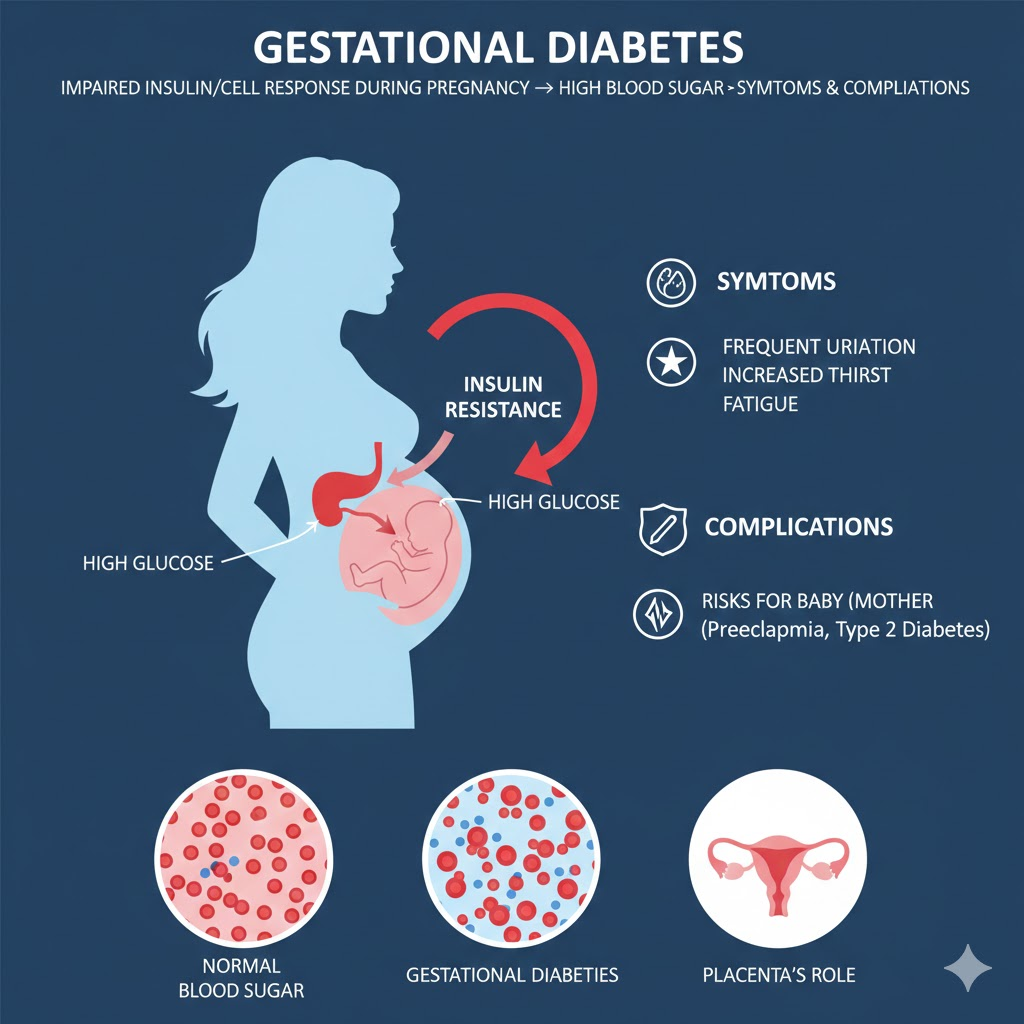
Gestational Diabetes develops when pregnancy hormones make the body’s cells less sensitive to insulin —
the hormone that helps sugar enter the cells.
The placenta produces hormones that help the baby grow,
but these same hormones can block insulin’s gentle work.
The result:
- Sugar stays in the bloodstream instead of entering the cells
- The pancreas works harder
- Blood sugar rises above the body’s comfort zone
This usually begins halfway through pregnancy
and often disappears after childbirth.
But in this temporary imbalance,
the body is signaling a need for deeper care —
not only for the mother, but for the little one growing within.
How It Feels
Many women have no symptoms,
yet some feel subtle shifts:
- Thirst that feels stronger than usual
- Tiredness that goes beyond normal pregnancy fatigue
- Hunger that returns quickly
- Mild headaches
- Blurred vision
- A sense that the body is working harder than it lets on
Emotionally, gestational diabetes can feel heavy:
- Worry for the baby
- Guilt that is undeserved
- Fear of doing something “wrong”
- Confusion about food, numbers, and testing
- A longing for reassurance
But every woman who walks this path learns something important:
You are not alone.
Your body is not betraying you.
It is simply speaking —
asking for intention, presence, and gentleness.
Why It Happens
Gestational Diabetes is not caused by eating too much sugar,
not caused by lack of willpower,
not caused by poor choices.
It arises from:
- Placental hormones that interfere with insulin
- Genetic tendencies
- Stress, inflammation
- The natural metabolic changes of pregnancy
Every woman’s body adapts differently to pregnancy’s hormonal tides.
And sometimes, the pancreas needs support.
This is not a personal failure.
This is physiology,
biochemistry,
life unfolding in its complex, mysterious way.
The Homeopathic Perspective
Supporting emotional balance and metabolic harmony
Homeopathy understands gestational diabetes as more than glucose imbalance —
it is the interplay of hormones, emotions, stress patterns, and constitutional tendencies.
A homeopath listens to the whole person:
- Are there fears about pregnancy or motherhood?
- Is there exhaustion, overwhelm, or suppressed worry?
- Does thirst feel insatiable?
- Is there irritability from hunger?
- What cravings tell the story of the inner state?
- How does stress manifest — quietly or loudly?
From this full picture, remedies are chosen to support the vital force,
help stabilize the emotional terrain,
and gently encourage metabolic harmony.
Commonly Considered Homeopathic Remedies
1. Syzygium Jambolanum
Used to support balanced blood sugar and excessive thirst.
2. Phosphoric Acid
For deep emotional fatigue, sadness, exhaustion, and heavy tiredness.
3. Lycopodium
For bloating, strong cravings, irritability before meals, and energy that drops in the late afternoon.
4. Natrum Muriaticum
For women who carry emotional burdens quietly and crave salt, cold drinks, or solitude.
5. Sulphur
For heat, burning sensations, excessive thirst, and metabolic imbalance.
6. Calcarea Carbonica
For women who feel overwhelmed, cold, fatigued, or anxious about responsibility.
7. Phosphorus
For sensitive, warm-hearted women with thirst for cold water and fear of something happening to the baby.
(Homeopathic remedies must be prescribed by a qualified practitioner who considers the full emotional and physical picture.)
Gentle Daily Care
Gestational diabetes invites a deep return to nourishment, rhythm, and softness.
1. Eat slowly and steadily
Small, balanced meals support both mother and baby.
2. Favor whole, gentle foods
Proteins, whole grains, vegetables, healthy fats, steady carbohydrates.
3. Keep blood sugar waves calm
Avoiding long gaps between meals eases the body’s work.
4. Move after meals
Even a short walk helps the body welcome insulin again.
5. Hydrate with presence
Water steadies the blood and eases thirst.
6. Soothe the emotional landscape
Pregnancy is a tender time —
journaling, breathing, gentle stretching, soft music
can ease the heart and settle the mind.
7. Rest without guilt
Fatigue is a message, not a weakness.
8. Seek support
Loved ones, midwives, doulas, and counselors can hold the emotional space with you.
A Closing Reflection
Gestational Diabetes can feel overwhelming,
especially when you’re carrying new life and navigating fear at the same time.
But remember:
Your body is still wise.
Your baby is still safe.
You are still strong.
And with care, rhythm, and support,
this condition can be managed gently and beautifully.
Most women go on to have healthy pregnancies,
healthy births,
and healthy babies.
This season is temporary.
It is a moment of learning,
a deeper connection to your body,
a reminder to nourish yourself while you nourish life within.
Let yourself be held —
by knowledge,
by support,
by compassion,
by your own quiet strength.



Leave a Reply