

WHEN LIFE BEGINS WITH A DIFFERENT PATH
Some journeys begin long before a child takes their first breath.
They unfold quietly during the earliest moments of life, when the body is still forming, shaping the delicate structures that will guide movement, thought, and growth.
Birth defects of the brain and spinal cord are part of these early beginnings.
They do not appear suddenly after birth.
They develop during pregnancy, when the brain and spinal cord — the central pathways of the nervous system — are forming with extraordinary complexity and precision.
Sometimes, in this delicate process, development follows a different path.
For families, the discovery can bring many emotions: confusion, worry, and deep questions about the future.
Yet it is also the beginning of a journey of care, patience, and profound love.
Understanding the Condition
The brain and spinal cord form very early in pregnancy, from a structure called the neural tube.
This tube later develops into the central nervous system, guiding movement, sensation, learning, and coordination throughout life.
When this process is interrupted or incomplete, certain structural differences may appear.
These may include conditions such as:
Openings or incomplete closure of parts of the spinal cord
Differences in the development of brain structures
Changes in how nerves communicate with muscles and organs
Some conditions are mild and allow relatively normal development with supportive care.
Others may create greater challenges affecting movement, learning, or bodily functions.
Every child’s experience is unique, shaped by the exact nature of the developmental change.
How It Feels — The Human Experience
For the child, these conditions may affect the way the body moves, senses the world, or learns new skills.
Some children may experience:
Difficulty with movement or coordination
Muscle weakness or limited mobility
Challenges with learning or development
Sensitivity in certain parts of the body
Delays in reaching developmental milestones
For parents, the emotional journey can be profound.
There may be moments of fear or uncertainty, but also remarkable strength.
Families often discover a deep well of patience, resilience, and devotion as they support their child’s growth.
Many children with these conditions show extraordinary courage and adaptability, finding their own ways to explore the world.
Why It Happens
Birth defects of the brain and spinal cord can arise from several influences during early development.
Sometimes genetic factors play a role.
In other cases, nutritional deficiencies during pregnancy, particularly a lack of certain essential nutrients, may influence neural development.
Environmental exposures or illnesses during pregnancy may also contribute.
Yet often, the exact cause remains unknown.
It is important to remember that parents do not cause these conditions through anything they did or did not do.
The development of life is a delicate and complex process, and sometimes it unfolds in unexpected ways.
The Homeopathic Understanding — Supporting Growth and Vitality
Homeopathy approaches these conditions with a gentle, individualized perspective.
Rather than focusing solely on the structural change, the homeopath looks at the whole child — their vitality, temperament, sensitivities, digestion, sleep, emotional responses, and overall development.
The goal is to support the vital force, encouraging the body’s natural capacity for balance, adaptation, and growth.
Each child’s remedy is selected carefully, based on their unique physical and emotional characteristics.
Remedies Sometimes Considered
A trained homeopath may consider remedies such as:
Calcarea Phosphorica
Often associated with developmental delays, slow bone growth, and general weakness in growing children.
Baryta Carbonica
For delayed mental or physical development and shyness or timidity in children.
Silicea
When growth is slow and the body shows sensitivity or difficulty maintaining strength.
Causticum
When nerve weakness or muscular difficulties are prominent.
Tuberculinum
For children who are restless, sensitive, and experience fluctuating vitality.
Remedies are always chosen individually, carefully matching the child’s overall constitution and developmental pattern.
Gentle Daily Care
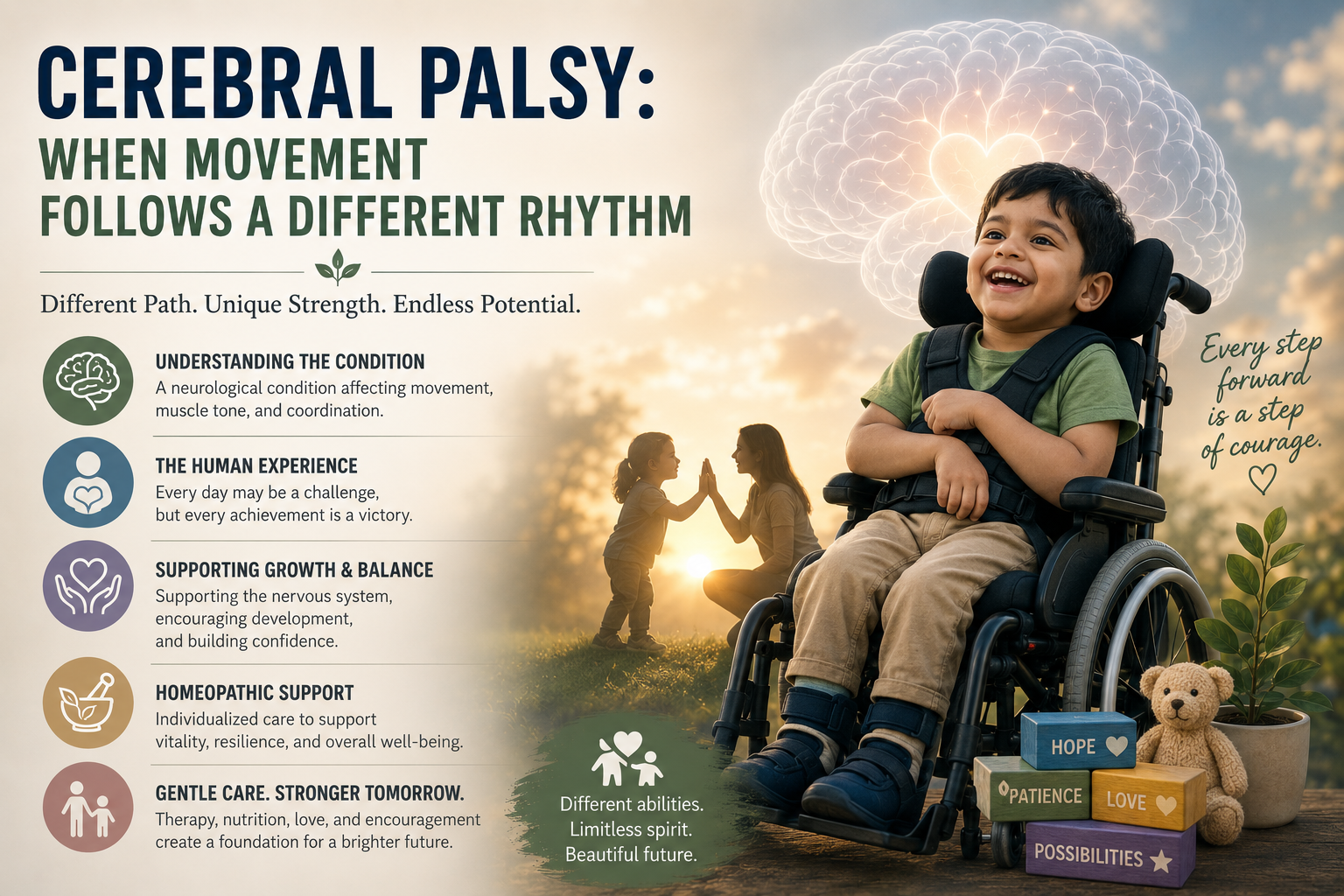
Supporting a child with neurological birth differences requires patience and steady encouragement.
Helpful approaches may include:
Early physical and developmental therapy
Nourishing meals that support growth and strength
Consistent daily routines that provide stability
Encouragement through play, movement, and gentle learning
Emotional warmth, reassurance, and family support
Every small step forward — a new movement, a new word, a moment of connection — carries deep meaning.
A Closing Reflection
Birth defects of the brain and spinal cord remind us that every life begins with its own unique path.
Some journeys may carry challenges from the very start.
But within those challenges often lies extraordinary strength — in the child, in the family, and in the love that surrounds them.
A child is never defined by a diagnosis.
They are defined by their spirit, their curiosity, their capacity to grow and connect with the world in their own beautiful way.
Healing, in this journey, means nurturing possibility — supporting each child as they unfold, step by step, with patience, compassion, and hope.



Leave a Reply