
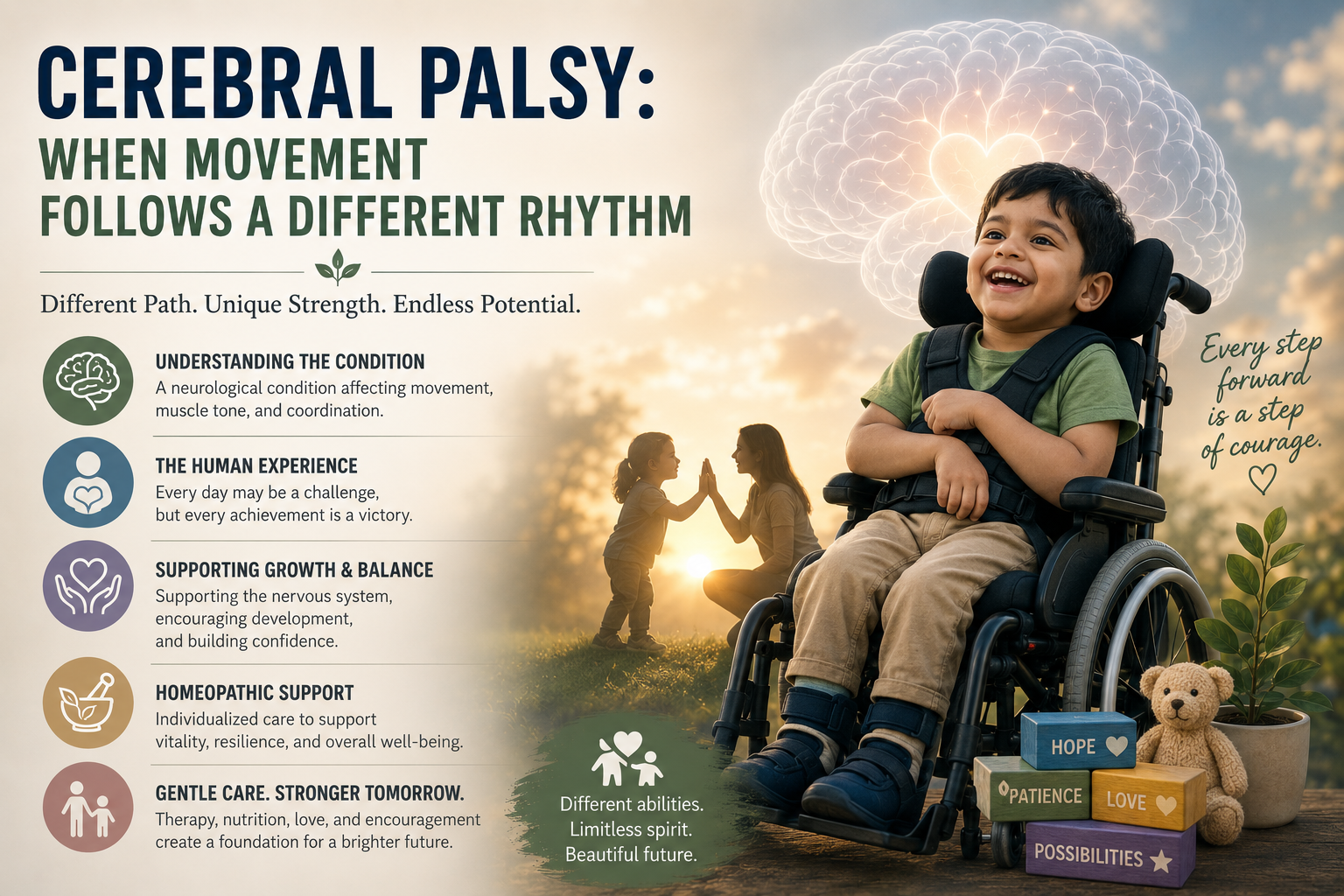
WHEN MOVEMENT FOLLOWS A DIFFERENT RHYTHM
Some children enter the world and grow along a familiar path — learning to roll, sit, crawl, and walk in their own time.
But for some families, the journey of development unfolds a little differently.
Cerebral palsy is one such path.
It is not an illness that suddenly appears later in life.
It is a condition connected to the early development of the brain, often present from infancy or early childhood.
Parents may first notice small differences.
A baby who seems unusually stiff or unusually floppy when held.
Movements that appear awkward or difficult to control.
Milestones such as sitting, crawling, or walking that take longer to arrive.
These moments can bring uncertainty and many questions.
Yet within this journey, there is also deep resilience — both in the child and in the family that walks beside them.
Understanding the Condition
Cerebral palsy refers to a group of conditions that affect movement, muscle tone, and coordination.
It occurs when a part of the developing brain responsible for controlling movement experiences injury or disturbance before, during, or shortly after birth.
Because the brain guides how muscles move and respond, this early change can influence how a child:
Moves their arms and legs
Maintains balance and posture
Controls muscle stiffness or looseness
Coordinates speech or swallowing
The condition itself does not usually worsen over time.
However, the way it affects movement may change as the child grows.
Each child with cerebral palsy has their own unique pattern of abilities and challenges.
How It Feels — The Human Experience
For a child with cerebral palsy, everyday movements may require more effort.
They may experience:
Stiff or tight muscles
Uncontrolled or jerky movements
Difficulty with balance and coordination
Challenges with speech or swallowing
Delayed development of motor skills
Despite these challenges, many children develop remarkable determination.
They learn to adapt in their own ways — exploring the world through creativity, persistence, and courage.
For parents and caregivers, the journey can be emotionally complex.
There may be moments of worry or exhaustion, but also moments of profound pride when a child achieves something new.
A first step.
A clear word spoken.
A smile that reflects effort and joy.
These milestones carry deep meaning.
Why It Happens
Cerebral palsy usually arises from a disturbance in the developing brain.
This may occur due to:
Reduced oxygen to the brain before or during birth
Premature birth and delicate brain development
Infections affecting the brain during pregnancy
Head injury or stroke early in life
In many cases, the exact cause is never fully known.
What matters most is understanding that parents do not cause this condition.
It is simply a different developmental pathway that unfolds within the complexity of early life.
The Homeopathic Understanding — Supporting Growth and Balance
Homeopathy approaches cerebral palsy by observing the whole child, not only the physical symptoms.
A homeopath carefully studies:
The child’s temperament and emotional nature
Muscle tone and movement patterns
Sleep habits, digestion, and sensitivities
Developmental milestones and responses to stimulation
The child’s overall vitality and resilience
The goal is to support the vital force, encouraging the nervous system and body to function as harmoniously as possible.
Homeopathic remedies are selected individually, respecting each child’s unique constitution.
Remedies Sometimes Considered
A trained homeopath may explore remedies such as:
Calcarea Phosphorica
Often considered when children show delayed development and weakness in bones or muscles.
Baryta Carbonica
Associated with delayed physical and mental development and timidity.
Causticum
Sometimes explored when nerve weakness and muscular stiffness are present.
Agaricus Muscarius
For involuntary movements or muscle twitching.
Plumbum Metallicum
Considered in cases involving nerve-related weakness or muscular contraction.
Each remedy is carefully chosen based on the child’s complete physical and emotional picture.
Gentle Daily Care
Children with cerebral palsy often benefit from consistent supportive care.
Helpful approaches may include:
Physical therapy to improve movement and strength
Speech and occupational therapy when needed
Balanced nutrition for growth and energy
Structured daily routines that provide comfort and stability
Encouragement through play, interaction, and emotional support
Every effort helps the child build confidence and independence in their own way.
A Closing Reflection
Cerebral palsy may shape how a child moves through the world, but it does not define who that child is.
Behind every diagnosis is a unique individual — curious, expressive, capable of joy, and full of potential.
Children often show extraordinary courage when learning to navigate challenges that others may never notice.
And families discover strength they never imagined they possessed.
Healing in this journey is not about forcing the body to follow a perfect pattern.
It is about supporting growth, nurturing abilities, and honoring the child’s unique rhythm of development.
Step by step, movement by movement, life continues to unfold — rich with effort, learning, and love.




Leave a Reply