
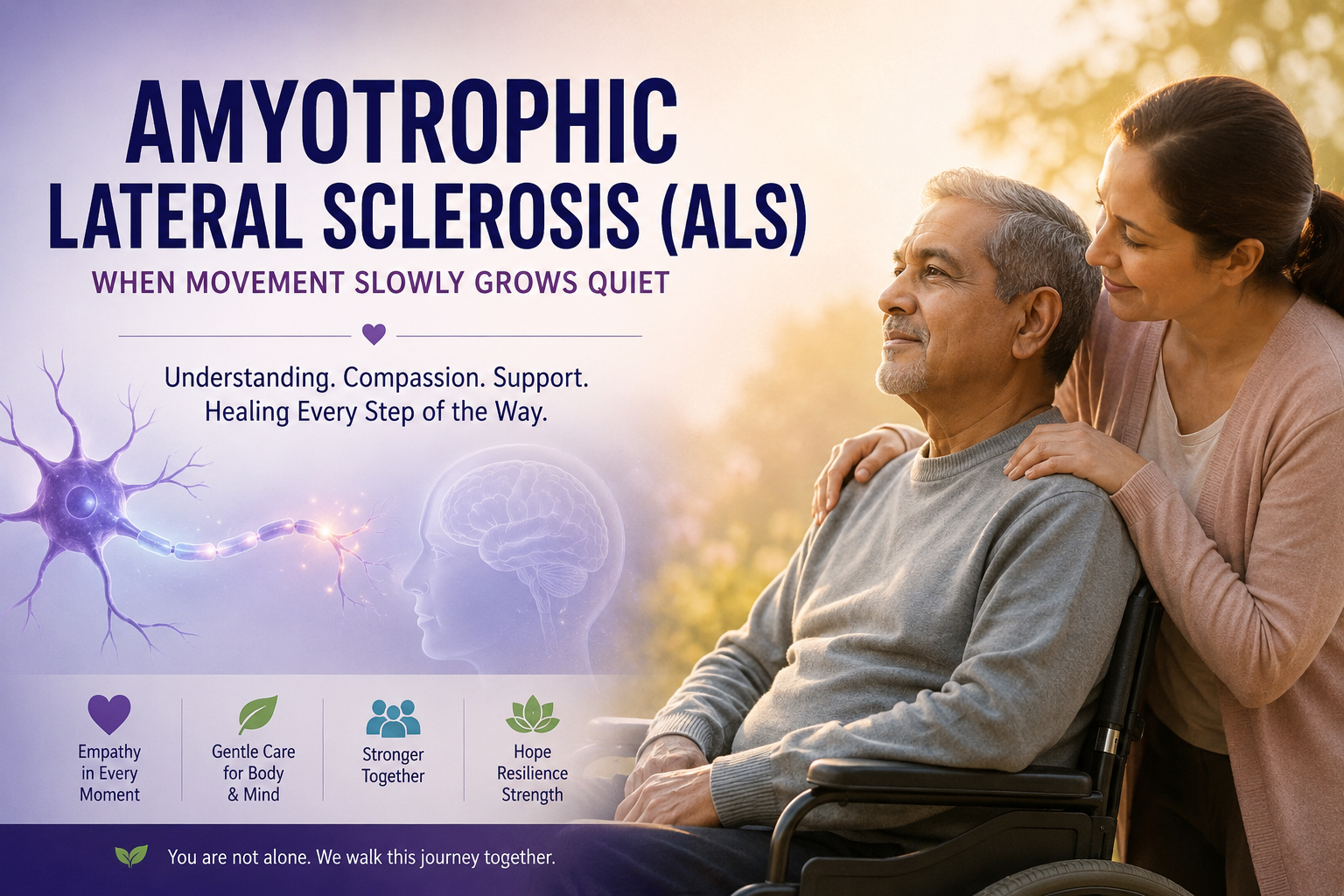
WHEN MOVEMENT SLOWLY GROWS QUIET
There are illnesses that arrive with noise and urgency.
And then there are those that unfold slowly, almost gently at first, changing life in small, quiet ways.
Amyotrophic Lateral Sclerosis, often called ALS, belongs to this quieter kind of journey.
In the beginning, the signs can seem small.
A hand that feels weaker when opening a jar.
A foot that trips more easily on the ground.
Muscles that twitch without reason.
Speech that occasionally feels slightly slower or heavier.
Nothing dramatic at first.
Just subtle shifts — the body moving a little differently than it once did.
Over time, these small changes reveal a deeper story: the nerves that guide the body’s muscles are slowly losing their strength.
The messages from brain to muscle grow faint, like a voice carried on a weakening breeze.
Yet within this difficult journey, the human spirit often reveals remarkable resilience, patience, and courage.
Understanding the Condition
ALS is a condition that affects motor neurons — the specialized nerve cells responsible for controlling voluntary movement.
These neurons carry instructions from the brain to the muscles, guiding actions like walking, speaking, swallowing, and breathing.
In ALS, these nerve cells gradually weaken and degenerate.
As the connection between brain and muscle becomes weaker, the muscles begin to lose their strength and coordination.
The progression is usually gradual.
Months and years unfold with subtle changes in movement, posture, speech, and daily activities.
The mind, emotions, and awareness often remain beautifully intact — a reminder that a person is always far more than the illness touching their body.
How It Feels — The Human Experience
Living with ALS carries both physical and emotional layers.
People may experience:
Muscle weakness that slowly spreads through the body
Twitching or small involuntary muscle movements
Difficulty with speaking or swallowing
Fatigue that follows even small efforts
Loss of coordination in hands, arms, or legs
Changes in breathing strength over time
Yet beyond the physical symptoms, there are deeper human experiences.
Moments of frustration when the body does not respond as it once did.
Moments of reflection about independence and identity.
Moments of quiet courage — learning to adapt, to ask for help, to move forward despite uncertainty.
Families and caregivers also walk this path, often with extraordinary tenderness and devotion.
Why It Happens
The exact cause of ALS is not always clear.
In some people, genetic factors play a role.
In others, environmental influences or complex biological processes may contribute.
What matters most in the healing perspective is not blame or searching for fault.
The body is responding in the only way it knows how.
And within that response, there is still a need for care, compassion, and support.
The Homeopathic Understanding — Listening to the Whole Person
Homeopathy approaches conditions like ALS by looking beyond the diagnosis alone.
It asks gentle questions:
How does the person experience their symptoms?
What emotional patterns accompany the illness?
What sensitivities, fears, strengths, and tendencies shape the individual?
The aim is to support the vital force — the body’s inner organizing intelligence — helping the system maintain balance, comfort, and resilience.
Rather than focusing only on muscle weakness, the homeopath listens to the whole human story: sleep, digestion, emotions, temperature sensitivities, and mental state.
Remedies Sometimes Considered
A professional homeopath may consider remedies such as:
Plumbum Metallicum
Often considered in cases involving progressive muscular weakness, nerve involvement, and gradual loss of motor strength.
Causticum
Associated with nerve-related weakness, stiffness, and gradual loss of muscular control, especially when emotional sensitivity is present.
Conium Maculatum
Sometimes explored when muscular weakness progresses slowly and coordination declines.
Phosphorus
For sensitive, open-hearted individuals who experience nervous exhaustion and physical weakness.
Gelsemium
When profound fatigue, trembling, and muscular heaviness dominate the experience.
Each remedy must be chosen individually, carefully matching the person’s entire physical and emotional picture.
Gentle Daily Care
Living with ALS requires patience and deep kindness toward the body.
Helpful supportive practices may include:
Soft, nourishing meals that are easy to digest
Gentle physiotherapy or guided movement to maintain comfort
Adequate rest and restoration
Breathing exercises that encourage calm and relaxation
Emotional support through family, counseling, or spiritual reflection
Small comforts — a warm room, quiet surroundings, and attentive care — can bring meaningful relief.
Even the simplest acts of compassion can make a profound difference.
A Closing Reflection
ALS changes how the body moves, but it does not change the essence of a person.
The heart continues to feel.
The mind continues to think and dream.
The spirit continues to seek connection, meaning, and love.
Illness may slow the body, but it often deepens the human experience — revealing patience, tenderness, and strength that might otherwise remain unseen.
Healing, in this sense, is not always about reversing a condition.
Sometimes it is about creating comfort, dignity, and peace within the journey.
And in that quiet space of care and understanding, the human spirit continues to shine — steady, resilient, and profoundly alive.


Leave a Reply