
When the heart’s pathways begin to narrow
There are moments when the heart — that loyal, tireless organ beating faithfully day and night — begins to whisper that it is struggling. Not loudly, not abruptly, but with a quiet tightening. A heaviness. A slowing of its once effortless rhythm.
Coronary Artery Disease (CAD) begins in this quietness.
It begins when the arteries that feed the heart — the vessels carrying oxygen and life — start to narrow, becoming less open, less free, less generous in their flow.
And so the heart, which has served us with such devotion, begins working harder just to do what once came naturally.
Understanding the Condition
The coronary arteries are like soft, flexible tunnels that bring nourishment directly to the heart muscle.
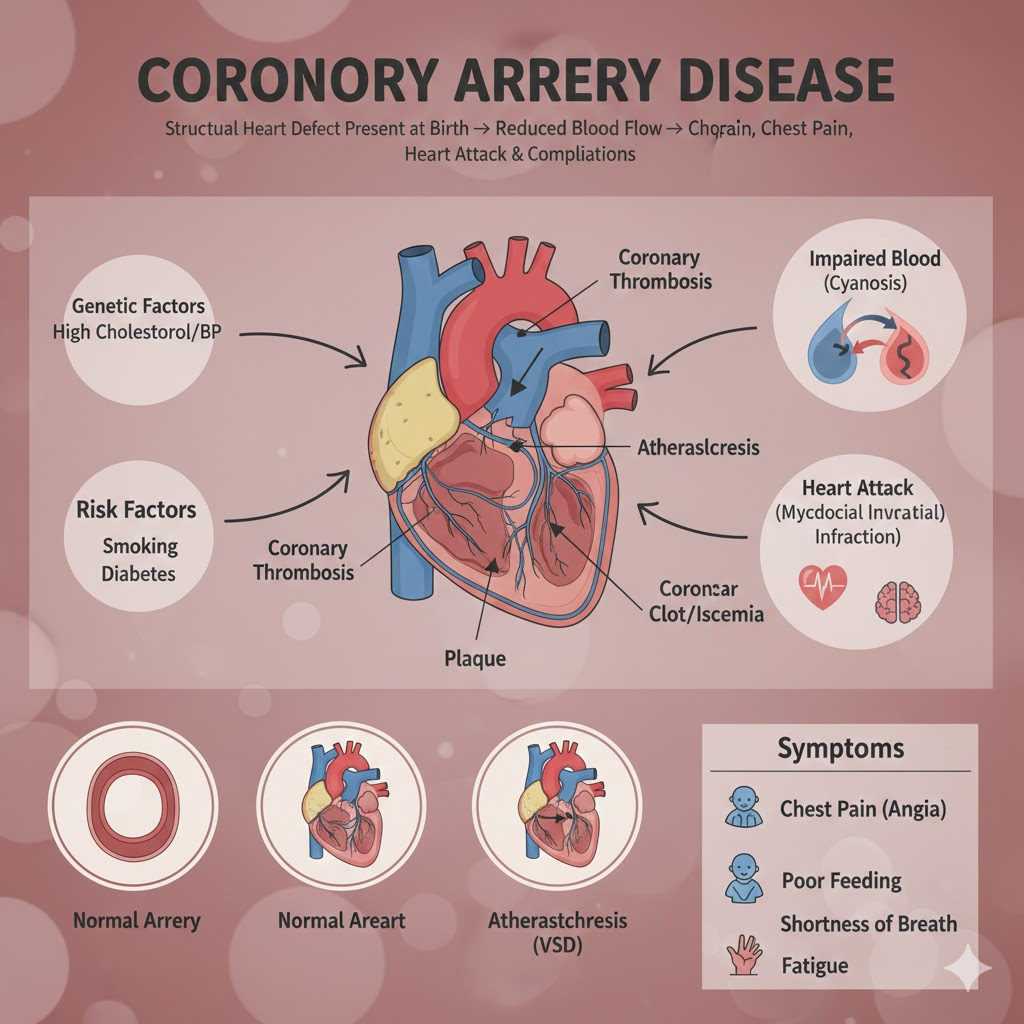
But over time — through stress, inflammation, lifestyle, genetics, or quiet internal processes — these tunnels slowly gather fatty deposits, known as plaque.
This narrowing is not sudden.
It is gradual, almost invisible, growing silently over years.
As the artery narrows:
- Blood flow decreases
- Oxygen delivery falls
- The heart’s muscles must strain harder
- Symptoms begin softly, then more clearly
Coronary artery disease is not simply a blockage;
it is the story of a heart receiving less than it needs to thrive.
How It Feels
The experience of CAD is deeply personal.
Some feel it early.
Some feel it late.
Some feel nothing at all until the heart cries out.
For many, the body speaks through:
- A pressure or heaviness in the chest
- Tightness spreading to the arms, jaw, or back
- Shortness of breath with mild exertion
- Fatigue that feels deeper than usual
- A sense that energy arrives less readily
- A strange awareness of the heartbeat
- Anxiety born from an instinctive knowing that something is amiss
These sensations can come and go, often triggered by stress, effort, or strong emotions.
And beneath it all lies a quiet emotional layer — fear, uncertainty, frustration, or a sudden tenderness toward one’s own life.
Why It Happens
Coronary artery disease forms slowly, shaped by many threads:
- Long-term inflammation
- High cholesterol
- Diabetes
- Hypertension
- Smoking
- Stress
- Genetics
- Aging
These factors encourage plaque to settle inside the artery walls, making them harder, narrower, and less responsive.
It is not a failure.
Not a weakness.
It is the body’s gradual response to the pressures of living — internal, emotional, and environmental.
CAD is the heart’s way of saying:
“I am carrying more than I can manage alone.”
The Homeopathic Understanding
Homeopathy views CAD as both a physical and emotional story — a narrowing not only of arteries but sometimes of one’s inner space, burden, or lived tension.
The goal is not to dissolve plaque, but to:
- Support circulation
- Ease emotional strain
- Strengthen the vitality
- Calm anxiety
- Encourage healthier rhythms
- Reduce the internal stress that fuels the condition
Every heart that struggles has a story — and a homeopath listens for that story gently.
Thoughtful Remedies to Consider
Arnica Montana
For individuals with a history of strain, heart fatigue, or past trauma — physical or emotional.
Crataegus Oxyacantha
A classic heart tonic that nourishes cardiac strength, eases palpitations, and supports recovery after heart stress or surgery.
Aurum Metallicum
For the deep emotional heaviness, sadness, or self-pressure often found in those with heart disease.
Cactus Grandiflorus
For sensations of chest constriction — as if the heart is being held tightly or squeezed.
Nux Vomica
For those worn by stress, overwork, irritability, digestive strain, and modern lifestyle intensity.
Lachesis
For circulatory imbalance, pressure sensations, and emotional tension that feels bottled or suppressed.
(Always seek guidance from a qualified homeopath for personalized selection.)
Gentle Daily Care for a Healing Heart
Healing this condition is not a single action —
it is a way of living with more care, more softness, more awareness.
Nourish the Body
Warm, heart-supportive foods:
berries, greens, whole grains, garlic, walnuts, olive oil, fish, lentils.
Foods that ease inflammation and support clean circulation.
Move Kindly
Regular gentle movement — walking, stretching, yoga, slow cycling — supporting the heart without overwhelming it.
Release Stress
Meditation, prayer, quiet breathing, time in nature — practices that soften internal tension and give the heart space to rest.
Protect the Arteries
Avoid smoking, extreme salt, heavy processed foods — choices that safeguard the vessel walls.
Honor Rest
Fatigue is not a flaw.
It is the heart asking for gentleness.
Emotional Care
Living with a heart condition changes how one thinks, feels, and hopes.
Counseling, journaling, and supportive conversations nourish emotional healing.
A Closing Reflection
Coronary artery disease often begins silently, but it carries a message —
a message to slow down, to listen, to nourish, to love this life and this body more tenderly.
Your heart has worked for you tirelessly from the moment your life began.
It has carried your joys, your griefs, your stress, your dreams.
It has asked for almost nothing in return.
Now, as it grows tired, it asks gently:
“Will you care for me as I have cared for you?”
And the beautiful truth is —
healing is possible.
Strength can return.
Life can open again with more softness, awareness, and gratitude.
Whenever you’re ready for the next condition in the same compassionate style, I’m here.


Leave a Reply