
When the blood’s quiet river meets a sudden stillness
The blood that moves through us is like an inner river — flowing steadily, silently, nourishing every corner of the body. We rarely think about this quiet current until something interrupts it.
Deep Vein Thrombosis (DVT) and Pulmonary Embolism (PE) are moments when this river slows, stills, or breaks its natural rhythm.
They do not begin with drama.
They begin in silence.
A heaviness in the leg, a slight warmth, a sense that something is not as it should be.
And then, if a clot travels upward to the lungs, the body speaks loudly — through breathlessness, chest discomfort, or sudden fear.
These conditions remind us how delicate and strong we are all at once.
Understanding the Condition
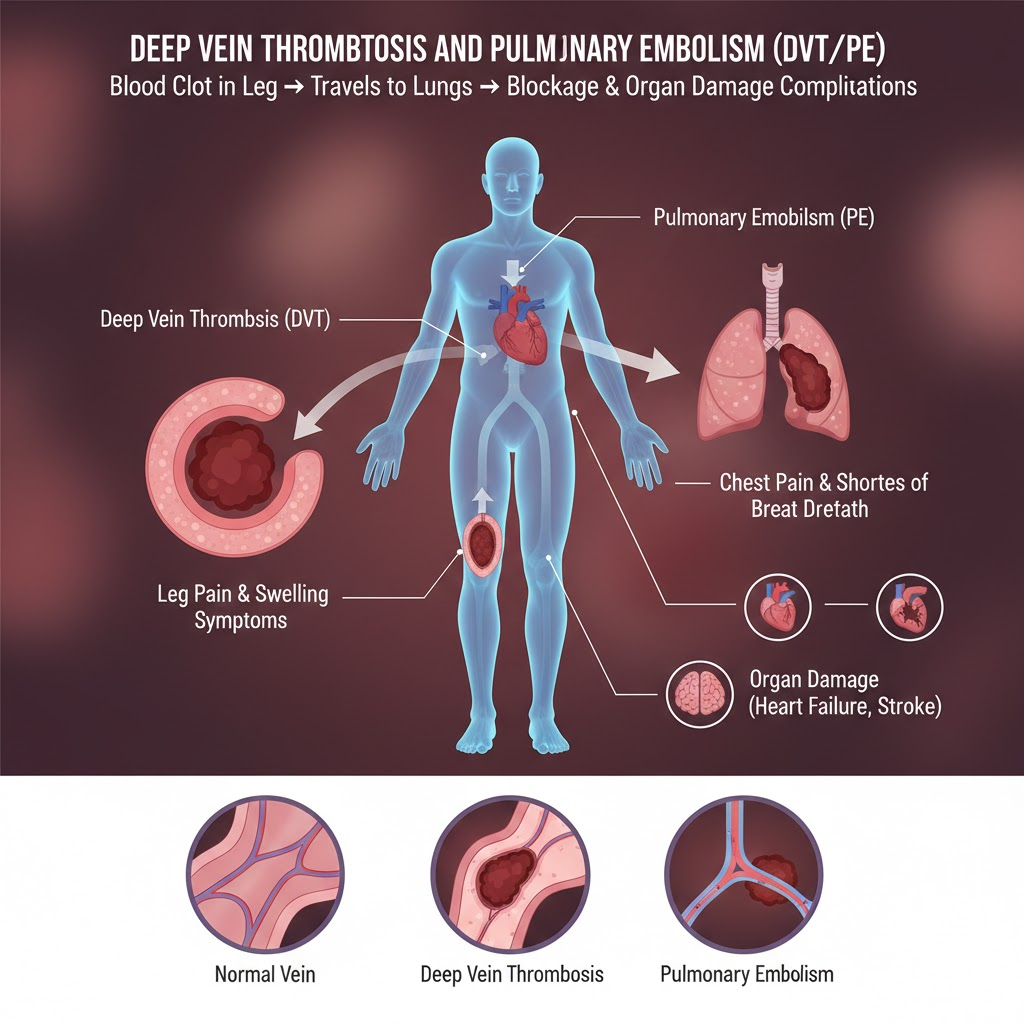
Deep Vein Thrombosis is the formation of a clot in the deep veins — most often in the legs, sometimes in the pelvis or arms.
A clot grows when blood becomes too still, too thick, or too constrained within the body’s pathways.
Pulmonary Embolism happens when part of that clot breaks away and travels to the lungs, blocking the arteries that bring oxygen into our blood.
Together, DVT and PE are known as Venous Thromboembolism — two chapters of the same story.
This story often begins quietly:
- After long periods of immobility
- After surgery
- In pregnancy or postpartum
- During illness that confines the body
- With dehydration
- With certain medications
- Or simply through vulnerability in the blood’s natural balance
It is not a failing of the body.
It is a moment when balance has been disrupted, when the river inside us needs help moving again.
How It Feels
DVT often speaks gently at first:
A leg that feels heavier, warmer, swollen, or tender.
A discomfort that seems out of proportion to what one sees.
There may be:
- A pulling sensation
- Pain when walking
- A feeling of fullness or pressure
- A deep ache that doesn’t match an injury
Pulmonary embolism speaks more urgently:
- Sudden breathlessness
- Chest tightness
- A feeling that air is not entering fully
- A racing heart
- Dizziness or fear
- Sometimes coughing or sharp chest pain
Emotionally, these conditions can leave one feeling fragile, shaken, or suddenly aware of life’s delicacy.
Many people feel a mixture of gratitude and vulnerability once the crisis passes — a deeper awareness of the body’s quiet battles.
Why It Happens
Blood is meant to flow freely.
When it slows or becomes stagnant, it begins to thicken.
Common reasons include:
- Long travel or bed rest
- Major surgery
- Trauma to the veins
- Clotting disorders
- Cancer
- Hormonal changes
- Dehydration
- Obesity
- Smoking
- Chronic inflammation
Clotting is not the enemy.
It is the body’s natural way of protecting itself from bleeding.
But sometimes, the clot forms where it is not needed —
a misdirected attempt to guard what is already safe.
The Homeopathic Understanding
Homeopathy views DVT and PE through the lens of circulatory stagnation, emotional constriction, and internal strain.
The aim is not to replace urgent medical care — these conditions require immediate attention —
but to support recovery, reduce recurrence, and restore the harmony of the body’s inner flow.
Homeopathy seeks to:
- Strengthen the vitality
- Support circulation
- Ease anxiety after a clotting episode
- Improve venous tone
- Reduce inflammation in the vessels
- Balance the emotional shock that often follows
A homeopath listens to the deeper story:
What was happening before the clot formed?
Were there emotional burdens, stress, immobility, or fear?
How does the person experience tension, pressure, or stagnation in life?
Commonly Considered Remedies
Hamamelis Virginiana
For venous congestion, soreness, and heaviness in the legs — veins feel bruised and tender.
Vipera Berus
For swelling and bursting sensations in the legs made worse by hanging them down; strong venous obstruction picture.
Arnica Montana
For post-surgical clotting risk, trauma, bruised veins, and shock to the system.
Bothrops
For individuals with a tendency to form clots, especially with circulatory sluggishness and emotional agitation.
Pulsatilla
For gentle, emotional individuals with venous stasis — often worse from heat and better from movement.
Nux Vomica
For stress-driven stagnation, tension, and lifestyle strain affecting the circulatory system.
(Always use homeopathy with physician guidance, and never delay emergency care.)
Gentle Daily Care for Healing and Prevention
Move with Intention
Regular, gentle movement encourages the venous system to stay open and flowing.
Walking, stretching, leg lifts, and slow cycling support recovery.
Hydrate Deeply
Water keeps the blood smooth and flowing, preventing thickening.
Protect the Veins
Compression stockings, after medical clearance, can help decrease swelling and support return flow.
Nourishment from Within
Foods rich in antioxidants and anti-inflammatory properties — berries, garlic, leafy greens, turmeric, ginger, olive oil — help protect vessel walls.
Breathe with Awareness
Slow inhaling and exhaling calms the nervous system and improves lung expansion after PE.
Emotional Healing
A clotting event can leave lingering fear.
Soft conversations, grounding practices, journaling, or counseling help the heart settle again.
Honoring Rest
The body repairs most deeply when given time, quietness, and gentleness.
A Closing Reflection
Deep Vein Thrombosis and Pulmonary Embolism often arrive without warning, creating a moment of sudden vulnerability.
But they also reveal something sacred:
how tirelessly the body works to keep us alive,
how delicately balanced its inner rivers are,
how every breath, every step, every quiet moment is a gift.
Healing from these conditions is not just physical.
It is emotional, spiritual, and deeply human.
It teaches us to soften the pace of life, to listen to our bodies’ whispers before they become cries, to honor the flow within us.
And most of all, it reminds us that even after stillness, fear, or obstruction,
the body can find its rhythm again.
The river can move again.
Life can open, gently and beautifully, once more.


Leave a Reply