
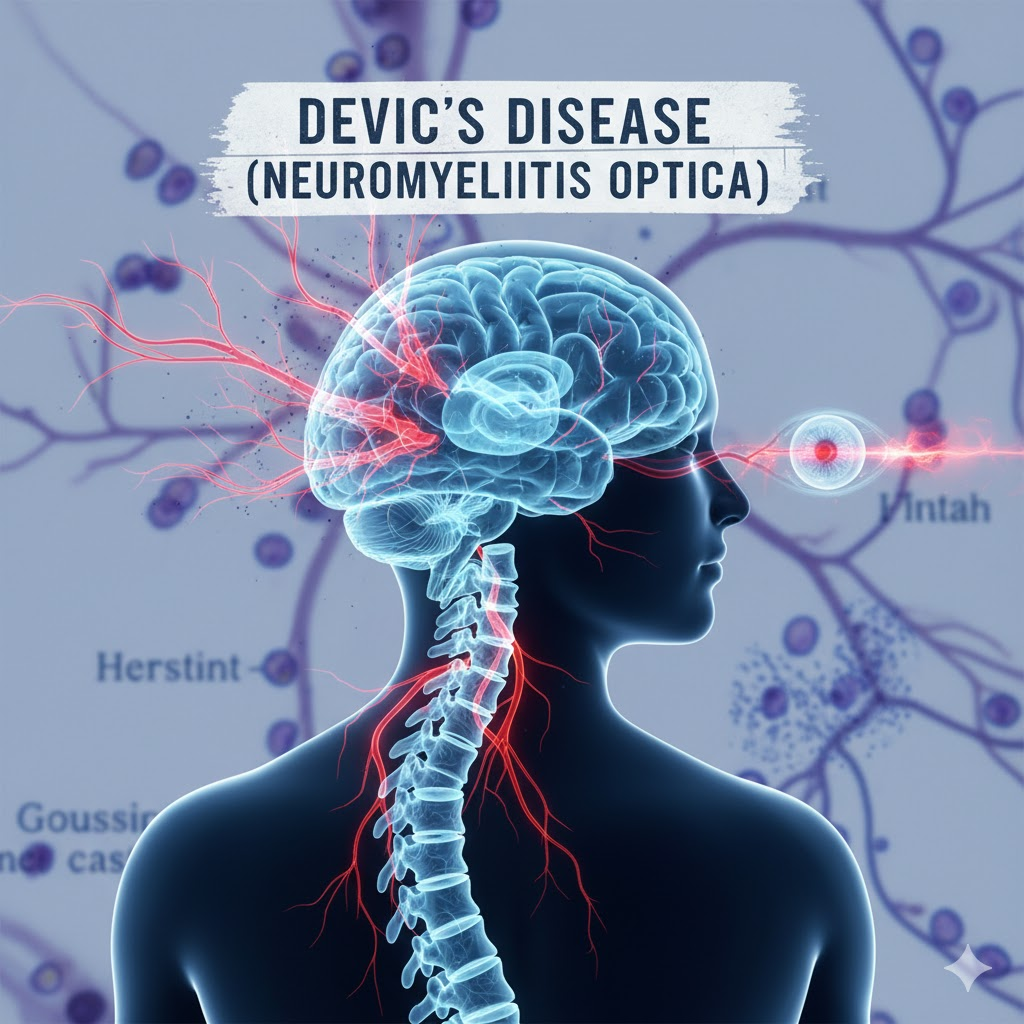
When the Eyes Grow Tired and the Body Feels Heavy: Living with Devic’s Disease (Neuromyelitis Optica)
Some illnesses come softly, with whispers the body can almost ignore — a flicker of blurred vision, a strange tiredness in the legs.
And then, there are those that arrive suddenly, like a storm, leaving you wondering what happened to the strength you once took for granted.
For many, Devic’s Disease, also called Neuromyelitis Optica (NMO), begins this way — with the eyes and spine trying to speak, asking for attention, asking for calm.
It is a rare condition. Yet for the one living through it, it feels anything but rare. It is deeply personal — a quiet battle between strength and surrender, between what the body can do and what it must rest from.
When the Body Turns Inward
Devic’s Disease is an autoimmune condition. That means the body, in its effort to protect, becomes confused.
The immune system begins to mistake parts of its own nervous system — especially the optic nerves and the spinal cord — as something foreign.
In that confusion, inflammation rises like fire. It can blur vision, make walking difficult, or cause deep exhaustion that no amount of sleep seems to fix.
The episodes often come in waves — some days clearer, some heavy.
And with each wave, the person learns a little more about patience, about pacing, about trusting that healing can come slowly, quietly.
How It Feels
No two people experience it the same way, but there’s a shared story of unpredictability — of waking up and wondering how the day will unfold.
People often describe:
- A sudden loss or dimming of vision, sometimes painful, sometimes just fading quietly
- Weakness or numbness in the arms or legs, as if the connection between brain and body has thinned
- Tiredness that feels heavy, not just in the body but in the spirit
- Muscle stiffness or spasms, especially in the lower body
- Changes in bladder or bowel function, when the spinal cord is inflamed
- Emotional weariness, the quiet kind that comes from long uncertainty
These aren’t just symptoms — they are experiences. They change the rhythm of life. They teach gentleness, patience, and the art of slowing down.
Why It Happens
The deeper truth is that Devic’s Disease begins in the immune system — not from infection or weakness, but from imbalance.
For reasons not yet fully understood, the body produces certain antibodies (often called AQP4 antibodies) that attack the protective layers of the nervous system.
Sometimes, this imbalance is awakened by infection, stress, or even grief — those unseen moments when the body holds too much.
It’s not anyone’s fault. It’s simply the body’s way of saying, “I am overwhelmed. I need balance again.”
Homeopathic View: Calming the Inner Fire
Homeopathy looks at Devic’s Disease as more than a neurological condition — it sees it as the body’s inner energy turning against itself, asking for a softer kind of guidance.
The goal isn’t to suppress the immune system, but to teach it balance again.
To quiet the fire without extinguishing the flame.
Each case is unique — because no two stories are ever the same.
Where the pain settles, how it began, what emotions travel with it — all of this matters.
Commonly considered remedies may include:
- Phosphorus – for deep fatigue, weakness, and sensitivity of nerves and emotions alike.
- Causticum – for muscle weakness and stiffness, often paired with compassion and strong emotion.
- Gelsemium – for trembling, dullness, and the heavy tiredness that follows viral illness.
- Arsenicum Album – for burning sensations, restlessness, and anxiety that worsens at night.
- Plumbum Metallicum – for progressive muscle weakness, especially in the limbs.
Treatment works best when guided by a trained homeopath who can tailor the remedy to both body and mind.
Living with the Body’s New Rhythm
Healing with Devic’s Disease is not a race.
It’s a practice of listening — to the body’s boundaries, to its fatigue, to the quiet ways it asks for rest.
Simple, steady care helps more than anything:
- Rest fully when exhaustion comes — don’t fight the body’s need for pause.
- Eat simply and nourishingly — whole foods, gentle on the digestion, rich in natural strength.
- Stay gently active — slow stretching, supported movement, mindful breathing.
- Protect from cold and overexertion — warmth soothes inflammation.
- Keep emotional balance — meditation, journaling, prayer, or time in silence can bring the calm the body longs for.
- Stay in touch with both your medical team and homeopath, letting both guide your journey safely and wisely.
Finding Stillness Beyond the Storm
Living with Devic’s Disease can change how you see life — quite literally and deeply.
It teaches that strength is not always in doing, but often in being — in waiting, in breathing, in trusting that the body is finding its way home.
There are days when the fatigue feels endless, and yet, with time, something shifts — a small return of energy, a quiet steadiness, a sense of knowing that healing is happening in ways unseen.
Your body isn’t your enemy. It’s your messenger — one that speaks through sensations and stillness, asking you to live gently, to listen closely.
And in that listening, something beautiful happens:
You begin to find peace, not only with the illness, but with yourself.
Because even when the body falters, the spirit remembers how to heal — slowly, softly, and always in its own perfect rhythm.


Leave a Reply