
When the Quiet Currents of the Body Turn Restless: Understanding Granulomatosis with Polyangiitis (GPA)
There are moments when the body begins to whisper through unusual aches — a lingering sinus infection that never quite heals, a cough that deepens over weeks, a strange tiredness that seeps into the bones.
At first, it feels like a stubborn cold or perhaps stress. But slowly, these signs start weaving a different story — one of the immune system turning too vigilant, too fierce, mistaking the body’s own tissues for something to fight.
This is how Granulomatosis with Polyangiitis (GPA) often begins — not as an attack from the outside, but a quiet fire from within.
What Is Granulomatosis with Polyangiitis?
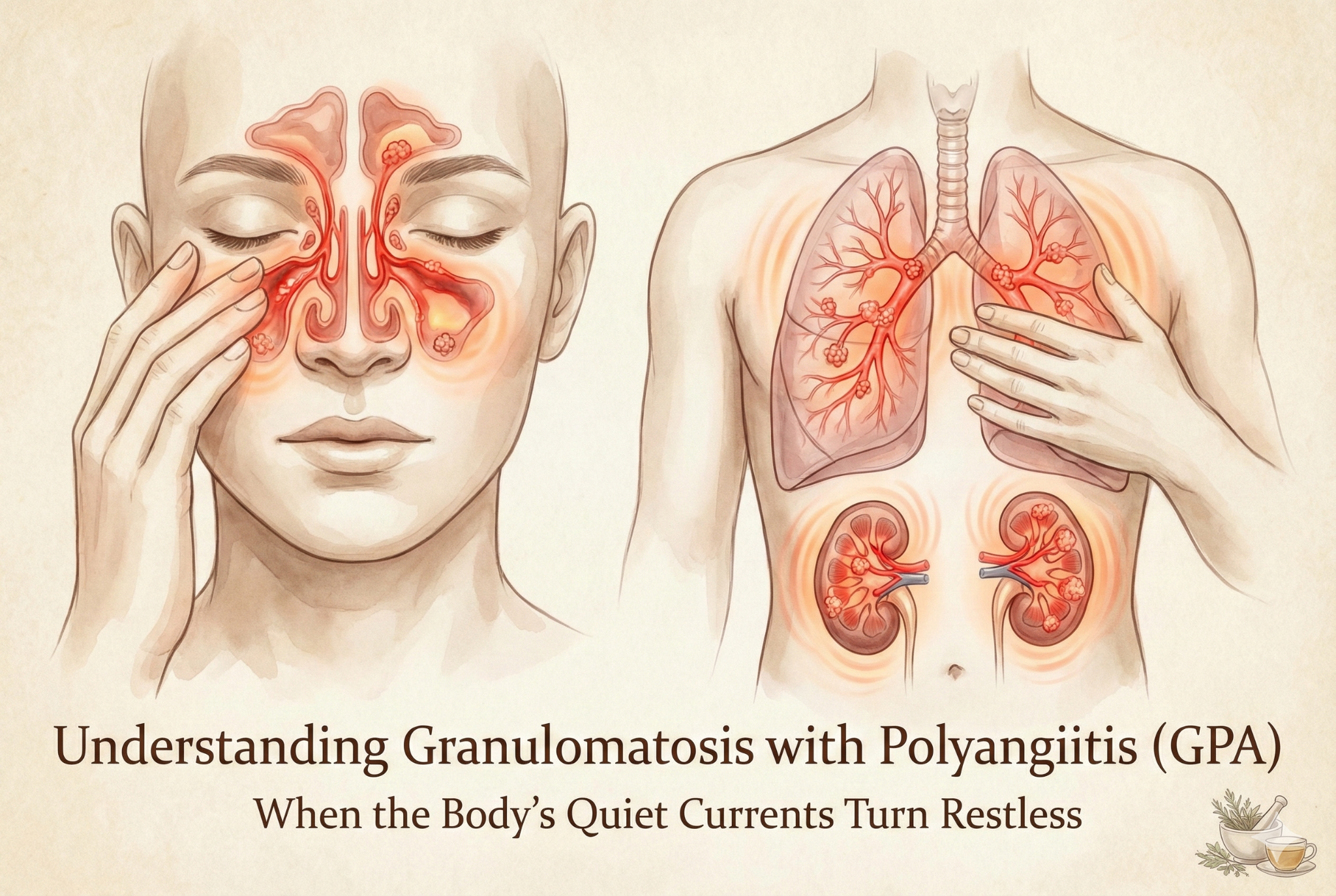
Granulomatosis with Polyangiitis, once known as Wegener’s Granulomatosis, is a rare autoimmune disorder that causes inflammation in the blood vessels — a condition called vasculitis.
This inflammation can narrow or block the tiny vessels that carry blood to organs, most often affecting the sinuses, lungs, and kidneys.
As the vessels swell, tissues are deprived of oxygen and nourishment, and small areas may begin to scar.
The immune system, in its confusion, builds little “granulomas” — clusters of immune cells that form where the body believes it must defend.
The name may sound complex, but at its heart, GPA is the story of a body that has forgotten how to rest — a body that protects too much, until protection becomes harm.
How It Feels
The symptoms can be subtle at first — a bit of sinus pressure, nosebleeds that come too often, a cough that won’t go away.
But over time, they deepen, sometimes involving the lungs, kidneys, skin, or even joints.
People living with GPA often describe:
- Constant sinus infections or nasal congestion
- Nosebleeds or nasal crusting that won’t heal
- Coughing, shortness of breath, or chest pain
- Fatigue and unexplained fever
- Joint and muscle pain
- Blood in the urine, indicating kidney involvement
- Ear pain or hearing loss in some cases
There’s often a quiet emotional toll, too — the weariness of chronic illness, the uncertainty of flare-ups, the fear that the body might turn against itself again.
Why It Happens
No one knows exactly why GPA occurs.
It’s believed that a combination of genetic tendencies and environmental triggers — perhaps infections, stress, or exposure to toxins — awaken an immune system already on edge.
Once awakened, the immune system begins to attack the blood vessels, as though fighting an invisible threat.
It’s a pattern seen in many autoimmune illnesses — the body, confused by stress or imbalance, turning inward with too much force.
From a holistic view, this inflammation can reflect deeper unrest — emotions or energy that have stayed unresolved, turning heat inward instead of releasing outward.
The sinuses, lungs, and kidneys — all organs of exchange and cleansing — may be speaking the same message: Let go. Breathe. Rest.
A Gentle, Integrative Approach to Healing
Conventional medicine often uses immunosuppressive medications to calm inflammation and protect organs.
These are essential in many cases and can save lives.
But alongside that, many people find comfort in homeopathic or holistic care, which aims to help the body find peace with itself — to teach the immune system calm rather than suppression.
Homeopathic remedies are chosen based on the individual — the pace of the illness, emotional temperament, and the specific organs involved.
Some often-considered remedies include:
- Silicea – for deep, recurring infections that heal slowly.
- Phosphorus – for lung involvement, weakness, and emotional sensitivity.
- Kali Bichromicum – for chronic sinus infections with thick discharges.
- Arsenicum Album – for restlessness, fatigue, and fear around health.
- Sulphur – for inflammatory tendencies and heat in the system.
(Always work with a trained homeopath for personalized guidance.)
Daily Care and Quiet Strength
Living with GPA means learning to move gently through each day — balancing rest and resilience, listening for what the body asks before it shouts.
- Rest fully, even on days you feel stronger. Healing is built on stillness.
- Eat softly — whole, nourishing foods that cool inflammation and steady energy.
- Avoid toxins like smoke, heavy pollution, or chemical fragrances.
- Stay close to care, working with both medical professionals and holistic practitioners to monitor progress.
- Honor your emotions — unspoken grief, frustration, or exhaustion often sit quietly in the body until they’re seen and released.
Healing is not only physical; it’s emotional and spiritual. The body and heart often heal together.
Finding Peace Beyond the Inflammation
Granulomatosis with Polyangiitis is not a story of weakness — it’s a story of intensity.
The immune system fights too fiercely because, at its core, it wants to protect.
Your body has not betrayed you; it has simply forgotten how to rest.
With time, care, and compassion, it can learn again.
The inflammation can soften. The breath can return. The flow of life — oxygen, energy, ease — can begin to move freely once more.
Healing from GPA is not only about silencing the immune system.
It’s about helping the body remember calm.
And as it does, something deeper begins to shift —
a quiet trust returning, a breath that no longer burns,
a reminder that even after fire, the body can learn to be gentle again.


Leave a Reply