
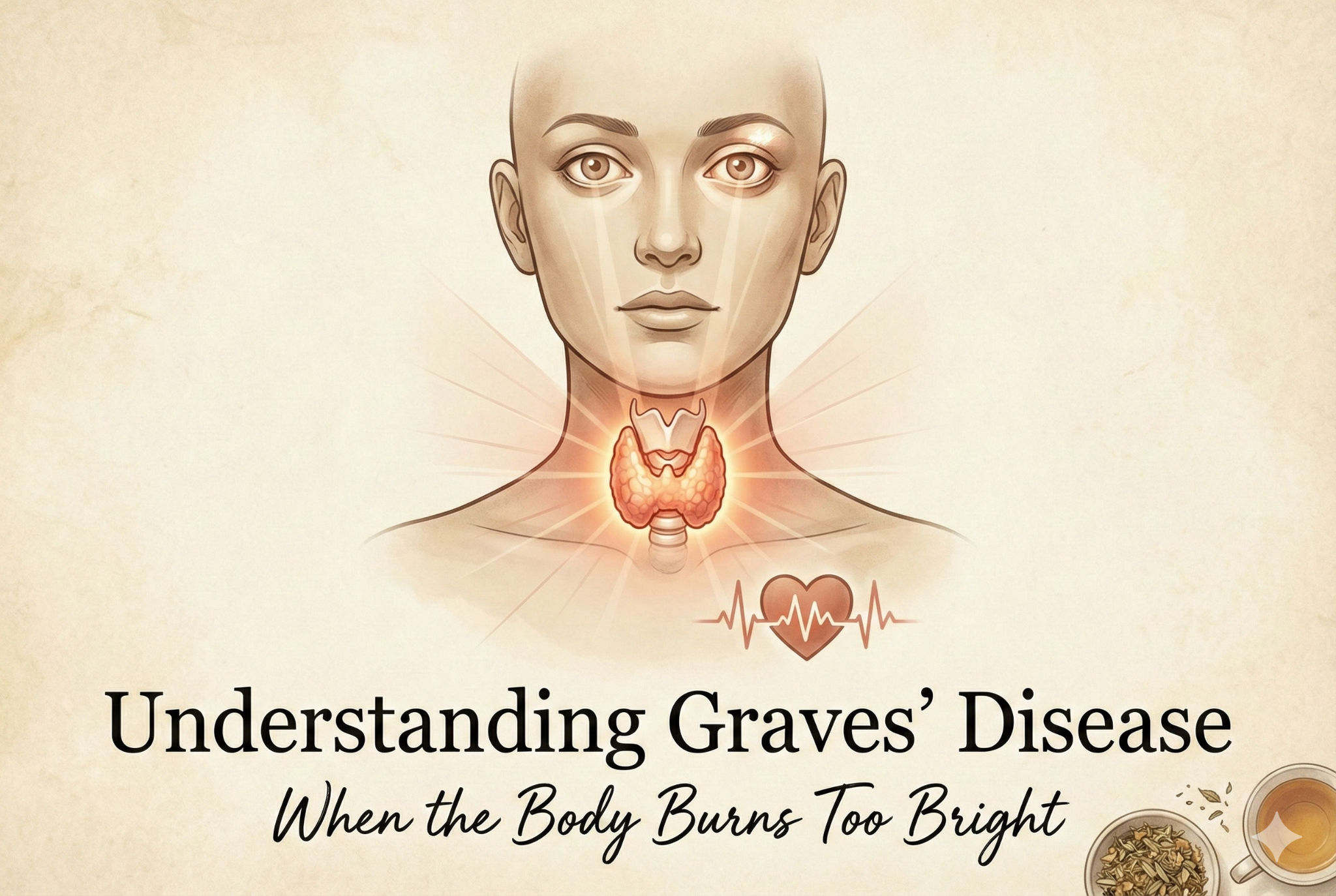
When the Body Burns Too Bright: Understanding Graves’ Disease
There are times when life feels like it’s moving too fast — when the heart races for no reason, sleep becomes shallow, and energy feels more like a surge than a strength.
For some, this inner intensity doesn’t come from stress or excitement; it comes from deep within the body itself — a fire burning too brightly in the thyroid, the small butterfly-shaped gland that rests gently at the base of the neck.
This is the story of Graves’ Disease — a condition where the body’s own energy center becomes overactive, sending every cell into a quiet frenzy.
What Is Graves’ Disease?
Graves’ Disease is an autoimmune disorder that causes the thyroid gland to produce too much hormone — a state called hyperthyroidism.
These hormones control the body’s metabolism — the rhythm that decides how quickly we burn energy, regulate temperature, and maintain emotional balance.
When the immune system begins producing antibodies that overstimulate the thyroid, the body’s quiet rhythm turns into a race.
Every heartbeat, every thought, every breath seems to move faster than it should.
The thyroid, meant to be the gentle conductor of the body’s orchestra, starts playing too loudly.
How It Feels
Graves’ Disease doesn’t whisper; it hums beneath the skin.
At first, the symptoms might seem like simple anxiety or stress, but gradually they weave into every part of daily life.
People often describe:
- A rapid heartbeat or palpitations — the feeling that the heart is fluttering or pounding.
- Heat intolerance — always feeling too warm, even when others are comfortable.
- Weight loss despite good appetite, as metabolism speeds up.
- Tremors or restlessness — hands that won’t stay still, thoughts that won’t slow down.
- Nervousness, irritability, or insomnia.
- Thinning hair, sweating, or muscle weakness.
- Changes in the eyes, such as puffiness or bulging (known as Graves’ ophthalmopathy).
It can feel as though the whole body is on edge — the mind racing, the pulse quickening, the spirit weary from the constant motion.
And beneath it all lies a deeper fatigue — the exhaustion of living in a body that won’t stop running.
Why It Happens
The exact reason the immune system begins to attack the thyroid isn’t fully understood.
But stress, infection, hormonal changes, and emotional strain often play their part — waking an immune system that becomes too alert, too protective.
In Graves’ Disease, antibodies called thyroid-stimulating immunoglobulins (TSI) bind to the thyroid and push it to release more hormone than needed.
It’s as if the body is burning energy in anticipation of a battle that never arrives.
From a holistic view, Graves’ Disease can be seen as the body’s call for slowing down — a reminder that something inside has been moving too quickly for too long.
The thyroid, the gland of vitality and expression, may simply be saying: “I can’t hold this pace anymore.”
A Homeopathic and Holistic View: Cooling the Inner Fire
Homeopathy and holistic care approach Graves’ Disease as a disturbance in the body’s balance — a system overheated and overreacting.
The goal is to soothe, not suppress — to help the body remember calm, to teach it how to burn gently again.
Commonly considered remedies include:
- Iodum – for restless energy, heat, and constant hunger with weight loss.
- Phosphorus – for palpitations, sensitivity, and emotional overstimulation.
- Lycopus Virginicus – known to calm an overactive thyroid and rapid pulse.
- Spongia Tosta – for heat, dryness, and throat tightness.
- Arsenicum Album – for anxiety, exhaustion, and fear that something terrible may happen.
(Always work with a trained homeopath for personalized guidance.)
Each person’s journey is different — and the choice of remedy depends on their emotional landscape, physical symptoms, and pace of life.
Homeopathy works gently, helping the thyroid and immune system find peace again, often alongside conventional treatment.
Daily Care: Restoring Balance Gently
When living with Graves’ Disease, healing is not only medical — it’s emotional and spiritual. The body needs stillness as much as it needs medicine.
- Rest often, even if you feel wired — fatigue hides behind hyperactivity.
- Choose calming foods — whole grains, cooling vegetables, fresh fruit, and nourishing soups. Avoid excess caffeine or sugar, which can feed the inner fire.
- Practice quiet breathing — slow, deep breaths that invite calm back into the nervous system.
- Spend time in nature, letting the body match its rhythm to something steadier than stress.
- Protect your peace — emotional overstimulation fuels physical overstimulation.
Healing begins when the body feels safe enough to slow down.
Finding Stillness After the Fire
Graves’ Disease can feel like living with too much light — too much energy, too much heat, too much everything.
But beneath that fire lies the same wisdom that burns in all living things — the desire to stay alive, to protect, to express.
Your body isn’t your enemy.
It’s simply overwhelmed, asking for stillness after years of doing too much.
With time, care, and compassion, that overactive flame can soften.
The heart steadies. The breath deepens. The mind quiets.
And what remains is balance — the warm, steady glow of energy that no longer burns, but simply lives.
Your body remembers peace.
It just needs to be reminded — gently, patiently, lovingly.


Leave a Reply