
When Strength Turns to Stillness: A Homeopathic View of Juvenile Myositis (JM)
There is something deeply moving about the way a child moves — with effortless strength, unguarded freedom, and a trust in their own body’s power.
But for some children, this freedom begins to fade. Climbing stairs becomes hard. Lifting arms feels heavy. A playful day turns into quiet exhaustion.
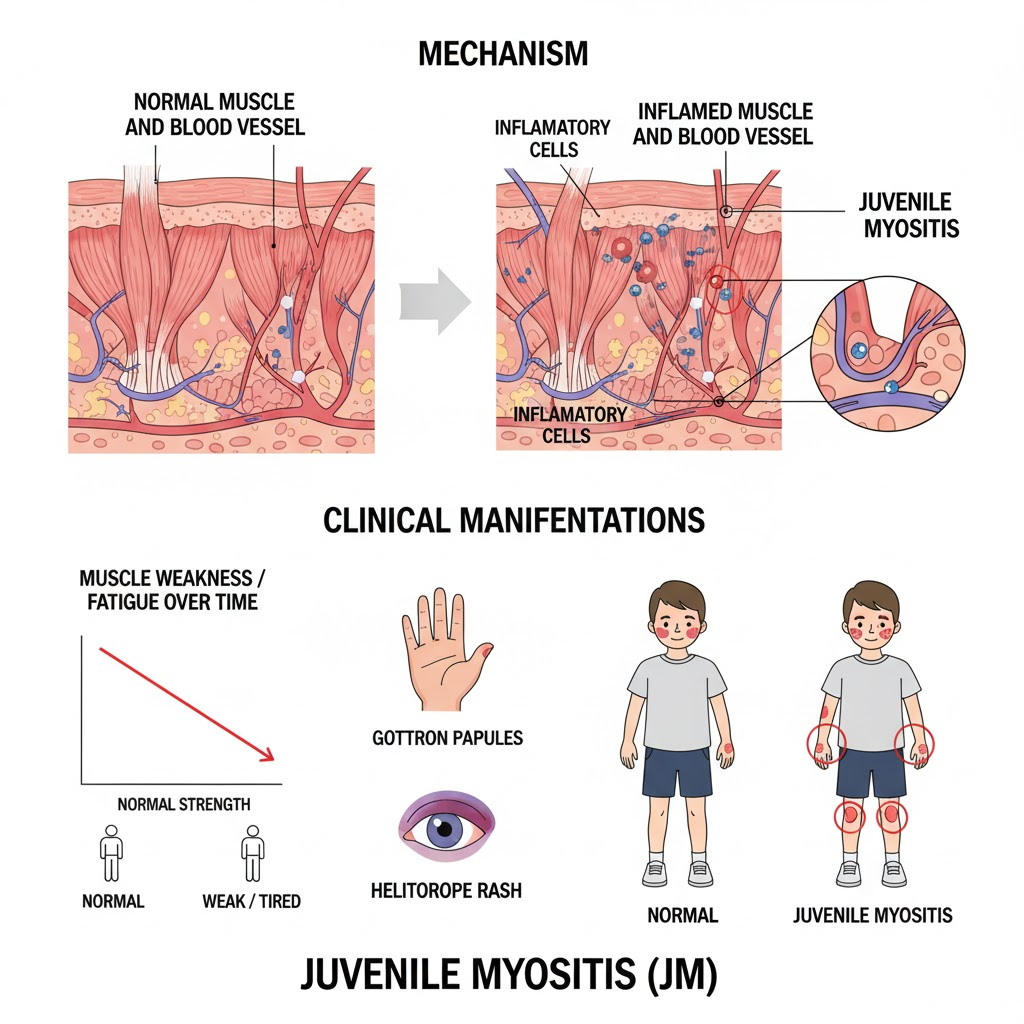
This is Juvenile Myositis (JM) — a condition where the body’s own defenses begin to attack its muscles, causing weakness and inflammation where once there was ease.
It can be confusing, even heartbreaking, for both the child and the family. You may look at your little one and wonder, why does something so full of life suddenly struggle to move?
Yet in this question lies the beginning of deeper understanding — because healing begins not with fighting the body, but with listening to what it’s trying to say.
When the Body’s Strength Feels Lost
Juvenile Myositis doesn’t always arrive loudly. Sometimes it starts with small changes — trouble getting up from the floor, fatigue after play, a rash on the face or hands, or muscle pain that lingers.
The body, once full of energy, begins to tire easily. Even smiles may come slower, as fatigue settles deep into the muscles.
But homeopathy teaches us to look beyond symptoms.
Behind the body’s inflammation, there is often a story — of inner tension, sensitivity, or quiet emotional strain.
The muscles, which carry us through life, may be expressing something that words never could: the weight of unspoken emotion, fear, or loss of inner confidence.
The Homeopathic View: Listening to the Child’s Inner Song
Homeopathy sees Juvenile Myositis not as an error, but as a message — a call from the body’s intelligence asking for balance.
The goal is not to suppress inflammation, but to help the child’s energy — the vital force — find harmony again.
Each child’s illness carries a personal imprint. One child may have become quiet and withdrawn, another frustrated or fearful, another weary but brave.
A homeopath listens to these subtleties — the tone of the voice, the light in the eyes, the emotional undercurrent beneath the physical pain.
Remedies are chosen based on the whole child, not just the diagnosis — because the illness is never just in the muscles, but in the deeper rhythm of the being.
Remedies Often Considered
Every child’s journey is unique, yet some remedies are often called upon to restore balance and vitality:
- Causticum – for weakness with stiffness and emotional sensitivity; children who cry easily at others’ pain and have a quiet inner strength.
- Rhus Toxicodendron – for muscle stiffness and soreness that improves with gentle movement, worse after rest or cold weather.
- Phosphorus – for delicate, open-hearted children who tire easily, crave affection, and are deeply affected by fear or sadness.
- Calcarea Phosphorica – for thin, growing children who feel weak, chilly, and discouraged, especially after exertion.
- Gelsemium – for children who feel dull, tired, and shaky, as if energy has slipped away quietly.
(Always work with a trained homeopath for personalized guidance.)
Gentle Ways to Support Healing
Healing from Juvenile Myositis asks for patience — from the body, from the parents, from life itself.
Children need not only medicine but atmosphere: warmth, rhythm, and the steady reassurance that they are safe in their own skin.
- Rest with compassion, not guilt. The body heals best when it feels safe.
- Encourage gentle movement, as tolerated — stretching, swimming, or light play, to remind the body of its fluid grace.
- Nourish simply, with fresh fruits, greens, warm soups, and anti-inflammatory herbs like turmeric and ginger.
- Avoid overexertion or emotional pressure. Children heal in calm, steady environments.
- Bring in laughter. Joy and creativity are medicine that no pharmacy can bottle.
When life becomes slower, let it be sacred — a time for reconnection, not just recovery.
The Emotional Landscape of a Brave Heart
Children with JM often carry invisible emotions. They may not say much, but the body speaks — through fatigue, soreness, or quiet sadness.
They may feel left out, or frightened that they can’t “keep up” with others. Some may fear disappointing their parents or teachers.
Homeopathy honors this emotional truth.
It seeks not only to bring strength back to the muscles, but also peace back to the child’s heart — a sense that their worth is not measured in speed or strength, but in the simple beauty of being.
When the right remedy meets the child’s inner story, a soft shift happens: sleep improves, energy returns in waves, and the body starts remembering movement as joy, not effort.
A Closing Reflection
Juvenile Myositis is not the end of a child’s freedom — it is a pause, an invitation to move differently, more consciously, more kindly.
Homeopathy walks alongside that journey — not to battle the body, but to teach it to remember its natural rhythm, its gentle power.
Healing is not always about running again — sometimes, it begins with breathing deeply, smiling softly, and learning to trust that movement will return in its own time.
The child’s body knows how to heal.
It just needs space, care, and the tender reminder — whispered through homeopathic medicine — that strength is not lost.
It’s simply waiting to rise again, quietly, from within.


Leave a Reply