
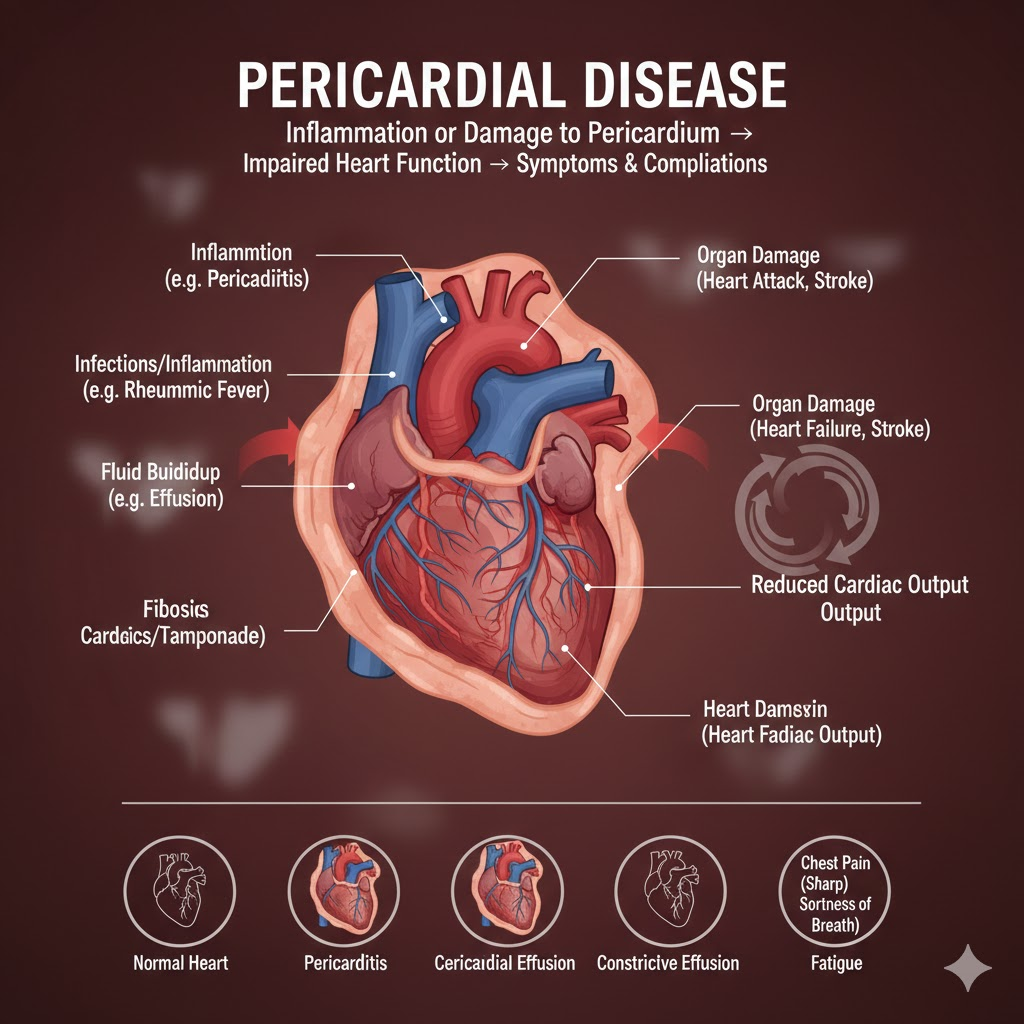
When the Heart’s Protective Embrace Becomes Uncomfortable
The heart is not alone in its work. It is wrapped in a thin, protective sac called the pericardium — a gentle envelope that cushions every beat, absorbs the shocks of daily life, and helps the heart move smoothly within the chest.
Pericardial disease occurs when this protective layer becomes inflamed, thickened, or filled with fluid. It is as if the heart’s comforting hug becomes tight, heavy, or pressuring — a reminder that even the strongest hearts sometimes need care.
It often arrives quietly at first: a subtle pressure in the chest, fatigue, or a heaviness that is difficult to describe. But slowly, it shapes how the body moves, breathes, and even rests.
Understanding the Condition
The pericardium is meant to protect and ease the heart’s movements. But when it becomes irritated or filled with excess fluid, it can no longer move as freely.
Common forms include:
- Pericarditis — inflammation of the pericardium, often sharp or stabbing in sensation.
- Pericardial effusion — excess fluid around the heart, creating a feeling of fullness or pressure.
- Constrictive pericarditis — thickening or scarring that limits the heart’s natural expansion.
Causes may include viral or bacterial infections, autoimmune reactions, chronic inflammation, heart surgery, or trauma. Sometimes, it appears after a long-standing illness, gently reminding the person to listen to the heart’s needs.
How It Feels — The Human Experience
Pericardial disease often speaks through sensations rather than loud alarms:
- Chest pressure or heaviness — sometimes worsening when lying down or taking a deep breath.
- Shortness of breath — a gentle whisper that the heart cannot move as freely.
- Fatigue — subtle, persistent, difficult to shake.
- Palpitations or irregular heartbeat — the heart’s struggle to move smoothly in its confined space.
- Swelling in the abdomen or legs — as fluid accumulates.
- Emotional weight — anxiety, fear, or a sense of vulnerability may accompany physical symptoms.
Living with pericardial disease can feel like carrying a soft but constant pressure — one that asks for attention, patience, and tenderness.
Why It Happens — A Deeper Perspective
The pericardium becomes inflamed or compromised when the body’s defenses are overactive or misdirected:
- Following infection or illness
- After emotional or physical trauma
- With autoimmune conditions or chronic inflammation
- Due to long-term stress or fatigue
It is not a sign of weakness.
It is a protective system — sometimes overprotective — asking the person to pause, breathe, and honor the heart’s rhythm.
Homeopathic Understanding — Restoring Harmony to the Heart’s Envelope
Homeopathy sees pericardial disease as a disruption of the body’s vital force — a gentle but persistent blockage or irritation in the area surrounding the heart. Remedies aim to reduce inflammation, support circulation, ease fluid imbalance, and calm emotional strain.
A homeopath listens to the whole story:
- How does the chest feel?
- What emotions are present with the physical symptoms?
- When does discomfort increase or lessen?
- How has life’s stress shaped the heart’s protective patterns?
Commonly Considered Remedies
Aconitum napellus
For sudden, intense pain or anxiety, often following shock or fright.
Bryonia alba
For stitching chest pains worsened by movement or deep breathing; dryness and fatigue accompany symptoms.
Arsenicum album
For restlessness, anxiety, and the feeling of tightness or pressure in the chest.
Kalmia latifolia
For radiating heart pains and pressure, especially when the left side is involved.
Rhus toxicodendron
For pericardial inflammation associated with stiffness and discomfort, sometimes worse with rest.
Spongia tosta
For constrictive sensations in the chest, as if the heart is wrapped tightly.
All remedies should be individualized and coordinated with a physician or cardiologist.
Gentle Daily Care — Supporting a Heart Under Pressure
Healing the pericardium requires patience, care, and awareness:
- Rest and gentle pacing — let the body and heart breathe.
- Warm, nourishing foods — broths, lightly spiced meals, and anti-inflammatory foods like turmeric, ginger, and leafy greens.
- Breathing practices — slow, mindful breaths ease pressure and support circulation.
- Emotional tending — journaling, counseling, meditation, or soft movement practices to release tension in the chest.
- Hydration and gentle movement — support fluid balance without overexertion.
- Follow medical advice — regular monitoring and safe interventions are essential.
A Closing Reflection
Pericardial disease is not a punishment.
It is the body’s quiet call for attention, reminding us that the heart, though resilient, sometimes needs care beyond its usual strength.
The heart’s protective envelope is a sacred space — and when it becomes tight, inflamed, or heavy, it asks us to slow down, breathe, and honor the rhythm within.
With gentleness, patience, and compassion, both the body and the heart can regain harmony:
The pressure softens.
The breath deepens.
The heart remembers how to move freely — carrying not only blood, but life, love, and the courage to continue.



Leave a Reply