
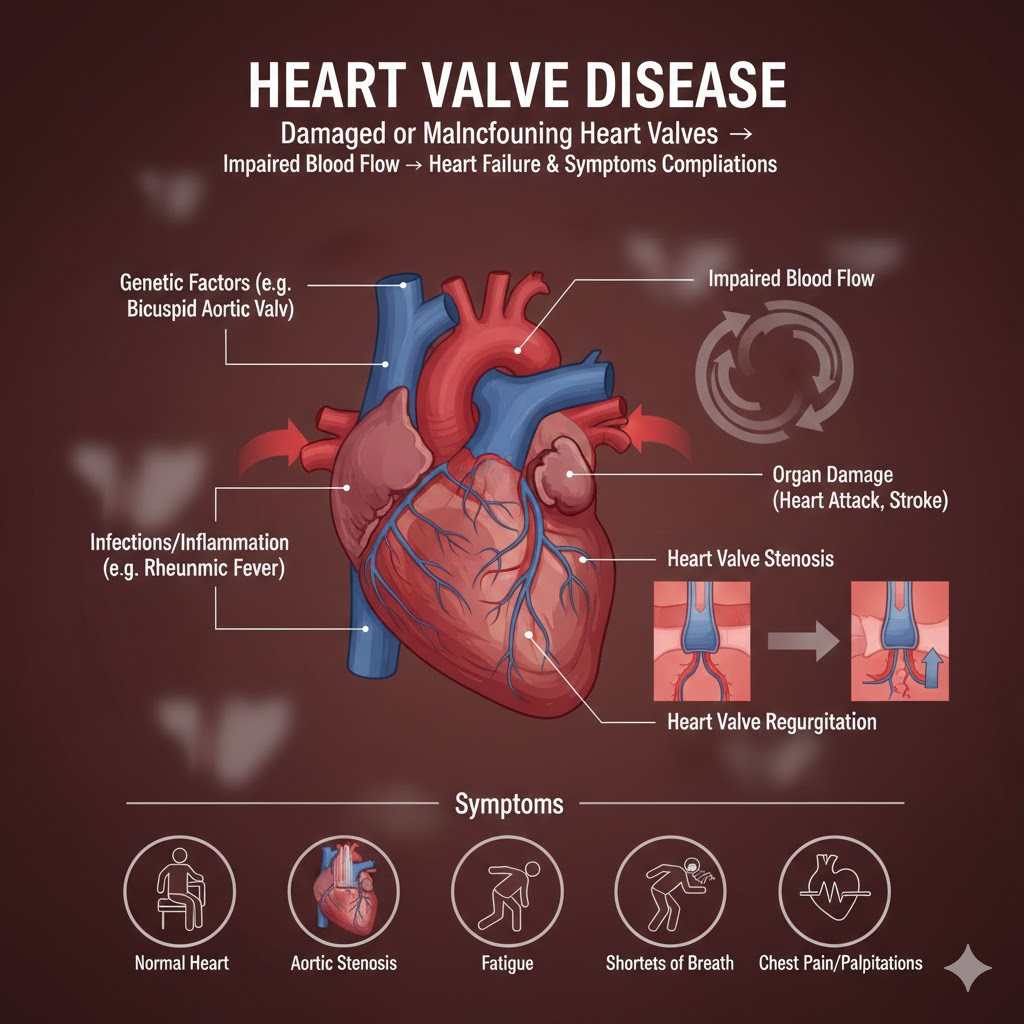
When the Heart’s Doors Begin to Lose Their Grace
The heart is a home with four small doors —
each opening and closing in perfect rhythm,
each allowing life to move gently from one chamber to the next.
When these doors — the heart valves — begin to stiffen, leak, or lose their smoothness, the rhythm changes.
Not suddenly, not violently,
but like a door that creaks open a little slower,
or fails to close completely when the wind pushes through.
Heart valve disease is the story of these doors growing tired…
and the heart having to work a little harder to keep life flowing.
Understanding the Condition — What Is Heart Valve Disease?
The heart has four valves:
- Aortic valve
- Mitral valve
- Tricuspid valve
- Pulmonary valve
These valves ensure blood always moves forward —
never backward, never lost.
In heart valve disease, one or more of these valves may:
Narrow (Stenosis)
The door becomes tight, rigid, difficult to open.
The heart must push harder just to move the blood.
Leak (Regurgitation)
The door doesn’t close fully.
Blood slips backward, forcing the heart to repeat its efforts.
Lose shape or support (Prolapse)
The valve becomes weak or floppy, creating irregular flow.
The cause may be age, infection, birth defects, high blood pressure, or simply years of quiet strain.
But whatever the reason, the heart is not failing —
it is adapting, doing its best to keep life moving.
How It Feels — The Inner Experience
Living with heart valve disease often feels like walking with a weight you didn’t realize you were carrying.
Breathlessness
Not immediately — but gradually, breath becomes less spacious, especially when walking or climbing.
Fatigue that arrives too early
The heart works harder, so energy becomes precious.
Chest sensations
A heaviness, a flutter, a pressure —
not always painful, but noticeable.
Palpitations
Moments where the heart seems to hurry or stumble.
Swelling in legs or belly
From fluid the heart struggles to move forward.
Lightheadedness
The mind reflecting the heart’s effort.
Emotionally, people often describe:
- A sense of fragility
- A fear of overexertion
- A longing for the days when energy felt effortless
- A deep respect for the heart’s quiet labor
The heart valves may be small —
but the burden they carry touches the entire body,
and the entire emotional landscape.
Why It Happens — The Deeper Roots
Heart valve disease can arise from:
- Aging (valves naturally stiffen)
- Rheumatic fever or infection
- Congenital valve defects
- High blood pressure
- Connective tissue disorders
- Wear and tear over years
But beneath the physical reasons, there is often a human story:
Years of pushing through fatigue.
Years of carrying emotional weight.
Years of not listening to the quiet whispers of the body.
Sometimes it is simply life, taking its toll gently, slowly, inevitably.
The Homeopathic Perspective — Healing the Heart’s Rhythm
Homeopathy sees heart valve disease not only as a structural issue but as a disturbance of inner vitality — a sign that the heart’s rhythm has been shaped by both physical strain and emotional history.
A homeopathic practitioner listens to the whole story:
When did the breath grow short?
What stresses, losses, or pressures have shaped your life?
How do fear, grief, or fatigue show themselves in your body?
Commonly Considered Remedies
Crataegus oxyacantha
A profound heart nourisher — strengthens the heart muscle and supports valve function with gentle steadiness.
Digitalis purpurea
For slow, irregular pulses; valve weakness; anxiety centered on the heart; and deep fatigue.
Cactus grandiflorus
When the heart feels gripped or squeezed — often linked with emotional tightness.
Spigelia
For sharp or stitching heart pains, palpitations, and valve-related discomforts.
Laurocerasus
For severe weakness of circulation, breathlessness, and bluish tinges.
Arnica montana
For hearts “overworked” from physical or emotional strain — when the heart feels bruised or weary.
Homeopathy seeks to strengthen the heart from within, improve vitality, ease emotional burdens, and support the natural rhythm that may have been disrupted.
(Always work with a qualified homeopath and continue all conventional heart care.)
Gentle Daily Care — Supporting a Tired Heart
Healing heart valve disease is not about force.
It is about softening, slowing, nourishing.
Rest fully
The heart does not heal through pushing.
It heals through gentleness.
Eat light but nourishing meals
Warm foods, healthy fats, minerals, leafy greens — all support the heart’s quiet work.
Avoid excessive salt
To reduce fluid strain.
Move slowly and lovingly
Small walks, stretching, slow breathing — never pushing past comfort.
Emotional care
The heart responds to every feeling.
Allow yourself to process grief, stress, or fear without guilt.
Breathing practices
Deep, slow breaths help the heart feel less pressured and more supported.
Follow medical guidance
Modern and holistic care together offer the safest path.
A Closing Reflection
Heart valve disease is not the story of a broken heart —
but of a heart that has worked faithfully for years,
opening and closing its delicate doors thousands of times a day,
without once asking for gratitude.
When those doors grow stiff or tired, it is not weakness.
It is a sign that the heart needs a new kind of relationship with life —
gentler, slower, more tender.
And in that gentleness, healing begins:
The breath deepens.
The fear softens.
The rhythm steadies.
The heart remembers its strength.
The heart, even when tired, still knows how to love, how to carry, how to endure —
with quiet wisdom and infinite grace.



Leave a Reply