
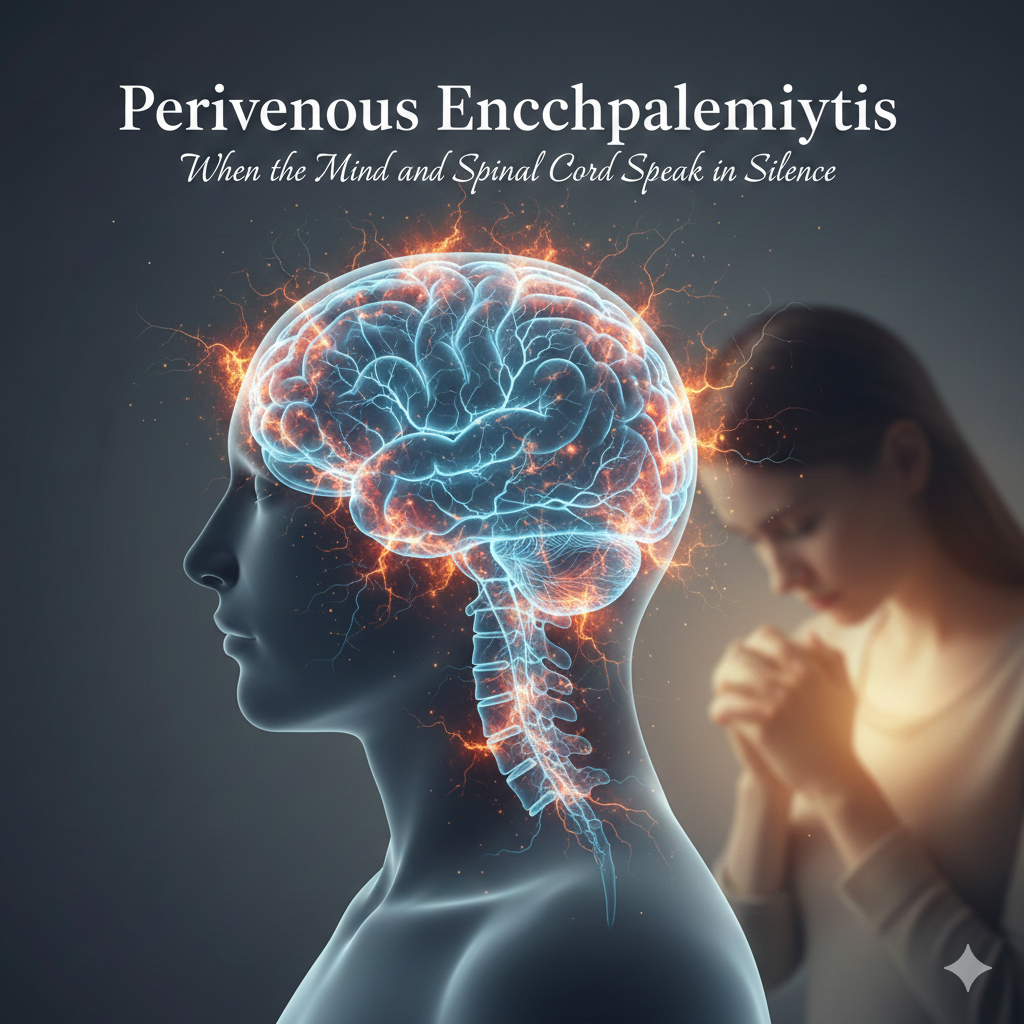
When the Mind and Spinal Cord Speak in Silence: Understanding Perivenous Encephalomyelitis
Some illnesses announce themselves with dramatic signs — fever, rash, or sudden pain.
Others speak more quietly, through confusion, weakness, or subtle shifts in the body and mind.
Perivenous Encephalomyelitis (PVE) is one of these conditions — a rare, sudden inflammation that touches the brain and spinal cord, creating a ripple through both body and spirit.
It often begins after an infection or, in some cases, a vaccination. You may notice:
- Sudden weakness or numbness in the limbs
- Changes in vision or balance
- Headaches, fever, or fatigue
- Confusion, drowsiness, or difficulty concentrating
The onset can feel frightening. One day you feel fine, and the next, the body’s communication seems disrupted.
Though rare, for those who experience it, PVE can feel isolating and bewildering — the mind and body speaking in ways that are hard to interpret.
What Is Perivenous Encephalomyelitis?
PVE is an inflammation of the protective sheath (myelin) surrounding nerves in the brain and spinal cord.
This inflammation occurs around small veins — “perivenous” — leading to slowed or disrupted signals between the brain and body.
It is often triggered by an immune response to infection or, rarely, vaccination.
It is not contagious. It is not caused by fault or weakness.
It is the body’s defenses misdirected — a temporary miscommunication that requires care, patience, and support.
How It Feels
Living with PVE can feel like being trapped between two worlds — the body struggling to move, and the mind struggling to focus:
- Weakness or paralysis in limbs
- Numbness, tingling, or unusual sensations
- Fatigue that rest cannot fully relieve
- Confusion, memory lapses, or difficulty speaking
- Emotional challenges: fear, uncertainty, anxiety, and a sense of loss of control
Yet within these difficulties, many discover patience, self-compassion, and a deeper connection to their own body’s rhythms.
Why It Happens
PVE arises when the immune system, after an infection or trigger, mistakenly attacks the myelin around nerve fibers.
- This leads to inflammation around small veins, slowing or blocking nerve signals.
- The exact triggers are often infections of the respiratory tract, sometimes vaccinations, or unknown factors.
- Recovery is usually gradual, but the brain and spinal cord often repair themselves over time with supportive care.
It is not punishment. It is a signal that the nervous system needs calm, protection, and gentle support.
The Homeopathic Understanding: Supporting Nervous System Harmony
Homeopathy views PVE as a disturbance in the vital balance of the nervous system.
The goal is to help the body restore its own rhythm of communication, reduce inflammation, and gently support recovery.
Some remedies often considered include:
- Gelsemium – for weakness, drowsiness, and delayed reactions.
- Arnica Montana – for post-infection nerve inflammation or trauma.
- Hypericum Perforatum – for nerve irritation, tingling, and shooting pain.
- Ruta Graveolens – for weakness and slow nerve recovery in limbs.
Each remedy works subtly, guiding the body toward self-repair and balance. (Always consult a qualified homeopath for individualized guidance.)
Gentle Daily Care
- Rest and protect the body – allow recovery without overexertion.
- Nourish mindfully – foods rich in antioxidants, healthy fats, and vitamins support nerve and brain health.
- Stay hydrated – water aids circulation and cellular repair.
- Support cognition and calm – gentle mental exercises, meditation, and mindfulness can soothe the nervous system.
- Collaborate closely with medical teams – homeopathy and holistic care complement conventional neurological management.
Healing is not rushed; it is slow, patient, and compassionate — honoring both mind and body.
Life Beyond the Diagnosis
Living with PVE is a journey through uncertainty, awareness, and resilience:
- Noticing small gains in movement, coordination, or mental clarity
- Trusting in the nervous system’s remarkable capacity to repair
- Cultivating patience, self-compassion, and deep presence
Even when the body falters, the mind and spirit endure. Every step of recovery, every quiet improvement, is proof that the body remembers how to heal.
You are not merely surviving Perivenous Encephalomyelitis — you are learning to live with gentle awareness, resilience, and profound human courage.


Leave a Reply