
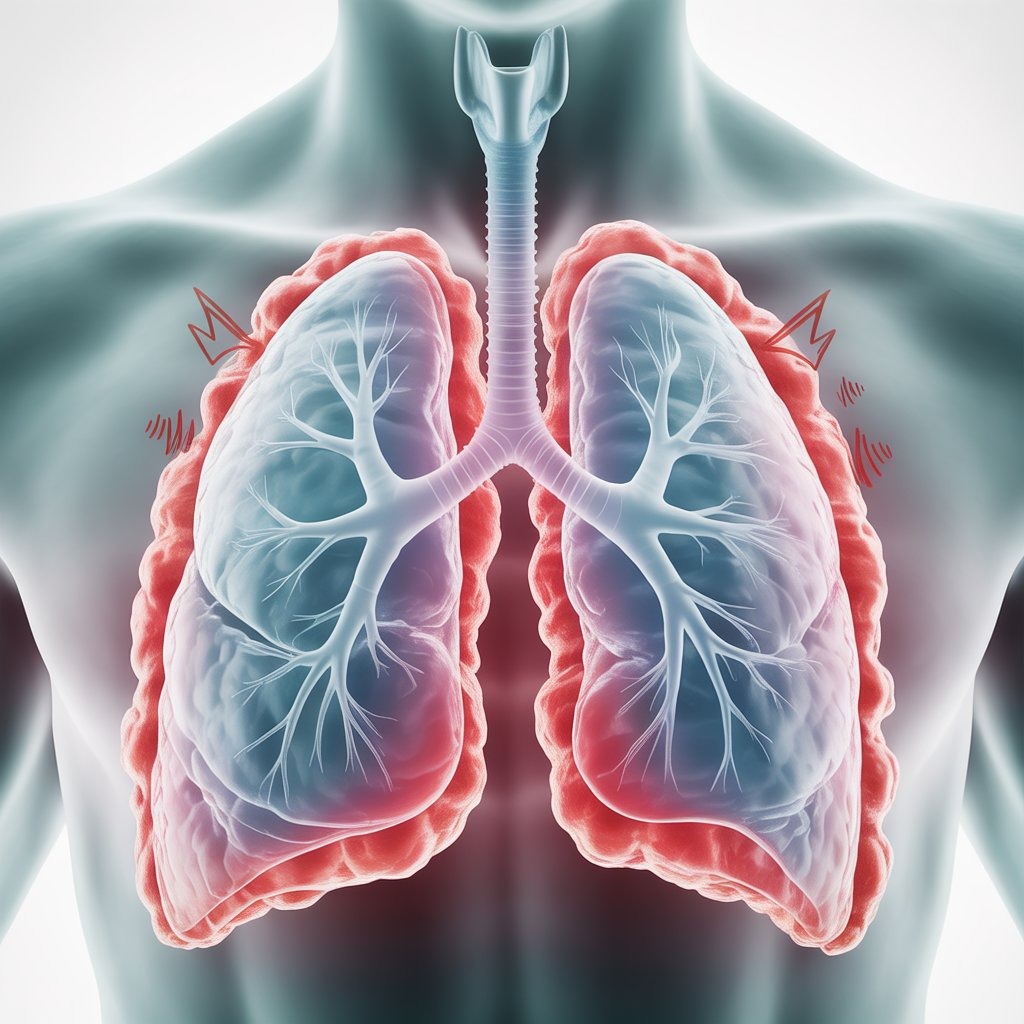
When every breath feels tender
There are times when breathing — something we trust without thinking — suddenly becomes careful, measured, almost guarded.
A deep breath brings a sharp reminder.
A cough sends a ripple of pain through the chest.
Even laughter feels restrained.
Pleurisy enters the body quietly but makes itself known with each breath.
It is not only discomfort in the chest —
it is the feeling that the lungs and the body are no longer moving together with ease.
Understanding the Condition
Pleurisy is an inflammation of the pleura — the thin, delicate membranes that line the lungs and the inner chest wall.
Normally, these layers glide smoothly over one another with every breath, assisted by a small amount of fluid.
In pleurisy, inflammation disrupts this harmony.
The surfaces become irritated.
Movement creates friction.
Breathing — once effortless — becomes painful.
Pleurisy may arise from:
- Viral or bacterial infections
- Pneumonia
- Tuberculosis
- Autoimmune conditions
- Pulmonary embolism
- Chest injury
- Inflammation spreading from nearby structures
The condition itself is not the enemy —
it is a signal that something deeper needs attention.
How It Feels — The Lived Experience
Pleurisy has a very distinct presence.
Physically, people often describe:
- Sharp, stabbing chest pain
- Pain that worsens with deep breathing, coughing, or sneezing
- Shallow breathing to avoid discomfort
- Tenderness along the ribs
- Breathlessness due to guarded respiration
- Fever or fatigue if infection is present
Emotionally, there may be:
- Anxiety around breathing deeply
- Fear of movement
- Irritability from persistent pain
- A sense of fragility — as though the chest must be protected
Many instinctively hold their breath more than they realize, not out of choice, but out of self-protection.
Why It Happens — A Deeper Reflection
The pleura exists to allow freedom of movement.
When it becomes inflamed, that freedom is temporarily lost.
From a broader perspective, pleurisy often follows a period where the body has been fighting — infection, inflammation, or internal stress.
The tissues become sensitive, reactive, and sore.
It is not weakness.
It is the body saying:
“Something has irritated me. I need care. I need time.”
The Homeopathic Understanding — Listening to the Pain
Homeopathy approaches pleurisy with deep respect for the individuality of pain.
It asks:
- Is the pain sharp or burning?
- Does movement worsen it?
- Is the person anxious, restless, or withdrawn?
- Does cold air aggravate or soothe?
- Did the condition follow infection, exposure, or emotional shock?
Remedies are chosen not for the diagnosis alone, but for how the person experiences the illness.
Commonly considered remedies may include:
Bryonia
When pain is sharp, stitching, and worse with the slightest movement — the person prefers to lie very still.
Ranunculus Bulbosus
For intense, localized chest pain that feels sore, bruised, or stabbing.
Aconitum
When pleurisy begins suddenly after cold exposure, with anxiety and fear.
Phosphorus
For chest tightness, burning pain, sensitivity, and emotional openness.
Arsenicum Album
When pain is accompanied by anxiety, restlessness, and weakness.
Sulphur
For lingering inflammation, heat, and sensitivity, especially during recovery.
(Homeopathic care should always be guided by a qualified practitioner and used alongside appropriate medical evaluation.)
Gentle Daily Care
- Rest is essential — the pleura heals with stillness
- Avoid deep forced breathing during acute pain
- Keep the chest warm and protected
- Hydrate well to support tissue recovery
- Follow medical treatment if infection is present
- Return to activity gradually, respecting the body’s pace
Pain teaches the body caution —
healing restores trust.
A Closing Reflection
Pleurisy reminds us how intimate breathing truly is.
Each breath moves not just air, but tissue, sensation, and life itself.
When the chest aches with every inhale, the body asks us to slow down —
to breathe gently,
to listen closely,
to rest without resistance.
And slowly, as inflammation settles,
the lungs remember their rhythm,
the chest softens,
and breath once again moves freely —
quiet, unguarded, and whole.


Leave a Reply