
When breath feels weighed down
There are times when breathing does not hurt sharply, but feels heavy — as though something unseen is pressing gently yet persistently against the chest.
The breath shortens.
Lying flat becomes uncomfortable.
Fatigue settles in without clear reason.
Pleural effusion often arrives this way — quietly, gradually — not with stabbing pain, but with a sense that the lungs no longer have the space they need.
It is the body holding excess fluid where there should be lightness, asking for attention in a soft but steady voice.
Understanding the Condition
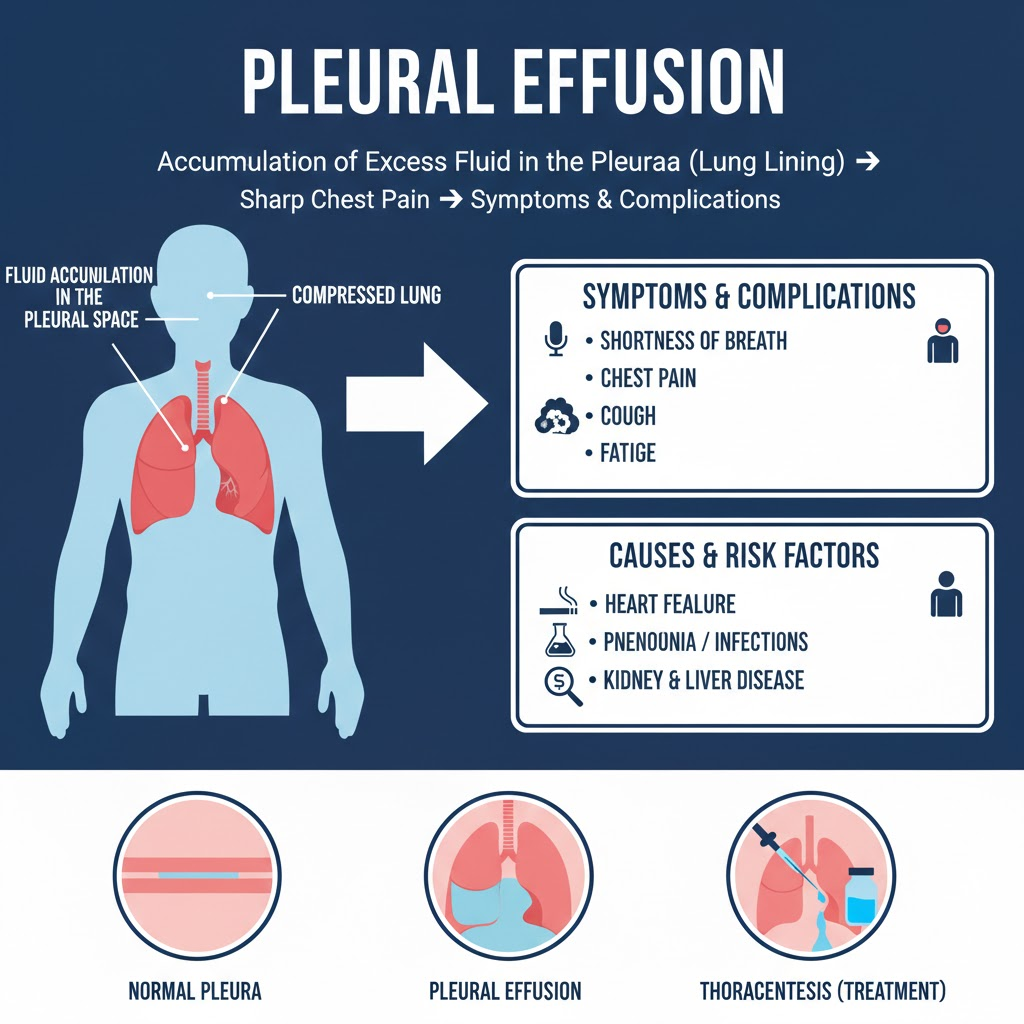
Pleural effusion is the accumulation of fluid in the pleural space, the narrow area between the lungs and the chest wall.
Normally, this space contains only a thin layer of fluid that allows smooth movement during breathing.
When more fluid collects than the body can absorb, it begins to compress the lungs.
This can occur due to:
- Infections such as pneumonia or tuberculosis
- Heart failure
- Liver or kidney disease
- Cancer
- Pulmonary embolism
- Autoimmune or inflammatory conditions
- After surgery or trauma
Pleural effusion is not a disease by itself —
it is a sign, a reflection of imbalance elsewhere in the body.
How It Feels — The Inner Experience
Pleural effusion often feels subtle at first.
Physically, one may notice:
- Shortness of breath, especially on exertion
- A heavy or full sensation in the chest
- Difficulty breathing while lying flat
- Dry cough
- Reduced stamina
- Chest discomfort rather than sharp pain
If infection or inflammation is present:
- Fever
- Weakness
- Loss of appetite
Emotionally, people often describe:
- Anxiety around breathing
- A constant awareness of the chest
- Fear of exertion
- Frustration from limited energy
It can feel as though the body is holding its breath — not from pain, but from lack of space.
Why It Happens — A Deeper View
Fluid accumulation reflects imbalance in circulation, inflammation, or pressure.
The body may:
- Leak fluid due to inflammation
- Retain fluid due to heart or kidney strain
- React to infection or malignancy
- Struggle to drain fluid effectively
This is not failure.
It is the body responding to overload —
trying to protect the lungs while managing a deeper challenge.
The Homeopathic Understanding — Supporting Release and Balance
Homeopathy views pleural effusion as a disturbance in the body’s fluid regulation and vital rhythm.
A homeopath listens carefully:
- Is the breath worse lying down or moving?
- Is there heaviness, burning, or stitching pain?
- Is the person anxious, exhausted, or withdrawn?
- Did the condition follow infection, heart strain, or emotional shock?
Remedies are selected based on the total experience, not fluid alone.
Commonly considered remedies include:
Bryonia
When breathlessness and discomfort worsen with movement, and the person prefers stillness.
Arsenicum Album
For anxiety-driven breathlessness, weakness, restlessness, and fear, especially at night.
Apocynum Cannabinum
When fluid retention is prominent, with swelling, shortness of breath, and heart involvement.
Digitalis
For pleural effusion related to heart weakness, slow pulse, and breathlessness.
Sulphur
For chronic or lingering effusions with heat, weakness, and slow recovery.
Kali Carbonicum
For breathlessness, weakness, and anxiety, especially when lying flat.
(Homeopathic remedies are supportive and must be guided by a qualified homeopath alongside medical care.)
Gentle Daily Care
- Follow medical evaluation and treatment closely
- Rest with the upper body elevated
- Avoid exertion during breathlessness
- Maintain gentle hydration as advised
- Support underlying conditions (heart, lung, kidney)
- Return to activity slowly as breathing improves
Healing often comes in stages —
first space,
then ease,
then strength.
A Closing Reflection
Pleural effusion reminds us how essential space is —
space for breath,
space for movement,
space for life to flow freely.
When fluid gathers, it is the body’s quiet message that something deeper needs care and balance.
With proper treatment, patience, and support, the lungs can expand again, breath can deepen, and heaviness can slowly lift.
The body knows how to restore harmony —
it only asks that we listen, respond, and allow it the time it needs to breathe freely once more






Leave a Reply