
When the world begins to move without warning
There are moments when the ground feels uncertain, when standing still no longer feels steady, and the world seems to tilt without permission.
Vertigo is not just dizziness.
It is the unsettling experience of movement when there is none — a sensation that the room is spinning, swaying, or pulling away.
For many, vertigo arrives suddenly:
while turning the head,
rising from bed,
or simply standing in a quiet room.
It can feel frightening, disorienting, and deeply vulnerable — as though the body has momentarily lost its internal compass.
Understanding the Condition
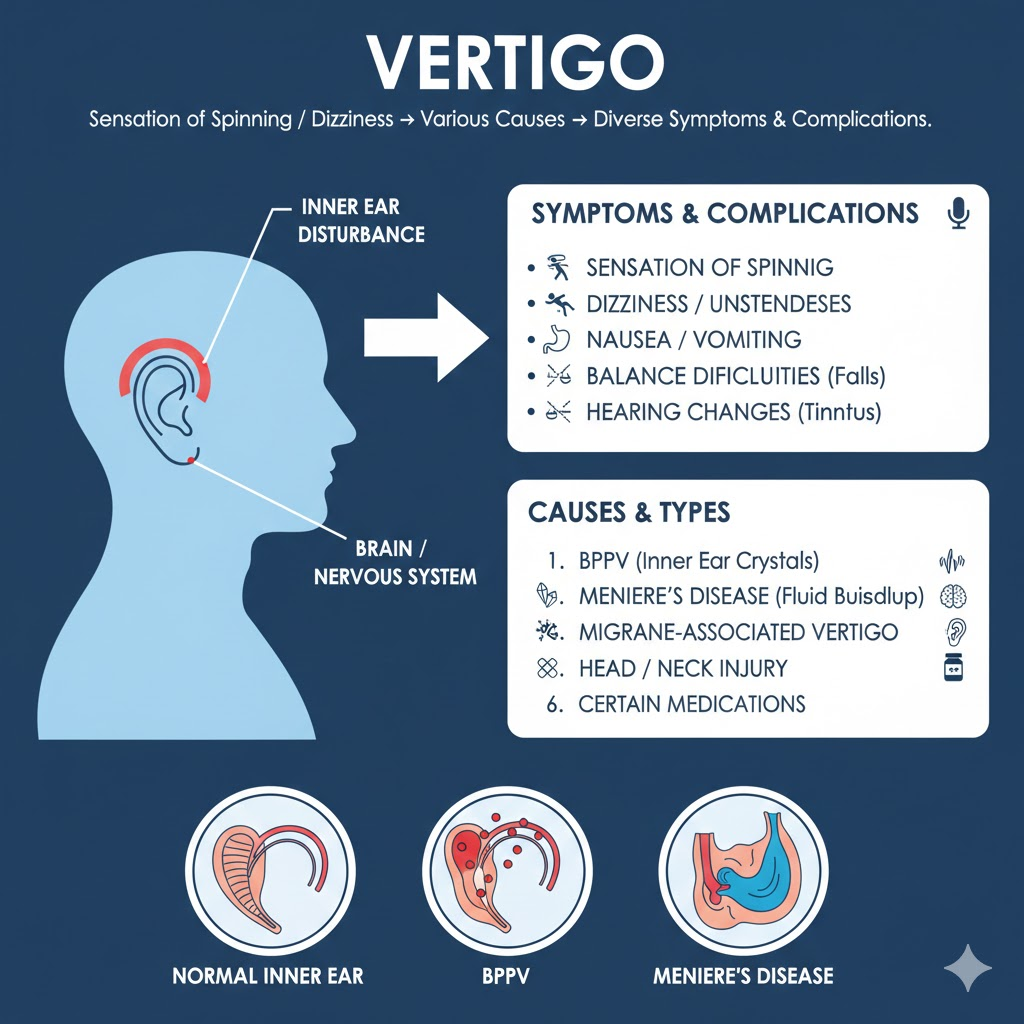
Vertigo is a symptom, not a disease itself.
It arises from disturbances in the balance system, which includes the inner ear, the brain, and the nerves that connect them.
Common causes include:
- Inner ear disorders (such as BPPV, vestibular neuritis, Ménière’s disease)
- Inflammation or infection of the inner ear
- Migraine-related vertigo
- Head or neck injury
- Circulatory issues
- Neurological conditions
- Emotional stress affecting the nervous system
The inner ear plays a crucial role in helping us understand where we are in space.
When its signals become confused, the brain receives mixed messages — and balance is lost.
How It Feels — The Inner Experience
Vertigo can vary from person to person, but many describe:
- A spinning or whirling sensation
- Feeling pulled to one side
- Unsteadiness or fear of falling
- Nausea or vomiting
- Sweating and paleness
- Sensitivity to movement or light
- Difficulty focusing or walking straight
Emotionally, vertigo often brings:
- Anxiety and fear of sudden attacks
- Loss of confidence in one’s body
- Avoidance of movement or travel
- A constant alertness — waiting for the next episode
It can feel as though trust in the body has been shaken — as if the simple act of standing has become uncertain.
Why It Happens — A Deeper View
Balance requires harmony between the inner ear, eyes, muscles, and brain.
Vertigo appears when this harmony is disturbed.
This disturbance may be physical — inflammation, displacement of inner ear crystals, pressure changes —
or it may be functional, where stress and nervous tension amplify imbalance.
The body is not failing.
It is signaling confusion — asking for recalibration, rest, and support.
The Homeopathic Understanding — Restoring Inner Orientation
Homeopathy views vertigo as a disturbance of the body’s vital balance — not only physical, but also nervous and emotional.
A homeopath listens carefully:
- Does the vertigo come with movement or stillness?
- Is it worse on turning the head or lying down?
- Is there nausea, fear, weakness, or ringing in the ears?
- What emotional strain or stress preceded the onset?
Remedies are selected based on the whole experience of the person.
Commonly considered remedies include:
Conium
For vertigo worsened by turning the head or lying down, often in older individuals or after prolonged inactivity.
Bryonia
When vertigo worsens with movement and the person prefers absolute stillness.
Cocculus
For vertigo with nausea, weakness, and a feeling of emptiness — often after sleep deprivation or emotional strain.
Gelsemium
For dizziness with heaviness, drowsiness, trembling, and anticipatory anxiety.
Phosphorus
For sensitive individuals with vertigo, lightheadedness, and fear when alone or in crowds.
Nux Vomica
For vertigo related to stress, overwork, digestive strain, or irritability.
(Homeopathic care is supportive and should be guided by a qualified practitioner, alongside medical evaluation.)
Gentle Daily Care
- Move slowly, especially when rising or turning the head
- Avoid sudden posture changes
- Rest during acute episodes
- Stay hydrated
- Reduce sensory overload (bright lights, loud noise)
- Address stress and emotional tension gently
- Follow medical advice for diagnosis and safety
Recovery often comes gradually —
first stability,
then confidence,
then trust in movement again.
A Closing Reflection
Vertigo reminds us how deeply we rely on balance — not just to stand, but to feel safe in our own bodies.
When that balance falters, fear often follows.
Yet vertigo is not a loss of control —
it is a message.
A message to slow down,
to listen closely,
to restore harmony between body and mind.
With patience, care, and the right support, steadiness can return.
The world can stop spinning.
And once again, the body can remember how to stand quietly, firmly, and at ease.


Leave a Reply