
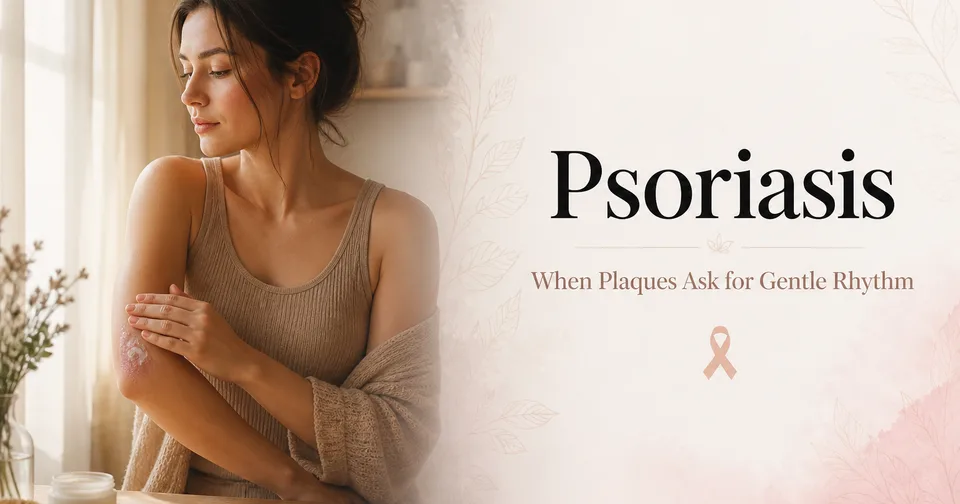
WHEN TURNOVER RACES AND PLAQUES SETTLE IN
Psoriasis often announces itself as sharply bordered plaques with silvery scale — on elbows, knees, scalp, or the lower back — that shed onto dark fabric and resist ordinary moisturizers. The skin may itch, burn, or crack, and joints can ache in some people, reminding them that psoriasis is more than a surface problem.
Immune-driven acceleration of skin turnover piles cells into visible plaques. Stress, infection, injury (Koebner response), cold dry weather, and certain medications can awaken or worsen disease. For many, living with psoriasis means negotiating visibility, flare seasons, and the emotional weight of a chronic inflammatory condition.
Yet within that challenge, people also discover careful routines, medical partnerships, and complementary supports that help them feel more at home in their skin again.
Understanding the Condition
Psoriasis is a chronic immune-mediated disease with several forms — plaque, guttate, inverse, pustular, and erythrodermic among them. Plaque psoriasis is most common: thick, scaly patches that may bleed when scale is lifted. Nail pitting and psoriatic arthritis can accompany skin disease.
Medical care is essential for widespread involvement, pustular or erythrodermic presentations, joint symptoms, and infection risk. Treatments range from topicals to phototherapy and systemic or biologic therapies when indicated.
Homeopathy, as practiced in complementary care settings in Canada, is not a replacement for diagnosis, emergency care, or prescribed dermatologic treatment. It may be considered as individualized supportive care that listens to the whole person alongside conventional guidance when needed.
In psoriasis, people often notice patterns such as:
- Thick plaques with silvery scale on elbows, knees, scalp, or trunk
- Itch or burning that worsens in dry cold seasons
- New plaques after skin injury, strep infection, or major stress
- Nail changes — pitting, oil-drop discoloration, or crumbling edges
- Joint stiffness that raises questions about psoriatic arthritis
Understanding psoriasis means holding immune biology and lived stigma in the same frame — both deserve respectful care.
People living with psoriasis often benefit from a both-and approach: respect for medical diagnosis and treatment when needed, and space for individualized complementary support that takes sleep, stress, climate, and emotional load seriously. In Canada, this collaborative framing helps keep care realistic, ethical, and person-centered. Climate, occupation, and cultural skin ideals also shape how loudly psoriasis is felt — a construction worker’s flare differs from a student’s, even when the label matches.
How It Feels — The Human Experience
Psoriasis is highly visible and often misunderstood as contagious or unclean. That social myth deepens the burden of an already inflammatory disease.
Common human experiences include:
- Embarrassment undressing at the gym or beach
- Frustration with shedding scale on bedding and clothing
- Anxiety about joint pain and long-term disease course
- Exhaustion from complex treatment schedules and flare unpredictability
- Quiet hope on weeks when plaques thin and itch softens
Partners help by learning the facts — psoriasis is not contagious — and by supporting medical follow-up without minimizing distress. Many people find community and self-advocacy restore a sense of agency.
Over months, many people notice that psoriasis teaches unexpected skills: reading early warning signs, asking clearer questions in clinics, and protecting energy on difficult skin days. Those skills are part of recovery literacy, not proof that someone should “just cope forever” without help.
The Homeopathic Understanding — Supporting the Vital Force
Homeopathy approaches psoriasis as an expression of the vital force through immune and skin patterning. A homeopath studies plaque character, modalities, emotional constitution, and concomitant joint or metabolic themes while respecting ongoing medical therapy.
In supportive care for psoriasis, a homeopath may explore:
- Dry cracking versus thick adherent scale; burning versus itching
- Better or worse from cold, sun, bathing, or night
- Emotional themes — suppressed grief, perfectionism, or irritability
- History of guttate onset after infection
- Overall vitality, circulation, and response to stress
Remedies are individualized. The aim is gentle support — never a claim to cure psoriasis or replace biologics or other medically necessary treatment.
Two people with the same label may receive different remedies because their modalities, thermal nature, and life story differ. That individuality is the method — not a delay tactic, and not a promise of cure. Follow-up visits matter: as sleep, season, and stress shift, the symptom picture of psoriasis may shift too, and prescribing should remain responsive rather than rigid.
Commonly Considered Remedies
The following remedies are sometimes considered in homeopathic practice when the symptom picture matches. This list is educational and not a prescription:
- Sulphur — when burning itch and heat aggravation dominate scaly eruptions
- Graphites — when thick, cracked, sticky plaques appear in folds
- Arsenicum Album — when burning, anxious restlessness and chilliness accompany dry scale
- Sepia — when hormonal shifts and exhaustion color the psoriasis picture
- Lycopodium — when right-sided plaques and digestive bloating appear together
- Petroleum — when deep winter cracking and washing aggravation are marked
(All remedies must be individualized by a qualified homeopath. Self-prescribing for chronic or serious concerns is not advised. Continue any medically necessary care unless your physician advises otherwise.)
Gentle Daily Care
Plaque-aware daily habits:
- Moisturize generously after short lukewarm baths; avoid harsh scrubbing of scale
- Use prescribed topicals consistently on active plaques
- Protect skin from injury and harsh weather; soft fabrics reduce friction
- Support stress regulation and sleep as flare modifiers
- Limit alcohol if it clearly worsens your plaques
- Report joint pain, rapid spread, pustules, or whole-body redness promptly to a physician
Barrier kindness and medical partnership together steady many psoriasis journeys.
Keep a simple weekly note of triggers, sleep, and what eased symptoms — not as self-blame, but as useful data for your physician and homeopath. Small patterns often become visible only when written down.
A Closing Reflection
Psoriasis is an immune story written in plaques and scale — visible, chronic, and deeply personal. Beneath the turnover race, the vital force still seeks equilibrium. Supportive homeopathic care listens for that intelligence while dermatology guides disease control and joint protection.
Healing, in this complementary sense, is invited through recognition, moisture, emotional safety, and skilled listening — never forced claims of cure. With attentive care, many people find calmer seasons and renewed confidence in their own skin.


Leave a Reply