
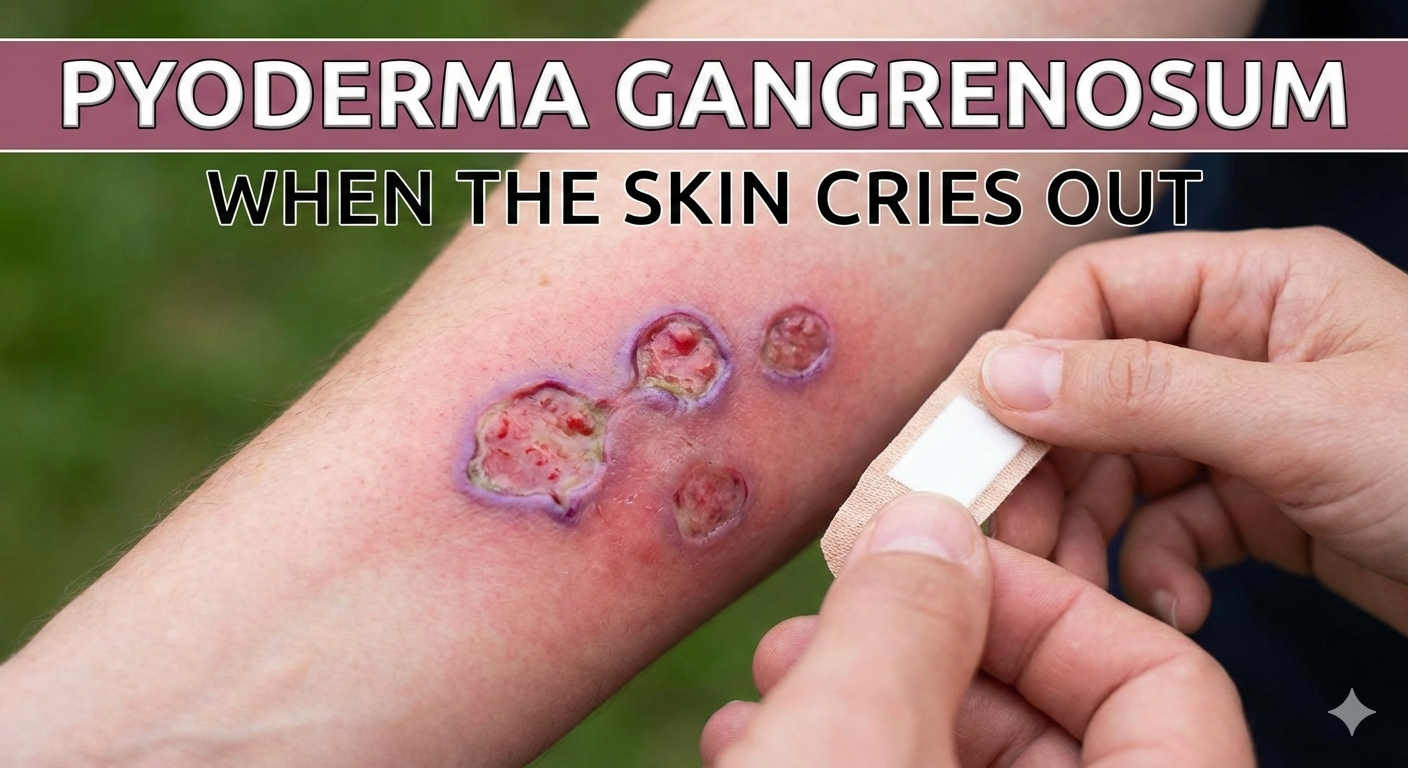
When the Skin Cries Out: Understanding Pyoderma Gangrenosum
Some illnesses speak through silence, but others cry through the body’s surface — through pain, through wounds that refuse to heal.
Pyoderma Gangrenosum (PG) is one of those conditions that speaks with raw honesty, where the skin itself becomes the language of distress.
It often begins as something small — a red bump, a blister, a tender patch that looks harmless at first.
But then, slowly, it deepens, turning into an open sore that expands, aching sharply and healing unevenly.
It can appear suddenly, or grow quietly over days, leaving behind a deep emotional and physical ache.
This illness is not contagious. It is not caused by infection or neglect.
It is the body’s own immune system, once again, losing its way — mistaking healthy skin for something to attack.
For those who live with Pyoderma Gangrenosum, the journey is not only about treating wounds, but about learning to live tenderly within them.
Understanding the Condition
Pyoderma Gangrenosum is a rare, autoimmune skin disorder.
In it, the body’s immune cells — normally defenders against infection — become overactive and begin to damage the skin and underlying tissues.
The result is painful ulcers, often on the legs, though they can appear anywhere: on the arms, around surgical sites, or even near stomas.
These ulcers often start small and grow quickly. They may have a violet or red border, and they can be exquisitely painful.
Even minor injuries — a bump, a scratch, a surgery — can sometimes trigger new sores, a phenomenon called pathergy, where the body overreacts to even the gentlest trauma.
Sometimes PG occurs on its own, but it may also appear in connection with other immune-related conditions like ulcerative colitis, Crohn’s disease, rheumatoid arthritis, or blood disorders.
Though its name sounds fierce, the illness itself carries a strange kind of fragility — a story of the body turned too defensive, too protective, too afraid.
How It Feels
Living with Pyoderma Gangrenosum is not just a physical experience — it’s deeply emotional.
The pain can be intense, sharp, and unrelenting.
Simple movements, clothing, or even air against the skin can feel unbearable.
And beyond the physical discomfort lies the emotional burden — the fear of new wounds, the frustration of slow healing, the isolation of living with something few understand.
You may feel helpless at times, watching your own skin — the boundary between you and the world — turn against itself.
But within that experience, there is also courage: the courage to care for wounds that require patience and presence, the courage to trust that even slow healing is still healing.
Why It Happens
The exact cause of Pyoderma Gangrenosum remains partly a mystery.
It is thought to be autoimmune — where the immune system mistakenly attacks the body’s own skin tissue.
This overreaction leads to inflammation, tissue destruction, and ulceration.
In some cases, it is associated with inflammatory bowel diseases, arthritis, or hematologic conditions; in others, it appears without any clear link.
But whatever its source, PG is not born of infection, impurity, or neglect — it is an overzealous defense, a sign that the immune system is too loud rather than too weak.
The Homeopathic Understanding: Healing the Inner Fire
In homeopathy, Pyoderma Gangrenosum is seen not only as a disease of the skin, but as an expression of deeper inner turmoil — a manifestation of inflammation that seeks release.
The skin, in this view, becomes a mirror for the mind and emotions: when the inner fire burns too fiercely, it erupts outward, asking to be soothed and understood.
The goal of homeopathic care is to quiet this misplaced intensity — to remind the immune system of gentleness and restore harmony between the inner and outer layers of the being.
Remedies often considered include:
Hepar Sulphuris Calcareum – for deep, painful ulcers that are highly sensitive to touch and cold; helps reduce overreaction and support natural healing.
Silicea – for slow-healing wounds that discharge pus, especially in those who tire easily and feel chilly or weak.
Mercurius Solubilis – when ulcers have ragged edges, offensive odor, and burning pain, reflecting deep inflammation and internal heat.
Arsenicum Album – for restlessness, burning ulcers, and anxiety about health or the future.
Calendula Officinalis (external and internal) – for supporting wound healing, soothing pain, and reducing infection risk gently.
Each case is deeply individual; the chosen remedy depends on the person’s overall state — their fears, their energy, their way of responding to illness — not on the appearance of the skin alone.
(Always seek guidance from a qualified homeopath for personalized care.)
Gentle Daily Care
Protect the skin. Avoid trauma or scratching; even small injuries can trigger new lesions.
Clean with care. Use mild, non-irritating cleansers and dress wounds as advised, keeping them moist but clean.
Ease the inflammation. Warm compresses, soothing ointments, or herbal infusions like chamomile can calm irritation.
Eat to reduce inflammation. Fresh fruits, greens, omega-rich oils, and clean water can help support inner balance.
Rest and reduce stress. Emotional strain can worsen flares; daily calm — through meditation, prayer, or slow breathing — can support the immune system’s equilibrium.
Stay connected. Chronic wounds can isolate; sharing your experience with others or with support groups can lighten the emotional load.






Leave a Reply