
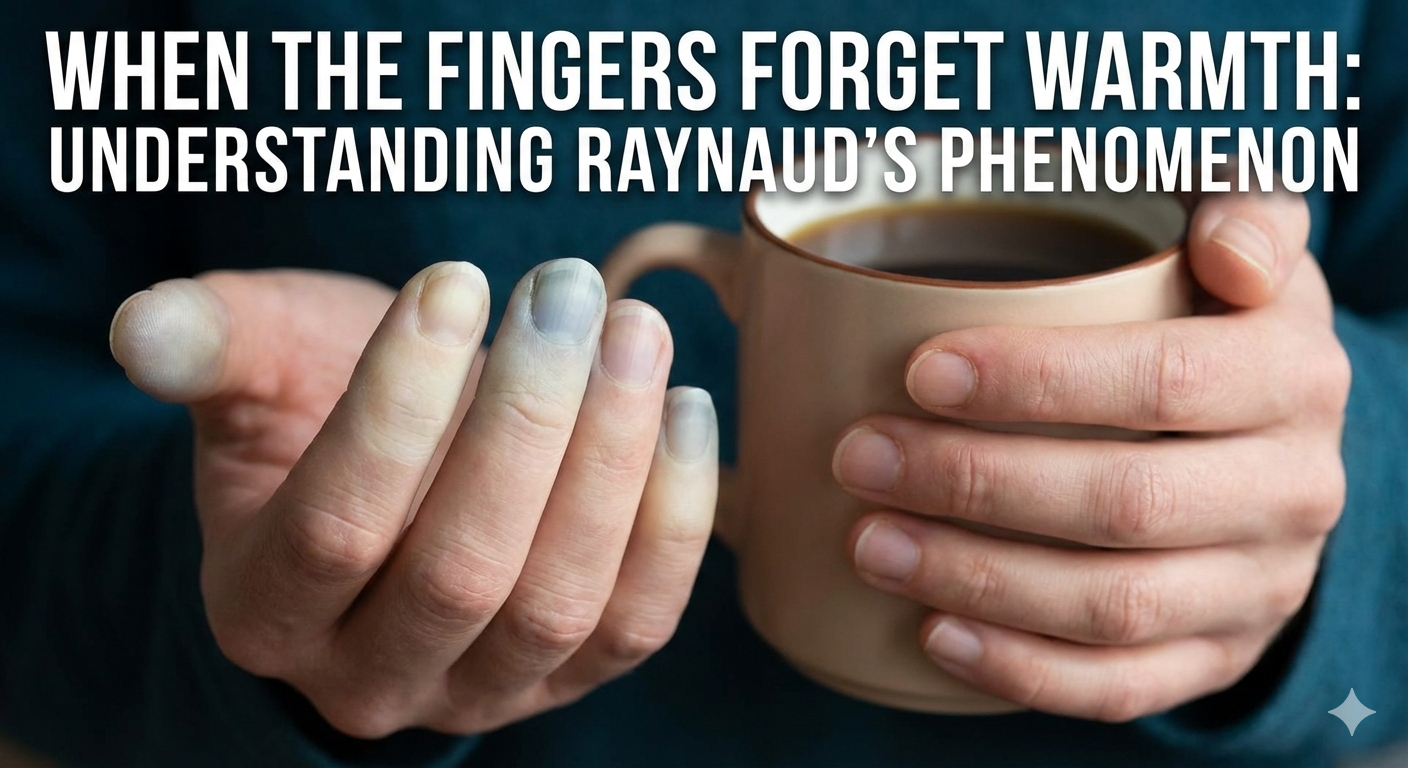
When the Fingers Forget Warmth: Understanding Raynaud’s Phenomenon
There are moments when the body, touched by cold or emotion, retreats into itself.
The fingers grow pale, the toes stiffen, the color drains away as if the warmth of life has been gently paused.
This is Raynaud’s Phenomenon — a quiet yet striking reminder of how intimately our circulation reflects our emotions, our stress, and our environment.
It often begins innocently: you reach for something in the refrigerator, step into a cool breeze, or feel a sudden wave of anxiety — and notice that your fingertips have turned white or bluish.
They may sting, go numb, or throb as blood rushes back.
For some, it’s a mild and fleeting discomfort; for others, it becomes a daily dance between warmth and chill, presence and withdrawal.
Though rarely life-threatening, Raynaud’s can feel deeply unsettling — as though the body itself is caught between worlds, unsure when to open and when to close.
Understanding the Condition
Raynaud’s Phenomenon is a condition where the small blood vessels — especially those in the fingers and toes — constrict excessively in response to cold or stress.
This narrowing temporarily limits blood flow, causing the affected areas to turn white, then blue, and finally red as circulation returns.
There are two main types:
Primary Raynaud’s – which appears on its own, often in young women and those with naturally sensitive circulation. It is generally mild and not linked to any underlying disease.
Secondary Raynaud’s – which occurs alongside autoimmune or connective tissue disorders such as scleroderma, lupus, or rheumatoid arthritis. This form can be more persistent and may cause small sores or tissue damage in severe cases.
What unites both forms is the body’s exaggerated protective reflex — a well-meant effort to conserve warmth, but one that goes too far, closing the doors to life’s flow.
How It Feels
For those living with Raynaud’s, the world of temperature feels more vivid, more personal.
A light chill that others barely notice can send shivers deep into the fingers.
The color changes — white, blue, then red — can look almost theatrical, but the sensations are far from it: tingling, numbness, and a piercing pain as warmth returns.
There is also the quiet emotional weight — the frustration of hands that refuse to cooperate, the self-consciousness of visible color changes, and the anxiety that stress itself can worsen the symptoms.
You learn to plan your movements, to keep gloves close, to guard warmth as though it were something sacred.
And slowly, you begin to see that what your body needs most is not just physical heat, but gentleness — in thought, in pace, in how you meet the world.
Why It Happens
In Raynaud’s, the small arteries that supply blood to the skin become overly sensitive.
Cold or emotional stress triggers them to constrict suddenly — a reaction meant to preserve core body temperature.
In most people, this spasm is brief and harmless, but in Raynaud’s, the response lingers and repeats, sometimes leaving the tissues starved of oxygen for moments that feel like hours.
In secondary forms, inflammation of the blood vessels or immune dysfunction adds another layer — the body’s defenses turning inward, tightening its own flow.
It is, in essence, a story of protection gone too far — the body closing itself off, not out of malice, but out of fear.
The Homeopathic Understanding: Reawakening the Flow
In homeopathy, Raynaud’s is seen as more than a circulatory disorder; it is a reflection of the body’s relationship with warmth — physical and emotional alike.
The constriction of vessels mirrors a deeper tendency toward withdrawal, rigidity, or overreaction — a system that clings too tightly when challenged.
The aim of treatment is to restore openness, flexibility, and balance — to help the body remember how to flow again, both in blood and in spirit.
Remedies often considered include:
Secale Cornutum – for icy cold, bluish extremities that feel numb or tingly; suited to those who dislike warmth yet suffer from coldness.
Carbo Vegetabilis – for cold, pale hands and feet with exhaustion and weakness; helps reawaken sluggish circulation.
Agaricus Muscarius – for tingling, burning, or frostbite-like sensations in the fingers; a remedy of sensitivity and overreaction.
Pulsatilla Nigricans – for those whose circulation shifts easily with emotion or temperature, often gentle, yielding, and easily chilled.
Nux Vomica – for stress-driven constriction, where overwork, tension, or irritability seem to shut down warmth and flow.
(Always consult a qualified homeopath to find the remedy most attuned to your unique constitution.)
Gentle Daily Care
Keep warmth close. Gloves, warm socks, and layered clothing are your first allies. Avoid sudden temperature changes when possible.
Move regularly. Gentle movement — walking, stretching, rotating the wrists — keeps circulation alive.
Avoid smoking and caffeine. These constrict blood vessels further and can worsen symptoms.
Eat warmly. Soups, herbal teas, ginger, garlic, and cinnamon help support circulation from within.
Soothe the mind. Meditation, calm breathing, and emotional grounding reduce the stress that often triggers attacks.
Protect the skin. Moisturize hands and feet daily; dryness worsens sensitivity.


Leave a Reply