
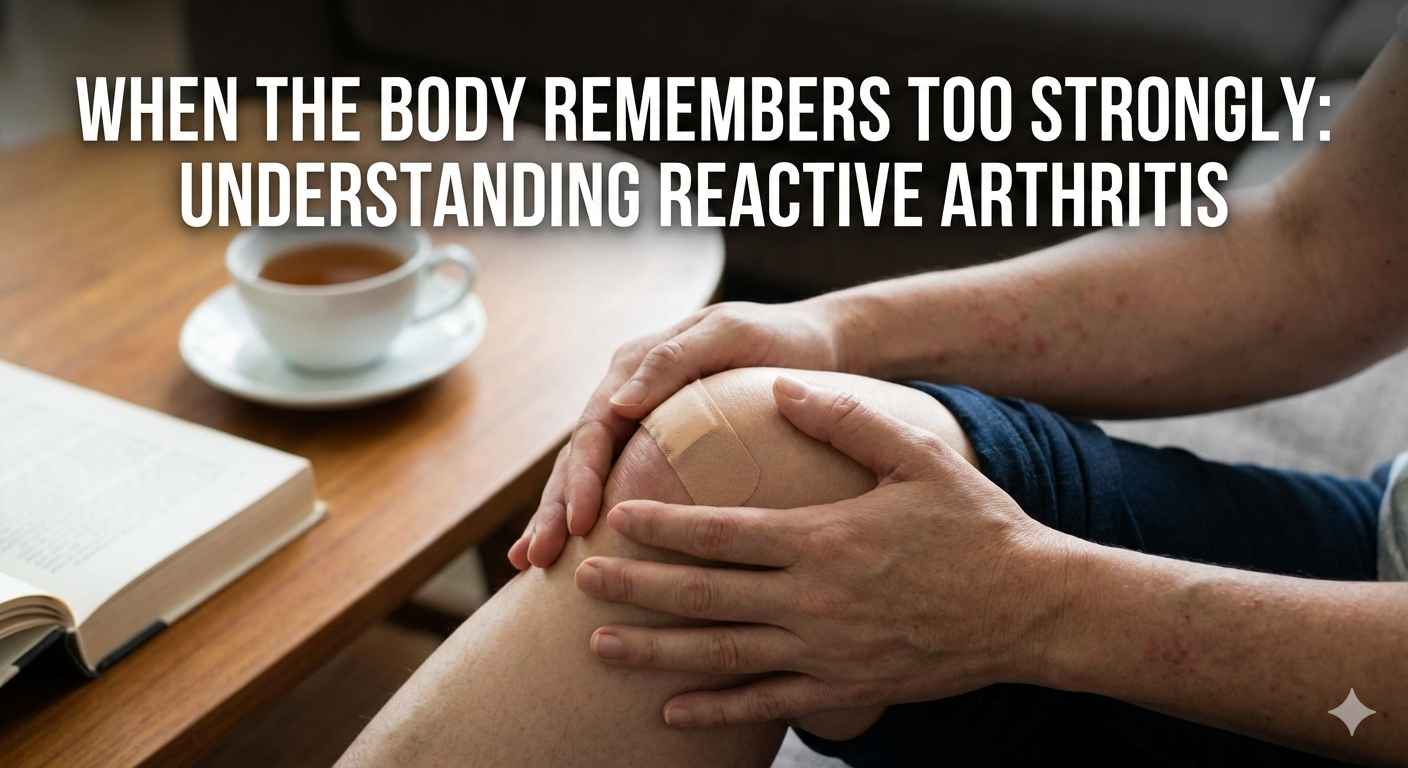
When the Body Remembers Too Strongly: Understanding Reactive Arthritis
Sometimes, the body faces an infection — a simple cold, a stomach upset, or a quiet urinary infection — and even after it passes, the body doesn’t forget.
Instead, it keeps fighting, as though the battle were still happening.
That lingering, misplaced defense is what gives rise to Reactive Arthritis — a condition where the immune system, unable to let go, begins to turn its reaction inward.
It can arrive unexpectedly: the joints begin to ache, the knees swell, or the heels throb with pain.
There may be redness in the eyes, discomfort when passing urine, or patches of irritated skin.
It often follows weeks after an infection, at a time when you think you’ve already recovered.
But deep inside, the immune system continues to echo that memory — reacting to what’s no longer there.
Understanding the Condition
Reactive Arthritis (once called Reiter’s Syndrome) is an autoimmune form of arthritis that develops in response to an infection elsewhere in the body.
The infection might be intestinal (like Salmonella or Shigella), urinary (such as Chlamydia), or sometimes respiratory.
Though the infection clears, the immune system stays alert — and in its confusion, it begins to attack the joints, eyes, and sometimes the skin or urinary tract.
Commonly affected joints include the knees, ankles, and feet.
It can also cause swelling of tendons, especially where they attach to bones — the heels, toes, or lower back.
Some people experience inflammation of the eyes (conjunctivitis or uveitis), mouth ulcers, or small skin rashes.
The body, in a sense, has remembered too well — continuing its defense long after the danger is gone.
How It Feels
Reactive Arthritis can feel like being caught between two recoveries — no longer sick from infection, yet not well enough to move freely.
The joints ache deeply, especially in the morning or after rest.
Swelling makes walking or standing difficult, and fatigue creeps in quietly, leaving even simple tasks feeling heavy.
Some days, the pain eases, giving a glimpse of normalcy; then, without warning, it returns — like a shadow from the past.
Emotionally, it can feel confusing.
You may wonder why your body still feels unwell when the infection has cleared, why it seems to fight ghosts.
But slowly, you begin to understand that your body isn’t betraying you — it’s overprotecting you.
It is still trying to defend, even though the battle has already been won.
Why It Happens
Reactive Arthritis is rooted in an immune miscommunication.
When the body fights an infection, immune cells learn to recognize the invading bacteria.
In some people, especially those with certain genetic patterns (such as the HLA-B27 gene), the immune system keeps that recognition too strongly.
Later, it mistakes the body’s own joint tissue for the invader — and inflammation begins again, uninvited.
This process doesn’t mean weakness or failure — it means your immune system is deeply vigilant, simply too much so.
And healing begins when that vigilance is soothed, not silenced.
The Homeopathic Understanding: Calming the Inner Memory
In homeopathy, Reactive Arthritis is viewed not merely as joint inflammation, but as a disturbance in the body’s inner conversation — the dialogue between protection and peace.
The body remembers too vividly. It continues to defend, unable to release the imprint of the past.
The goal of homeopathic care is to remind the system of balance — to teach it that the threat is gone and that it can rest again.
Remedies often considered include:
Rhus Toxicodendron – for joint stiffness that improves with gentle movement and warmth; often suited to those restless from pain.
Bryonia Alba – when every motion worsens pain, and rest brings relief; often accompanied by irritability and dryness.
Sulphur – for lingering inflammation, burning pains, or skin eruptions that accompany joint symptoms.
Kalmia Latifolia – for sharp, shooting pains that travel quickly from joint to joint.
Arsenicum Album – for exhaustion, anxiety, and restlessness following illness; a remedy for the weary and over-defended body.
(Always seek guidance from a qualified homeopath for an individualized prescription.)
Homeopathy works gently — not by suppressing inflammation, but by restoring recognition, helping the body to remember what is self and what is not.
Gentle Daily Care
Rest without guilt. Allow joints to heal; pushing through pain can worsen inflammation.
Move gently. Stretching, swimming, or yoga can keep joints flexible without strain.
Soothe inflammation. Warm compresses or Epsom salt baths often ease stiffness.
Eat anti-inflammatory foods. Include turmeric, ginger, olive oil, greens, and berries. Avoid processed or highly acidic foods.
Stay hydrated. Water supports detoxification and joint lubrication.
Protect emotional calm. Stress and emotional turmoil can reignite symptoms; find stillness through breathing, meditation, or quiet reflection.
Balance activity and rest. Healing comes through rhythm — the alternation of movement and pause, warmth and coolness, activity and stillness.


Leave a Reply